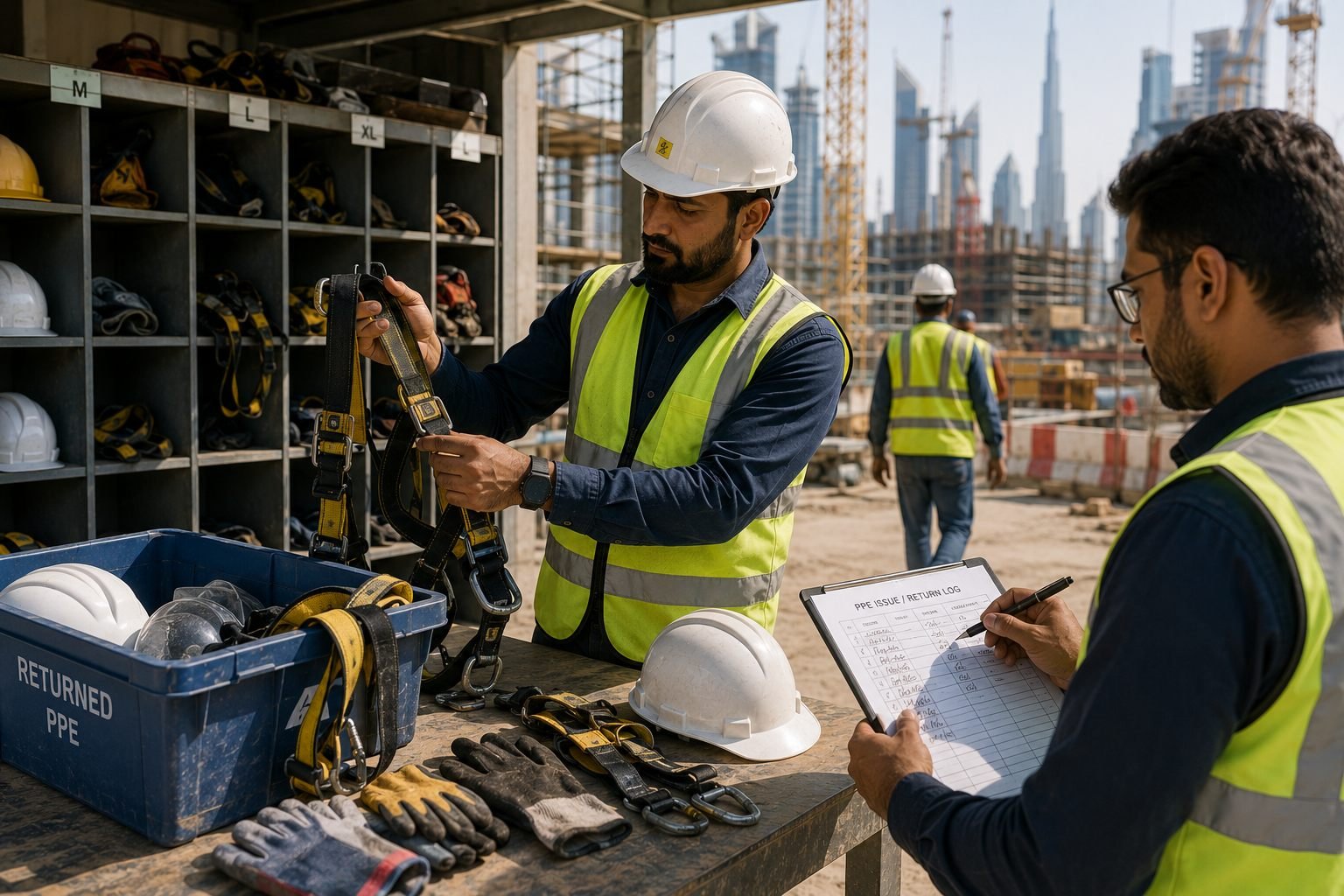
A project manager in Dubai opens the PPE store on a Monday and finds the harness rack half empty. Forty workers passed through over the weekend across two shifts. Some gear went home in a bag. Some got left on the deck and walked off. Some is just gone, with no record of who held it last. The crew is due at height in twenty minutes and there are not enough harnesses to go around. The budget shows the store was fully stocked on Thursday.
Lost equipment is a quiet drain that busy sites rarely see until it bites. Helmets, gloves, and vests disappear a few at a time, written off as wear or churn. Then a high-value item like a harness or a gas detector goes missing and the gap shows up as workers waiting, a compliance hole, and a reorder that takes days. The losses were always there. The pace of the site hid them until protection ran short.
UAE law does not let an employer pass the loss to the worker or leave a crew unprotected while the store is empty. The federal labour law on workplace health and safety and the supporting framework expect employers to keep suitable equipment available for everyone exposed to risk. To handle lost safety equipment on busy project sites, a company needs records that show who holds what, controls that slow the losses, and a buffer that keeps protection ready. This guide sets out that system.
Losing gear faster than you can track it across the Emirates? A supplier that holds depth in certified PPE keeps replacements ready for Dubai, Abu Dhabi, and Sharjah, so a loss never leaves a crew waiting. Speak to the team about a replacement buffer.
Why temporary crews need a different plan
The way you plan safety equipment for temporary crews exposes how mature your safety system is. A plan built for steady headcount falls apart the moment numbers swing and faces rotate.
Pace buries the small losses
A busy site moves fast, and a missing pair of gloves draws no attention. Multiply that across hundreds of handovers and the trickle becomes a flood the budget feels but nobody traces.
No return discipline at shift end
Gear handed out and never signed back walks off in bags and cab footwells. Across Dubai, Abu Dhabi, and Sharjah, the missing return step is where most losses begin.
What UAE law expects on lost or missing PPE
Before building a system, ground it in the rules across the Emirates. Two duties matter here, supply and cost.
The employer keeps gear available
The private sector labour law requires a safe environment and suitable protection for workers exposed to risk. The duty set out in Federal Decree Law No. 33 of 2021 means a crew cannot be sent to work because the store ran short. Losses are the company’s problem to absorb, not the worker’s to suffer.
The cost falls on the employer
The Ministry that enforces workplace safety for most private sites publishes worker protection guidance. Deducting the cost of lost mandatory PPE from wages runs against those worker protections. An inspector may ask how you handle lost safety equipment on busy project sites and whether replacement comes at no cost to the worker.
Emirate-level frameworks
Abu Dhabi runs its occupational health system through the Abu Dhabi public health authority. Dubai Municipality sets its own site requirements. Sharjah aligns with the federal rules. A company across emirates needs one approach that meets the strictest of them.
Find out why equipment disappears
You cannot cut losses you do not understand. Sort the causes before reaching for a control.
Separate the loss types
Wear is not loss. Walk-off is not theft. Each needs a different fix. Tagging every missing item as theft hides the real causes and points the controls in the wrong direction.
The table below maps common loss causes to the control that fits.
| Loss Cause | Control That Fits |
|---|---|
| Gear not returned at shift end | Return step at the gate |
| Items left on the deck | Marking and daily sweep |
| High-value gear walking off | Secure store, sign-out |
| Genuine wear written as loss | Inspection and honest scrapping |
| Churn taking gear off site | Recovery at exit |
Know which items go first
Small, useful, and easy to pocket items disappear fastest. Knowing the loss-prone lines tells you where to focus the controls and the buffer.
| Item | Loss Risk |
|---|---|
| Gloves | High, small and consumable |
| Safety glasses | High, easy to pocket |
| Helmets | Medium, bulky but reused |
| Vests | Medium, walk off in bags |
| Harnesses and detectors | High value, target for theft |
Build issue and return records
A record is the backbone of loss control. If you cannot say who held an item, you cannot trace where it went.
Sign out and sign back
Issue gear against a name and sign it back at shift end. The return step is the one most busy sites drop, and it is the one that stops the steady walk-off.
Record the basics
Capture the worker, the item, the date, and the size at issue, and mark the return. This links each piece to a person and turns a vague loss into a traceable one. You can source certified PPE in the quantities a busy site burns through, rated to EN and ANSI references for sites across the Emirates.
Keep the format current
A board suits a small Sharjah site. A spreadsheet or app suits a company running several Dubai sites at once. A record that lags the gate protects nothing.
Mark and track every item
Marked gear is harder to lose and easier to recover. An unmarked item vanishes into the pool and the city.
Give items an ID
Number or label reusable gear so it traces back through the log. A marked harness has an owner and a record. An unmarked one is anonymous the moment it leaves the rack.
Run a daily sweep
A quick end-of-shift sweep of the deck recovers gear left behind before it walks off overnight. Build it into the close-down routine, not the wish list.
Tie value items to a person
High-value gear like detectors and harnesses should sign out to a named worker for the shift and sign back. The higher the value, the tighter the control.
Watching high-value gear vanish on a busy Dubai or Sharjah site? A supplier that delivers certified replacements fast across the Emirates means a missing harness never stalls work at height. Send your site details for a stock plan.
Secure storage and controlled access
A store anyone can reach is a store that empties itself. Control the access and you cut the loss.
One way in, one keeper
Run issue through a single controlled point with a named keeper per shift. Open shelves that any worker can raid have no accountability and no record.
Separate value gear
Keep detectors, harnesses, and other high-value items behind tighter control than gloves and vests. Match the security to the cost and the theft risk.
Lock down between shifts
A store left open between shifts is the weekend gap that empties the harness rack. Secure it when no keeper is present.
Replace fast without leaving workers exposed
The point of loss control is not the budget alone. It is making sure a missing item never sends a worker to a task unprotected.
Never start work short
A crew cannot go to height because the harnesses are gone. The rule holds even on the busiest morning. Replacement comes first, the investigation second.
Hold the cost off the worker
Replace lost mandatory PPE at no charge to the worker. Charging for it breaches worker protections and pushes workers to hide losses, which makes the problem worse.
Keep a replacement ready
A loss should trigger a same-day replacement from a buffer, not a multi-day reorder. The buffer is what keeps the gate moving while the cause gets fixed.
Hold a buffer sized for real losses
A busy site loses gear at a steady rate. A buffer sized for that rate absorbs the loss without a scramble.
Size it to the loss rate
Track how fast each line goes missing and hold a buffer to match, heavier on the loss-prone items. Order the buffer ahead, not after the rack runs dry.
Keep value spares inspected
Spare harnesses and detectors held for replacement still need to be in date and inspected. A buffer of expired gear is no buffer at all. Fall arrest spares need inspection by a competent person, which matters for any work at height on Dubai and Abu Dhabi projects.
Reorder against the trend
Use the loss record to forecast the next reorder. A supplier who holds depth turns a loss into a same-day swap rather than a stalled crew. Fire and evacuation readiness feeds into site safety too, and the Dubai authority for fire and civil protection sets site expectations.
Investigate patterns, not just incidents
A single lost helmet is noise. A pattern is a signal. The records turn one into the other.
Read the log for patterns
If losses cluster on one shift, one crew, or one item, the cause is structural, not random. The log shows the pattern that a single incident hides.
Fix the cause, not the symptom
A shift that loses gear every week needs a control change, not another reorder. Trace the cluster to its cause and close it.
Account for the UAE climate
Heat pushes workers to ditch heavy gear in shaded corners where it gets left and lost. Breathable, ventilated equipment suited to the conditions across the Emirates keeps gear on the body and off the floor.
Common mistakes when companies handle lost safety equipment on busy project sites
Most loss failures repeat a few errors. Designing around them closes the gap.
Treating losses as unavoidable
Writing off losses as the cost of a busy site lets them grow unchecked. Track and control them like any other risk.
Skipping the return step
Issue without return is the single biggest source of walk-off. Sign gear back at shift end, every shift.
Charging workers for losses
Deducting lost PPE from wages breaches worker protections and drives losses underground. The cost stays with the employer.
Leaving the store open
An uncontrolled store empties itself, fastest between shifts. One keeper, one point of issue, locked when unattended.
Holding no buffer
Without a replacement buffer, a loss becomes a multi-day shortfall and a crew waits. Size a buffer to the real loss rate.
Ignoring the pattern
Replacing missing gear without reading the log misses the structural cause. Investigate clusters, not just single items.
Setting up loss control across your UAE sites? A supplier that holds certified stock at project depth keeps a replacement buffer ready for Dubai, Abu Dhabi, and Sharjah. Request a quote for a buffer sized to your sites.
Frequently Asked Questions
It means keeping records of who holds each item, controlling access and returns to slow the losses, holding a buffer for fast replacement, and investigating patterns rather than single incidents. The process meets the employer duty set out under Federal Decree Law No. 33 of 2021.
Deducting the cost of lost mandatory PPE from wages runs against UAE worker protections. The cost stays with the employer, and charging for it tends to push workers to hide losses rather than report them.
Gear issued and never signed back at shift end. The missing return step lets equipment walk off in bags and vehicles, a few items at a time, until the store runs short.
Keep value items behind tighter control, sign them out to a named worker for the shift, sign them back, and store them securely between shifts. Match the security to the cost and the theft risk.
Size it to the real loss rate of each line, heavier on loss-prone items like gloves and glasses. Track how fast gear goes missing and order the buffer ahead so a loss triggers a same-day swap.
Replace it first so no worker starts a task unprotected, then investigate the cause. Never send a crew to work because the store ran short, even on the busiest morning.
Look for recognised marks such as EN or ANSI references suited to the hazard. A helmet to EN 397 or a harness to EN 361 tells you the replacement performs the same as the lost item.
Yes. AAA Safe supplies certified safety equipment across the Emirates, including helmets, gloves, glasses, vests, and fall protection. As a supplier, it helps companies handle lost safety equipment on busy project sites by holding depth for fast replacement to Dubai, Abu Dhabi, and Sharjah. You can reach the team to plan a buffer.
Closing Thoughts
Lost gear feels like a small line on a busy site, a few gloves here, a vest there. It stays small right up until a harness goes missing on the morning a crew is due at height, and then the trickle is a shortfall with a worker standing idle and a compliance hole in plain view.
Companies that handle lost safety equipment on busy project sites well treat losses as a risk to manage, not a cost to swallow. A return step at the gate, marked gear, a controlled store, a buffer sized to the real rate, and a log read for patterns. The law across Dubai, Abu Dhabi, and Sharjah keeps the duty and the cost with the employer. The inspector will ask how you replace what goes missing without leaving a worker exposed. The site that loses gear and never leaves a crew waiting is the sign the system holds. Build it once, hold the routine through every shift, and lost equipment stops being the gap that empties the rack.
Disclaimer
This article is for general information and does not replace legal, regulatory, or professional safety advice. AAA Safe Dubai is a supplier of safety equipment and PPE and does not provide installation, inspection, or consultancy services. Employers remain responsible for compliance with all applicable UAE laws and standards.
Regulatory requirements change. Confirm current obligations with the relevant authorities before acting on any guidance here. Useful references include the UAE Government Portal for Federal Decree Law No. 33 of 2021, the Ministry of Human Resources and Emiratisation, Dubai Municipality, the Abu Dhabi Public Health Centre, and Dubai Civil Defence.
Product standards and inspection intervals vary by manufacturer. Always follow the instructions supplied with each item. Any tables in this article give general guidance and not product-specific direction.
The mention of standards such as EN, ANSI, and ISO is for reference and does not imply endorsement by any standards body. Verify the marking on each product against the current published standard.
This content reflects general practice at the time of writing. It may not cover every site condition, loss pattern, or hazard. A competent safety professional should assess your specific workplace.
AAA Safe Dubai accepts no liability for actions taken based on this article. Use it as a starting point and seek qualified advice for your circumstances.