Chemical spill response begins long before the spill. A site with proper secondary containment, correct storage segregation and an accessible spill kit deals with a drum failure in twenty minutes. A site without those things loses a shift, contaminates a drain and files a report with the authorities.
The response itself carries risk. Workers are injured cleaning up spills more often than by the original release. Usually they reached for the nearest gloves instead of the correct ones, or treated a vapour hazard as a liquid hazard.
Preventing the Spill Is Cheaper Than Responding to One
Segregate incompatible chemicals
Acids away from bases. Oxidisers away from flammables and organics. Cyanides away from acids. A spill that mixes incompatible materials produces heat, gas or fire in addition to the original problem.
Use secondary containment under every stored liquid
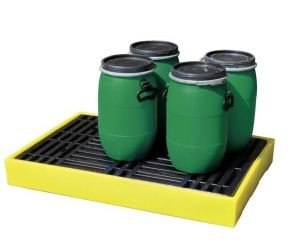
A container will eventually fail. A spill pallet holds the contents of the largest drum stored on it and keeps the release off the floor and out of the drainage system.
Contain bulk storage too
Intermediate bulk containers hold far more than a drum and cause proportionally larger releases. An IBC containment pallet provides the same protection at bulk volume.
Keep storage away from drains
Any storage sited near a drain converts a contained incident into an environmental one. Where relocation is impossible, drain covers should sit beside the storage area ready to deploy.
Inspect containers on a schedule
Corrosion, bulging, seam damage and cap failure are all visible before they release. Add container condition to routine inspection.
Manage the UAE heat factor
High ambient temperature raises vapour pressure inside sealed containers and accelerates degradation of plastic drums. Shaded, ventilated storage extends container life and reduces pressure build-up.
| STORAGE CONTROL | PURPOSE | COMMON FAILURE |
|---|---|---|
| Secondary containment | Capture release from container failure | Sized below largest container volume |
| Segregation | Prevent reaction between incompatibles | Stored by supplier, not by hazard class |
| Distance from drains | Prevent environmental release | Storage sited beside a floor gully |
| Shade and ventilation | Limit pressure build-up and degradation | Drums stored in direct UAE sun |
| Labelling | Enable correct response | Decanted containers unlabelled |
| Container inspection | Catch failure before release | Not on any inspection schedule |
Step 1. Assess Before You Approach
The first decision determines whether the response is safe.
Identify the material
Response depends entirely on what has been released. The safety data sheet holds the answer. It must be accessible from outside the storage area, not filed inside it.
Judge the scale
A litre of a known low-hazard liquid on a workshop floor is a housekeeping task. A ruptured IBC of an unidentified material is not. Set a defined volume and hazard threshold in the site procedure that separates the two.
Check for ignition sources
Flammable liquid releases generate vapour that travels along the floor to ignition sources some distance away. Isolate electrical equipment and stop hot work in the vicinity before approaching.
Decide clean up or evacuate
This is the decision sites get wrong. Evacuate and call specialist response in five situations. The material is unidentified. Vapour is present. The volume exceeds site capability. The release has entered a drain. Anyone has been exposed. Trained site personnel handle only spills that fall inside a defined, pre-agreed envelope.
Raise the alarm regardless
Even a spill handled internally should be announced so that nobody walks into the area unaware.
Step 2. Protect the Responder Before Anything Else
Responder PPE is selected against the specific chemical, not against a general spill kit list.
Match glove material to the chemical
Glove material determines breakthrough time. Nitrile, neoprene, butyl and PVC each resist different chemical families, and a glove that resists one solvent may fail rapidly against another. Options across the chemical resistant glove options cover chemical-specific selection with published resistance data.
Use gauntlet length for immersion tasks
Wrist-length gloves expose the forearm during decanting and clean-up. Longer PVC chemical gloves cover the forearm where splash and run-down occur.
Protect eyes and face against splash
Safety glasses stop nothing coming from below or the side. Chemical splash goggles or a full face shield worn over goggles covers the splash paths that matter.
Select respiratory protection against the vapour
Particulate filters do nothing against organic vapour. Cartridge selection must match the chemical family, and an organic vapour and acid gas cartridge covers a different range from a multi-gas unit. Where the atmosphere is unknown or oxygen may be displaced, filtering respirators are inadequate and the area must be evacuated.
Cover the body
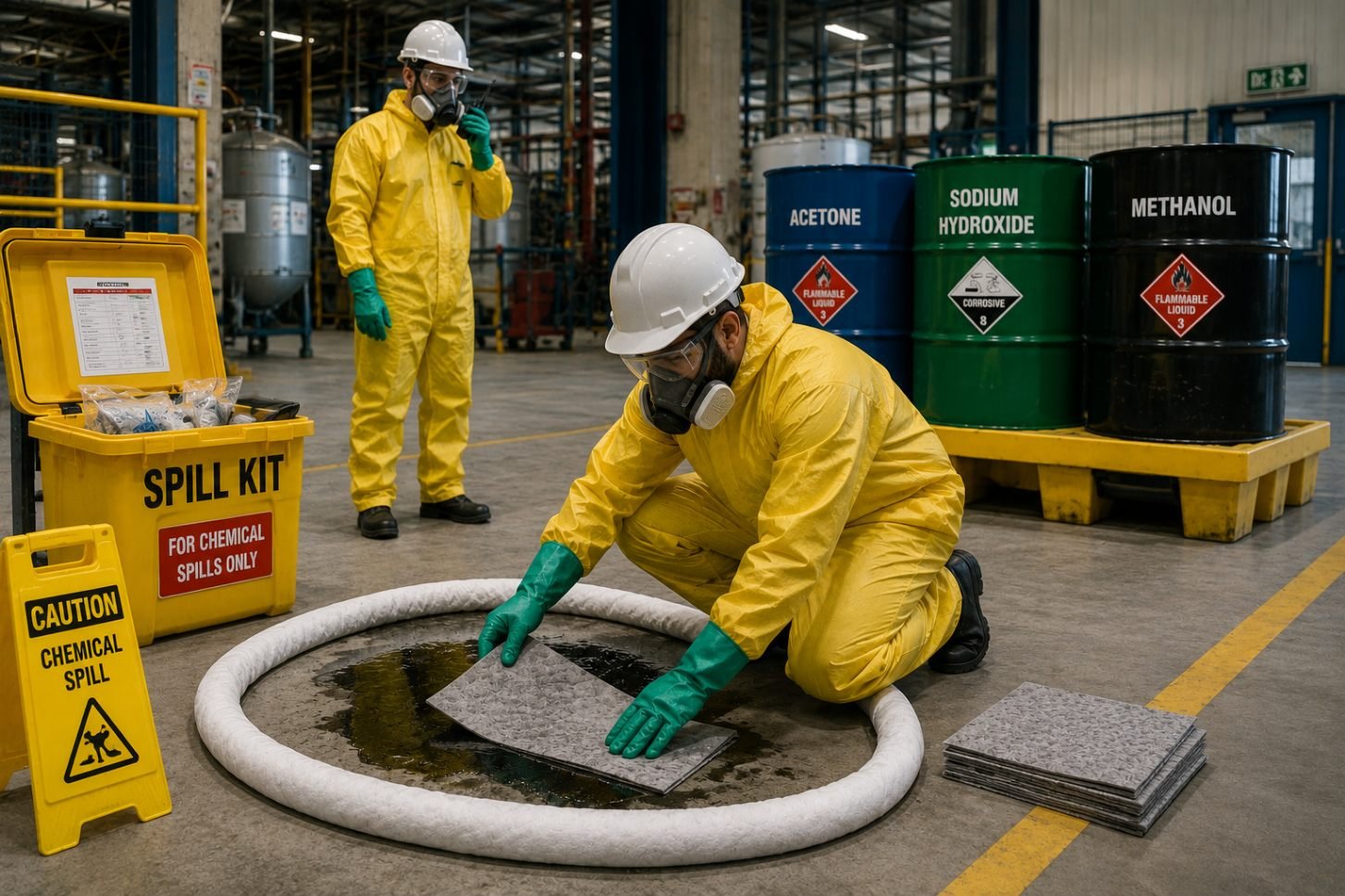
Chemical-resistant coveralls and boots, with trousers over boots so liquid cannot run inside. Selection guidance sits in our chemical resistant coveralls selection tips.
AAA Safe Team supplies chemical protective gloves, splash protection, respiratory equipment, containment products and decontamination provisions across Dubai, Abu Dhabi, Sharjah and the wider UAE. Contact our technical team for chemical-specific selection advice.
Step 3. Contain Before You Clean
Stopping the spread is more urgent than removing the liquid.
Stop the source if it is safe to do so
Upright a fallen drum, close a valve, plug a leak. Only where this can be done without exposure.
Protect the drains first
A spill that reaches a drain becomes a regulatory and environmental incident. Drain covers or absorbent socks around gullies take priority over the main pool.
Build a barrier around the pool
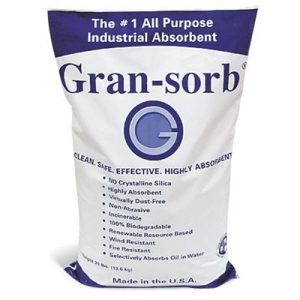
Absorbent socks, booms or dry inert material create a perimeter. Work from the outside inward so the pool cannot advance while you work.
Use non-sparking tools for flammables
A steel shovel striking concrete produces sparks. A non-spark plastic shovel removes that ignition source when moving absorbent material in a flammable release.
Cordon the area
Mark the boundary so nobody walks through the release or the contaminated zone. Danger tape plus a posted warning keeps the area closed until decontamination is verified.
Ventilate where vapour is present
Increase airflow to disperse vapour, taking care not to push it toward occupied areas or ignition sources.
Step 4. Treat Exposure Immediately
Exposure treatment runs in parallel with containment, not after it.
Flush eyes for the full duration
Chemical eye exposure requires sustained irrigation, commonly fifteen minutes or longer for corrosives. Stopping early because the pain reduced is a frequent and serious error.
Site eyewash within reach of the hazard.
An eyewash across the building is an eyewash nobody reaches in time. A portable eyewash station placed at the storage or decanting point closes that distance.
Fixed emergency eyewash and safety shower units serve areas with higher volumes or corrosive handling.
Remove contaminated clothing under the shower
Clothing holds chemical against skin and continues the exposure. It comes off during irrigation, not before or after.
Take the safety data sheet to the hospital
Treatment depends on the material. Sending the data sheet with the casualty saves time that matters for corrosive and systemic exposures.
Do not neutralise on skin
Neutralising a corrosive on skin generates heat and worsens the injury. Water irrigation is the treatment.
Step 5. Decontaminate, Dispose and Report
The incident is not closed when the liquid is gone.
Decontaminate equipment and surfaces
Residue on tools, footwear and floor surfaces transfers to other areas and to people. Wash down using a method appropriate to the chemical and capture the washings.
Dispose of contaminated material correctly
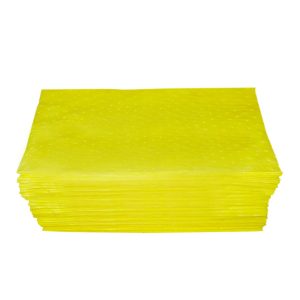
Used absorbent, contaminated PPE and washings are chemical waste. They go to a licensed disposal route, not to general waste. Emirate-level environmental authorities regulate this.
Verify the area before reopening
Confirm no residue, no vapour and no slip hazard remains. Only then remove the cordon.
Restock the spill kit immediately
A partially used kit is the reason the next response fails. Restocking is part of closing the incident, not a separate task.
Report internally and externally
Internal investigation identifies why the release happened. External reporting may be required where the release reached drainage, soil or the atmosphere, or where anyone required medical treatment. Investigation approach is covered in our guide to incident investigation techniques.
| RESPONSE ELEMENT | WHERE IT MUST BE SITED | CHECK FREQUENCY |
|---|---|---|
| Safety data sheets | Accessible from outside the storage area | On every chemical change |
| Spill kit | Within immediate reach of the hazard | Monthly, and after every use |
| Eyewash and shower | Close to decanting and handling points | Weekly flush, monthly inspection |
| Drain covers | Beside storage and transfer areas | Monthly |
| Chemical PPE | Stored clean, outside the contamination zone | Monthly, plus expiry check |
| Waste containers | Designated, labelled, segregated | Per disposal cycle |
Sites reviewing their full provision can browse the chemical safety equipment range or contact our specialists for an itemised quotation covering containment, protection and decontamination equipment.
Frequently Asked Questions
Secondary containment is a barrier beneath or around stored liquids that captures the release if the primary container fails. Spill pallets and bunded areas are common forms, and capacity should exceed the volume of the largest single container stored.
Evacuate and call specialist response where the material is unidentified or vapour is present. Also where the volume exceeds trained site capability, where the release has entered drainage, or where anyone has been exposed.
Select against the specific chemical using published breakthrough data. Nitrile, neoprene, butyl and PVC resist different chemical families, and a glove suitable for one solvent can fail quickly against another.
Sustained irrigation is required, commonly fifteen minutes or longer for corrosives. Stopping early because pain has reduced is a common and serious mistake. Seek medical attention and send the safety data sheet with the casualty.
No. Neutralisation generates heat and can worsen the injury. Irrigate with water and seek medical attention.
Within immediate reach of the hazard, not in a central store. A kit that takes several minutes to fetch arrives after the spill has spread and possibly after it has reached a drain.
As chemical waste through a licensed disposal route, not through general waste. Emirate-level environmental authorities regulate chemical waste disposal in the UAE.
Yes. High ambient temperature raises vapour pressure inside sealed containers and accelerates degradation of plastic drums. Shaded, ventilated storage reduces both effects.
Disclaimer
This article provides general guidance on chemical storage and spill response for industrial sites in the UAE. It is not legal, regulatory, environmental or toxicological advice and does not replace chemical-specific procedures, safety data sheet instructions or a site-specific risk assessment prepared by a competent person.
Chemical response is hazardous. Always follow the safety data sheet for the specific material. Where a release exceeds site capability or involves unidentified material, evacuate and call specialist emergency response.
Chemical storage, handling, waste disposal and reporting obligations vary by Emirate and by material, and regulations change over time. Verify current requirements with the relevant authority.