Manual handling safety addresses the injuries that build slowly instead of arrive suddenly. A back injury rarely comes from one bad lift. It comes from three hundred slightly wrong lifts, and the final one gets the blame.
Across UAE warehouses, construction sites and workshops, manual handling accounts for a substantial share of lost working days. The injuries are largely preventable, and the controls cost less than the absence they avoid.
How Manual Handling Injuries Develop
Cumulative loading
Spinal discs tolerate compression well and twisting poorly. Repeated loaded twisting produces micro-damage that accumulates. Symptoms appear long after the damage begins.
The four risk factors
Task, load, environment and individual capability. Manual handling risk assessment examines all four instead of the load weight alone.
Why heat compounds the problem
Fatigue degrades technique. In UAE summer conditions, workers tire faster and posture deteriorates through the shift. Afternoon lifts carry more risk than morning lifts on the same task.
| RISK FACTOR | WHAT TO EXAMINE | TYPICAL CONTROL |
|---|---|---|
| Task | Twisting, reaching, repetition, distance carried | Reposition work, reduce carry distance |
| Load | Weight, size, grip, stability, temperature | Split load, add handles, repackage |
| Environment | Floor condition, space, lighting, temperature | Clear route, improve lighting, schedule for cooler hours |
| Individual | Strength, height, training, health, clothing | Team lift, training, appropriate equipment |
Technique 1. Assess Before You Lift
The step everyone skips.
Test the weight before committing
Tip the load slightly. If it does not move easily, it is heavier than it looks. Stop and get help instead of committing to the lift.
Check the grip surfaces
A box with no handles, a damp carton or a smooth drum all reduce grip. Poor grip forces compensating posture that loads the spine.
Look at the route before moving
Where does the load go, and what is between here and there. Doors, steps, corners and obstructions all need to be known before the load leaves the ground.
Confirm the destination is clear
Setting down is where many injuries happen, because the worker arrives fatigued at a surface that turns out to be occupied.
Ask whether the lift is necessary
The safest manual handling technique is not lifting. Trolleys, pallet trucks and mechanical aids remove the exposure entirely.
Technique 2. Lift With Position, Not With Effort
Technique is about geometry.
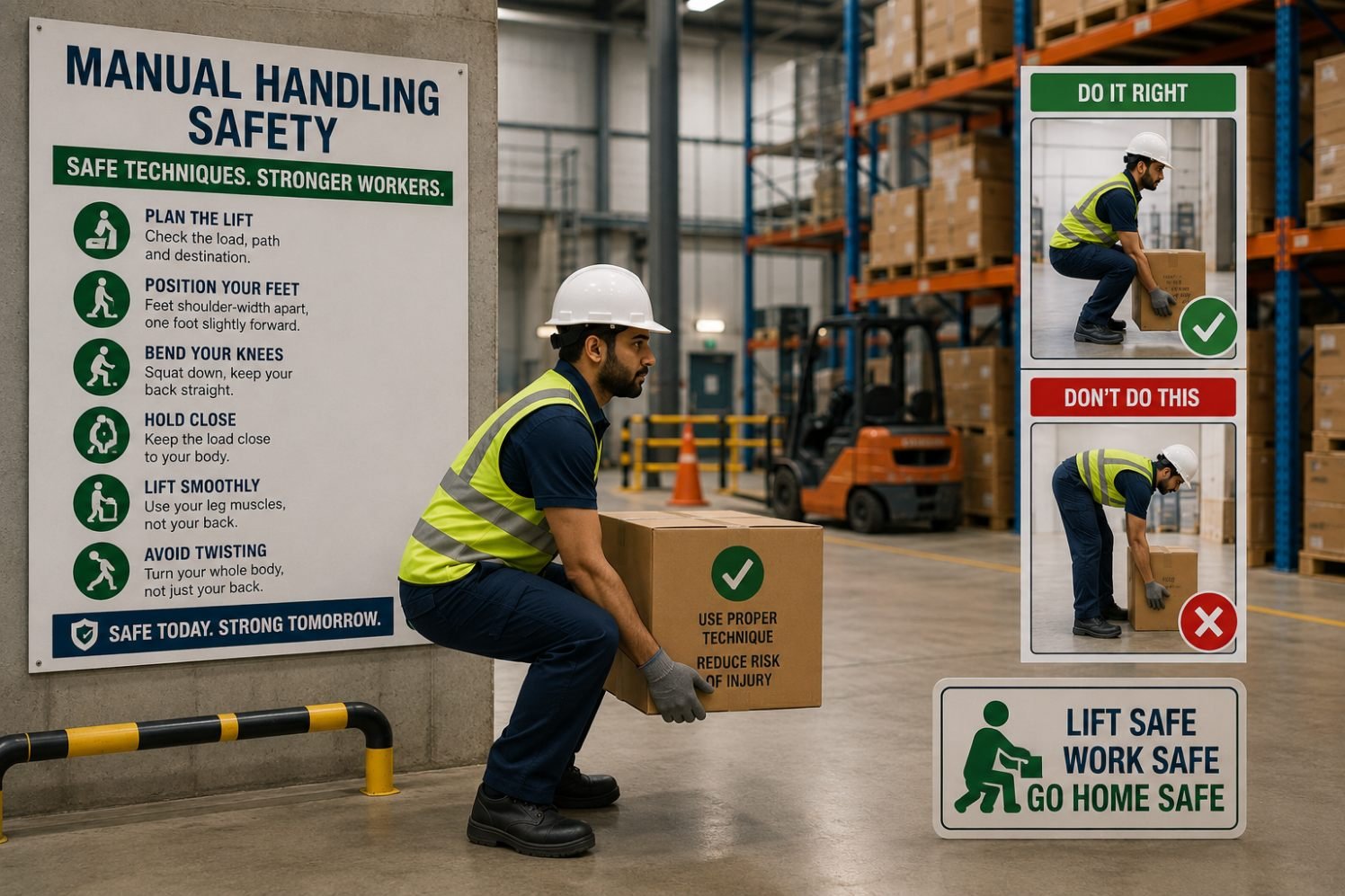
Position the feet first
Feet apart, one slightly forward, weight balanced. A narrow stance gives no stability and forces the back to compensate.
Bend the knees and hips, keep the back neutral
The back should hold its natural curve. Squatting fully is unnecessary and tiring. A hip hinge with bent knees works for many loads.
Get the load close before lifting
Load distance from the body multiplies spinal loading. A load held at arm’s length imposes several times the spinal force of the same load held against the torso.
Lift smoothly
Jerking a load introduces peak forces far above the static weight. Smooth movement keeps the load predictable.
Turn with the feet, never the spine
Twisting under load is the highest-risk movement in manual handling. Move the feet to change direction.
Keep the head up
Looking down rounds the upper back and shifts the load pattern. Eyes forward keeps the spine aligned.
Technique 3. Secure Grip and Footing Before Movement
Grip and footing are manual handling controls, not separate topics.
Match gloves to the load surface
A glove that slips forces a tighter grip and awkward posture. Coated palm gloves grip dry cartons, timber and steel well, and PU coated gloves give tactile feedback that thick gloves remove.
Rough or sharp materials call for leather handling gloves instead.
Avoid oversized gloves
A glove too large reduces grip strength substantially. Fit matters as much as material. The wider selection across our Ansell glove range covers cut protection and grip requirements for handling tasks.
Choose footwear with the right sole
Handling loads on a warehouse floor demands grip. A worn sole or a compound wrong for the surface turns a controlled lift into a slip. Options across our safety shoe range cover indoor and outdoor handling environments.
Protect the feet from dropped loads
Loads get dropped. Steel or composite toe protection is standard, and metatarsal foot guards add cover across the instep where heavy items strike.
Keep gloves accessible
Gloves left in a locker do not get worn. A glove clip on the belt keeps them at hand between tasks.
Technique 4. Use Team Lifts Correctly
Two people lifting badly is worse than one lifting well.
Match the lifters
Significant height difference tilts the load and puts a disproportionate share of the weight on the shorter person. Pair by height where possible.
Appoint one caller
One person calls the lift, the move and the set-down. Two people counting independently produces mismatched timing.
Agree the route and the set-down point first
Both lifters must know where the load is going and what happens at the corner.
Lift and lower together
The team lift injury seen more often than any other happens when one person lowers early and the other takes the full load unexpectedly.
Know when two is not enough
Some loads need mechanical handling regardless of how many people are available. Awkward, long or unstable loads do not become safe with more hands.
Technique 5. Design the Task to Remove the Risk
Training changes behaviour. Task design changes exposure.
Raise the work to waist height
Lifting from floor level and from above shoulder height are the two highest-risk zones. Store frequently handled items between knee and shoulder.
Reduce carry distance
Every metre carried adds fatigue and exposure. Reposition storage closer to the point of use.
Repackage where possible
A 25 kilogram sack split into two 12.5 kilogram units removes the hazard permanently. Discuss packaging with suppliers.
Provide mechanical aids and enforce their use
Trolleys, sack trucks, pallet trucks, hoists and vacuum lifters all exist. They only help if they are available, maintained and closer than the alternative.
Rotate repetitive handling tasks
Repetition drives cumulative injury. Rotate workers through handling and non-handling tasks across the shift.
Adjust for heat
Schedule heavy handling for cooler hours where the work is outdoors or in uncooled warehousing. Sites reviewing their broader warehouse safety equipment provision often find handling aids and floor condition emerge as the two highest-value changes.
| TASK DESIGN CHANGE | EFFORT TO IMPLEMENT | EFFECT ON RISK |
|---|---|---|
| Store heavy items at waist height | Low | High |
| Reduce carry distance | Low | Moderate |
| Split loads at supplier | Moderate | High |
| Provide trolleys and pallet trucks | Moderate | High |
| Install lifting aids or hoists | High | High |
| Rotate workers through tasks | Low | Moderate |
AAA Safe Team supplies handling gloves, safety footwear, foot protection and workwear for warehouse and construction handling operations across Dubai, Abu Dhabi, Sharjah and the wider UAE. Contact our technical team for task-specific selection advice.
Training That Changes Behaviour
Manual handling training fails when it is delivered once and filed.
Train on the actual loads
Generic box-lifting demonstrations do not transfer. Train on the loads the crew handles daily, in the location they handle them.
Keep sessions short and frequent
A ten-minute refresher on a specific task beats a two-hour annual session.
Have supervisors observe and correct
Technique degrades within weeks without correction. Observation on the floor is the maintenance mechanism.
Include the assessment step
Much training covers lifting posture and omits load assessment. The assessment is what prevents the lift that should never have been attempted.
Browse the full safety equipment range or contact our specialists to discuss handling equipment for your operation.
Frequently Asked Questions
Manual handling covers any transporting or supporting of a load by hand or bodily force, including lifting, lowering, pushing, pulling, carrying and moving.
There is no single safe weight. Risk depends on the task, the load, the environment and the individual. Guideline figures exist in various standards, but a formal assessment of all four factors gives a better answer than a weight limit alone.
Position the feet for stability. Bend at the hips and knees while keeping the back in its natural curve. Bring the load close to the body, lift smoothly and turn using the feet instead of twisting the spine.
Spinal discs tolerate compression far better than rotation. Combining rotation with load produces shear forces that cause both immediate injury and cumulative damage.
Evidence for back belts as a preventive control is weak. Task design, mechanical aids and technique produce far more reliable results than belts.
Grip quality determines posture. A glove that slips forces compensating grip and awkward positioning. A glove that is too thick or too large reduces grip strength. Match the glove to the load surface and fit it properly.
Short refreshers work better than infrequent long sessions. Supervisor observation on the floor is what maintains technique between formal sessions.
Yes. Fatigue degrades technique, and UAE summer conditions accelerate fatigue. Schedule heavy handling for cooler hours and increase rest frequency during hot months.
Disclaimer
This article provides general guidance on manual handling safety for workplaces in the UAE. It is not medical, legal or ergonomic advice and does not replace a task-specific manual handling risk assessment carried out by a competent person.
Individual capability varies. Workers with existing back conditions or other health issues should be assessed individually by a qualified occupational health professional.
Requirements vary by Emirate and by sector, and regulations change over time. Confirm current obligations with the relevant authority.