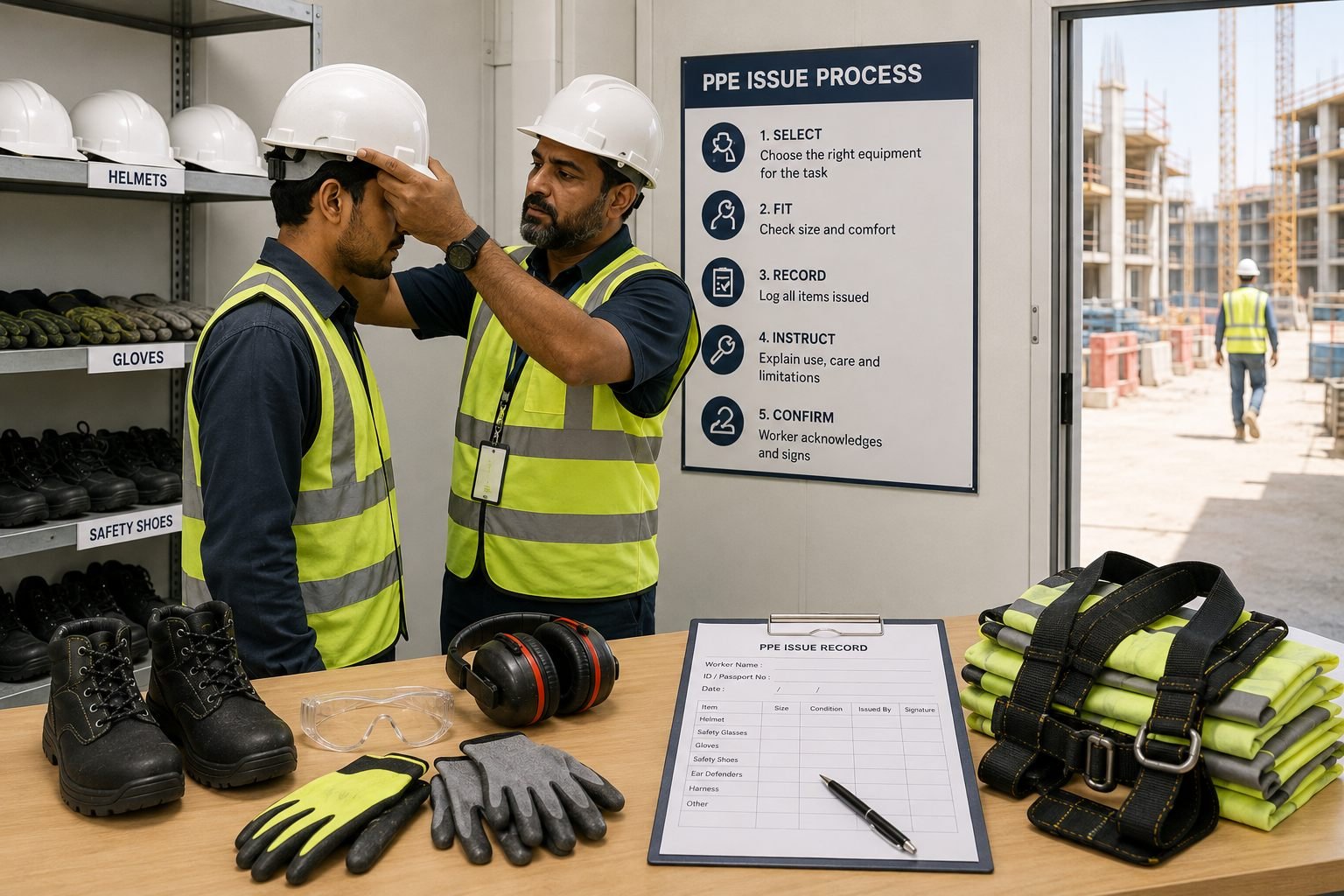
A new technician shows up on his first morning at a fit-out site in Dubai. The supervisor is short on time, so he points the worker toward a shelf of helmets and gloves and tells him to grab what fits. Nobody checks the size. Nobody logs what was handed over. Nobody explains when the gear needs replacing. By midday the man is on a scaffold wearing a harness he has never been shown how to clip.
That gap between handing over gear and handing over the knowledge to use it causes real harm. A loose helmet slides at the wrong moment. An oversized glove catches on a moving part. A respirator with a poor seal lets dust straight through. The equipment was present, yet the protection was missing. When an inspector or an insurer later asks for proof of issue, the site has nothing to show.
UAE law treats this as the employer’s duty, not a courtesy. Federal Decree Law No. 33 of 2021 places clear obligations on employers to protect workers from occupational risk, and the supporting framework expects documented control of personal protective equipment. To issue safety equipment to new workers the right way, you need a process that covers selection, fit, records, and instruction before the first task begins. This guide walks through that process step by step.
Need PPE that meets UAE standards for your new hires? AAA Safe supplies certified helmets, gloves, eye protection, harnesses, and respiratory gear across the Emirates. Talk to our team about a starter kit for your next intake.
Why the first day sets the safety tone
The way you issue safety equipment to new workers signals how serious the site is about risk. A worker who receives the wrong size on day one learns that fit does not matter here. A worker who signs a clear register and gets a short demonstration learns the opposite.
First impressions shape habits
New hires watch what the team tolerates. If experienced staff wear chin straps loose and nobody corrects it, the new worker copies that. The handover moment is your chance to set the standard before bad habits form.
The legal clock starts immediately
Protection duties apply from the first hour of work, not after a probation period. In Dubai, Abu Dhabi, and Sharjah, an injury on day one carries the same employer responsibility as one in month six. Treat the equipment handover as part of induction, not an afterthought.
What UAE law expects from employers
Before you build a process, anchor it in the rules that apply across the Emirates. The duties are spread across federal law and emirate-level frameworks.
Federal Decree Law No. 33 of 2021
This is the main labour law for the private sector. It requires employers to provide a safe working environment and the means of protection suited to the job. You can review the federal framework through the official portal at u.ae. Issuing the correct PPE and recording it sits squarely inside that obligation.
MOHRE oversight
The Ministry of Human Resources and Emiratisation enforces occupational safety for most private workplaces. Guidance and worker protection rules are published at mohre.gov.ae. During an audit, inspectors often ask to see how you issue safety equipment to new workers and whether the handover was logged.
Emirate-level frameworks
Abu Dhabi runs the OSHAD system through the Abu Dhabi Public Health Centre, with material available at adphc.gov.ae. Dubai Municipality sets its own technical and site requirements, published at dm.gov.ae. Sharjah aligns closely with federal rules. A contractor working across all three emirates needs one process that satisfies the strictest of them.
Map the hazards before you hand over anything
You cannot pick the right gear until you know what the worker faces. The handover starts with a hazard assessment for the role, not the person.
Match equipment to the task
A welder, a warehouse picker, and a scaffolder face different risks. Group your roles, list the hazards for each, and decide the standard kit per role. This makes the first-day handover fast and consistent.
Account for the UAE environment
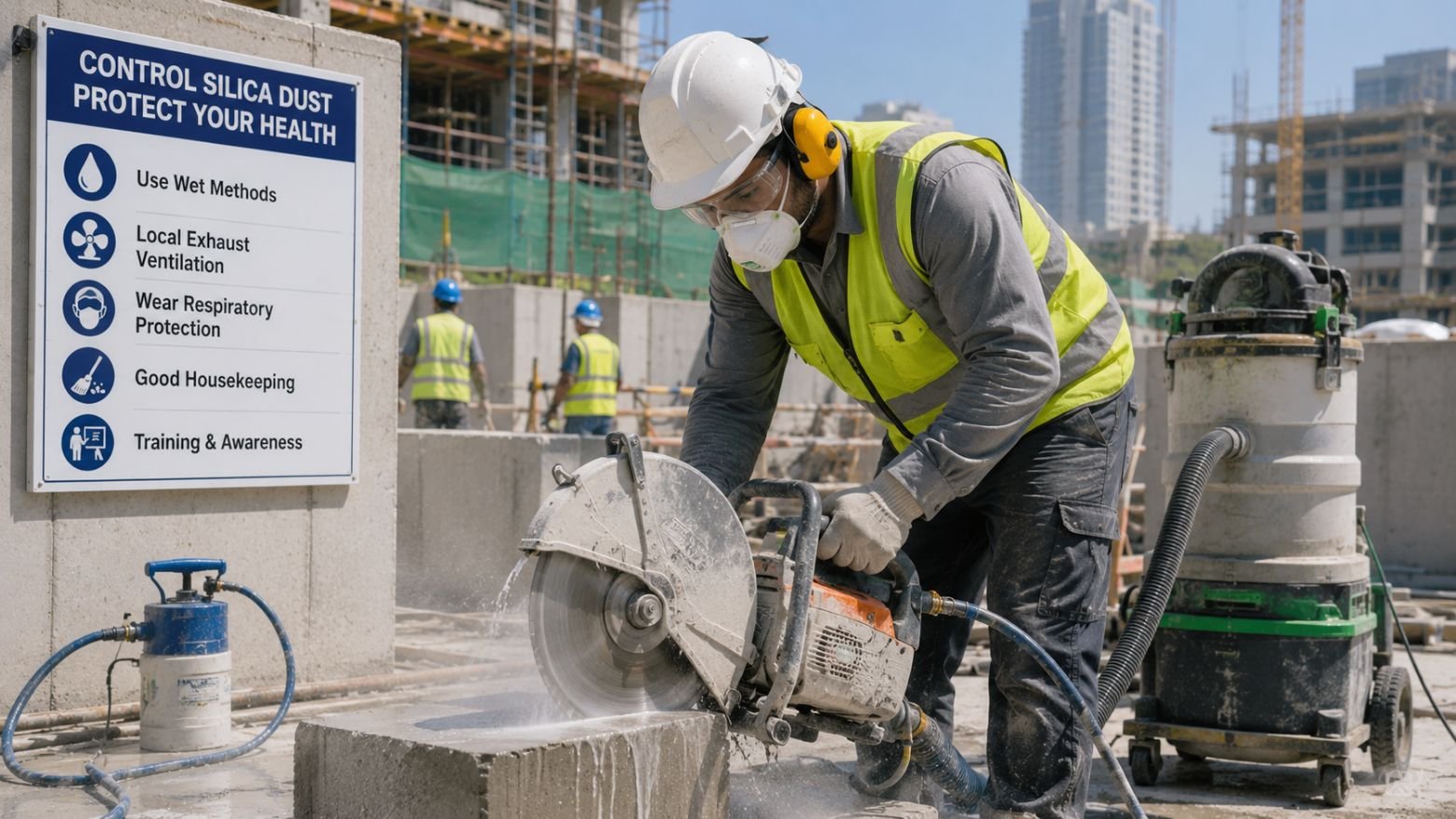
Heat is a hazard of its own. Sites across Dubai and Abu Dhabi run under the midday work ban during summer months, and gear should suit the climate. Breathable fabrics, ventilated helmets, and UV eye protection matter as much as the obvious mechanical risks.
The table below maps common hazards to the body region and the type of equipment you would issue.
| Body Region | Common Hazard | Equipment Type |
|---|---|---|
| Head | Falling objects, impact | Safety helmet with chin strap |
| Eyes and face | Dust, sparks, splash | Goggles, face shield |
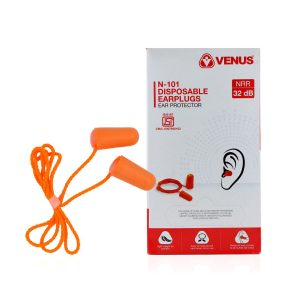
| Hearing | Continuous loud noise | Earplugs, earmuffs |
| Respiratory | Dust, fumes, vapour | Half mask, FFP respirator |
| Hands | Cuts, chemicals, heat | Cut-resistant or chemical gloves |
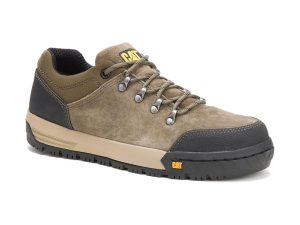
| Feet | Crush, puncture | Steel toe safety boots |
| Body | Fall from height | Full body harness, lanyard |
Reference the right standards
Equipment should carry a recognised mark so you know it performs as claimed. The common references in the UAE market are summarised here.
| Equipment | Standard Reference | What It Covers |
|---|---|---|
| Safety helmets | EN 397 | Industrial head protection |
| Safety footwear | EN ISO 20345 | Toe protection and slip resistance |
| Eye protection | EN 166 / ANSI Z87.1 | Impact and optical performance |
| Cut gloves | EN 388 | Abrasion, cut, tear, puncture |
| Respirators | EN 149 / NIOSH | Particle filtration efficiency |
| Fall harness | EN 361 | Full body arrest support |
You can source equipment carrying these marks through AAA Safe, which stocks PPE rated to EN, ANSI, and ISO references for sites across the Emirates.
Build a PPE issue checklist
A checklist turns a rushed handover into a repeatable one. Print it, keep it with the store, and run it for every new hire.
Items to confirm before issue
Check that the stock is in date, undamaged, and the correct standard for the role. Helmets have a shelf life. Harnesses have inspection tags. Respirator filters carry expiry markings. Issuing expired gear is worse than issuing none, because it gives false confidence.
Quantity per role
Decide how many of each item a worker receives. A scaffolder in Sharjah might get one helmet, two pairs of gloves, and a harness. A cleaner might get gloves and goggles only. Setting quantities per role removes guesswork at the counter.
Who signs off
Name the person allowed to release equipment from the store. In a small firm this might be the site supervisor. On a larger Dubai project it might be a dedicated safety officer. One named owner keeps the chain clear.
Get the fit right, every time
Fit is where most handovers fall short. Equipment that does not fit either fails to protect or gets removed within the hour because it hurts.
Helmets and head protection
The headband should sit snug without pinching. A loose helmet shifts and exposes the skull during an impact. Adjust the cradle with the worker present, then check the chin strap holds it in place when the head tips forward.
Gloves and hand protection
A glove that bunches at the fingertips reduces grip and dexterity. One that stretches too tight causes fatigue and gets discarded. Stock a range of sizes so you can match the hand, not force the hand to match the stock.
Footwear and harnesses
Boots need to fit with the socks the worker will wear on site. A harness needs adjustment at the legs, chest, and shoulders so the load lands on the hips and thighs during a fall, not the abdomen. Walk the worker through each buckle.
Respiratory fit checks
A respirator only works with a seal. Facial hair breaks that seal. For roles needing respiratory protection in Abu Dhabi industrial zones, run a fit check and record the result. The Abu Dhabi framework at adphc.gov.ae treats respiratory protection as a managed program, not a one-off issue.
Halfway through your intake and unsure which sizes to stock? AAA Safe helps Dubai and Sharjah employers build size-balanced PPE kits so every new worker gets a proper fit on day one. Send us your headcount.
Keep records that hold up to an audit
If it is not written down, it did not happen. That is how inspectors and insurers read a missing record. A clear log protects the worker and the company.
What the issue register should capture
A useful register records the basics of every handover so you can trace any item back to a person and a date.
| Field | Why It Matters |
|---|---|
| Worker name and ID | Links the item to a person |
| Date of issue | Starts the replacement clock |
| Item and standard | Confirms correct gear was given |
| Size issued | Proves fit was considered |
| Quantity | Tracks stock and reissue |
| Worker signature | Confirms receipt and instruction |
| Issuer signature | Names who released the gear |
Digital or paper
A paper register works for a small Sharjah workshop. A spreadsheet or safety app suits a contractor running several Dubai sites at once. Pick the format your team will keep up to date, because a register that lags reality is worse than honest.
Retention
Keep records for the duration of employment and beyond, in line with your company policy and MOHRE guidance. When you issue safety equipment to new workers, the signed record becomes the proof that you met your duty on that date.
Pair equipment with instruction
Handing over gear is half the job. The worker also needs to know how to wear it, when to replace it, and what to do if it fails.
Show, do not just tell
A two minute demonstration beats a page of text. Show the harness clip, the respirator seal check, the helmet adjustment. Then watch the worker repeat it. Language gaps are common across UAE sites, so a physical demonstration carries further than a written notice.
Cover storage and care
Equipment kept in a hot truck cab degrades faster. Explain where to store gear at the end of a shift and how to clean reusable items. A respirator left dirty becomes a hazard of its own.
Explain reporting
Tell the worker who to inform when gear is damaged or lost, and confirm that a replacement carries no cost to them. Workers who fear a deduction tend to hide damage, which defeats the purpose.
Set inspection and replacement schedules
Equipment does not last forever. A schedule keeps the gear you issued in working condition long after day one.
Daily user checks
Train workers to inspect their own gear before each shift. A cracked helmet shell, a frayed lanyard, or a torn glove should be pulled from use the moment it is spotted.
Periodic formal inspection
Fall arrest equipment needs documented inspection at set intervals by a competent person. Log each check against the item. This matters for any work at height across Dubai and Abu Dhabi high-rise projects.
Replacement triggers
The table below gives common replacement guidance. Treat manufacturer instructions as the final word, since these vary by product.
| Item | Typical Replacement Guidance |
|---|---|
| Safety helmet | Replace after any impact, or per shelf life |
| Earplugs (disposable) | Single use, replace each shift |
| Cut gloves | Replace when cuts, holes, or wear appear |
| FFP respirator | Replace per shift or when breathing resistance rises |
| Fall harness | Remove from service after a fall, or per inspection |
Fire and emergency readiness also feeds into this. Dubai Civil Defence sets site safety expectations, published at dcd.gov.ae, and your PPE program should sit alongside fire and evacuation planning rather than apart from it.
Common mistakes when you issue safety equipment to new workers
Most handover failures repeat the same few errors. Knowing them helps you design around them.
Treating handover as a formality
A worker who signs a form without a demonstration has paper, not protection. The signature should follow instruction, not replace it.
Ignoring fit to save time
Grabbing the nearest size off the shelf feels faster on a busy Dubai morning. It costs more later when the gear fails or gets removed. Fit is not optional.
Issuing expired or damaged stock
Old helmets and out-of-date respirator filters give a false sense of safety. Rotate stock and check dates before you issue safety equipment to new workers.
Keeping no record
Without a signed register, you cannot prove the handover happened. That gap surfaces at the worst time, during an injury claim or an inspection.
One size of process for every role
Forgetting refresher checks
Issuing gear once and never checking it again lets worn equipment stay in service. Schedule reviews so the protection you set up on day one holds through the months that follow.
Setting up a new site team across the Emirates? AAA Safe supplies certified PPE in the quantities and sizes your intake needs, with stock ready for Dubai, Abu Dhabi, and Sharjah delivery. Request a quote before your next start date.
Frequently Asked Questions
It means selecting protection suited to the role, checking the fit, recording the handover, and instructing the worker on use before the first task. The full process satisfies the employer duties set out under Federal Decree Law No. 33 of 2021.
Yes. The cost of protective equipment falls on the employer, not the worker. Deducting the cost of mandatory PPE from wages runs against MOHRE worker protection rules.
Before the worker starts any task that carries the relevant risk. Protection duties apply from the first hour of work, so the handover belongs inside induction.
Yes. A signed issue register protects both the worker and the company. It proves the handover took place and links each item to a person and a date, which matters during any inspection in Dubai, Abu Dhabi, or Sharjah.
Look for recognised marks such as EN, ANSI, ISO, or NIOSH references suited to the hazard. A helmet to EN 397 or gloves to EN 388 tells you the gear performs as claimed.
It depends on the item and use. Disposable earplugs are single use. Helmets follow a shelf life and any impact triggers replacement. Harnesses come out of service after a fall. Follow the manufacturer guidance for each product.
Yes. A respirator without a seal lets contaminants through. A loose helmet shifts during impact. Fit is part of the protection, not a comfort extra.
Yes. AAA Safe supplies certified safety equipment across the Emirates, including helmets, gloves, eye protection, respirators, and harnesses. As a supplier, AAA Safe helps employers stock the right sizes and standards to issue safety equipment to new workers from day one. Reach the team through the contact page.
Closing Thoughts
The handover on a worker’s first morning looks small. It is the moment your safety program either works or quietly fails. A helmet that fits, a record that is signed, a two minute demonstration of a harness clip. These cost minutes and prevent the kind of injury that costs far more.
When you issue safety equipment to new workers with care, you protect the person and you protect the company. The law across Dubai, Abu Dhabi, and Sharjah expects it. The inspector will ask for proof of it. The worker who goes home unharmed at the end of the shift is the real measure of it. Build the process once, run it the same way every time, and the first day stops being the weak point in your site safety.
Disclaimer
This article is for general information and does not replace legal, regulatory, or professional safety advice. AAA Safe Dubai is a supplier of safety equipment and PPE and does not provide installation, inspection, or consultancy services. Employers remain responsible for compliance with all applicable UAE laws and standards.
Regulatory requirements change. Confirm current obligations with the relevant authorities before acting on any guidance here. Useful references include the UAE Government Portal at u.ae for Federal Decree Law No. 33 of 2021, the Ministry of Human Resources and Emiratisation at mohre.gov.ae, Dubai Municipality at dm.gov.ae, the Abu Dhabi Public Health Centre at adphc.gov.ae, and Dubai Civil Defence at dcd.gov.ae.
Product standards and replacement intervals vary by manufacturer. Always follow the instructions supplied with each item. Any tables in this article give general guidance and not product-specific direction.
The mention of standards such as EN, ANSI, ISO, and NIOSH is for reference and does not imply endorsement by any standards body. Verify the marking on each product against the current published standard.
This content reflects general practice at the time of writing. It may not cover every site condition, role, or hazard. A competent safety professional should assess your specific workplace.
AAA Safe Dubai accepts no liability for actions taken based on this article. Use it as a starting point and seek qualified advice for your circumstances.