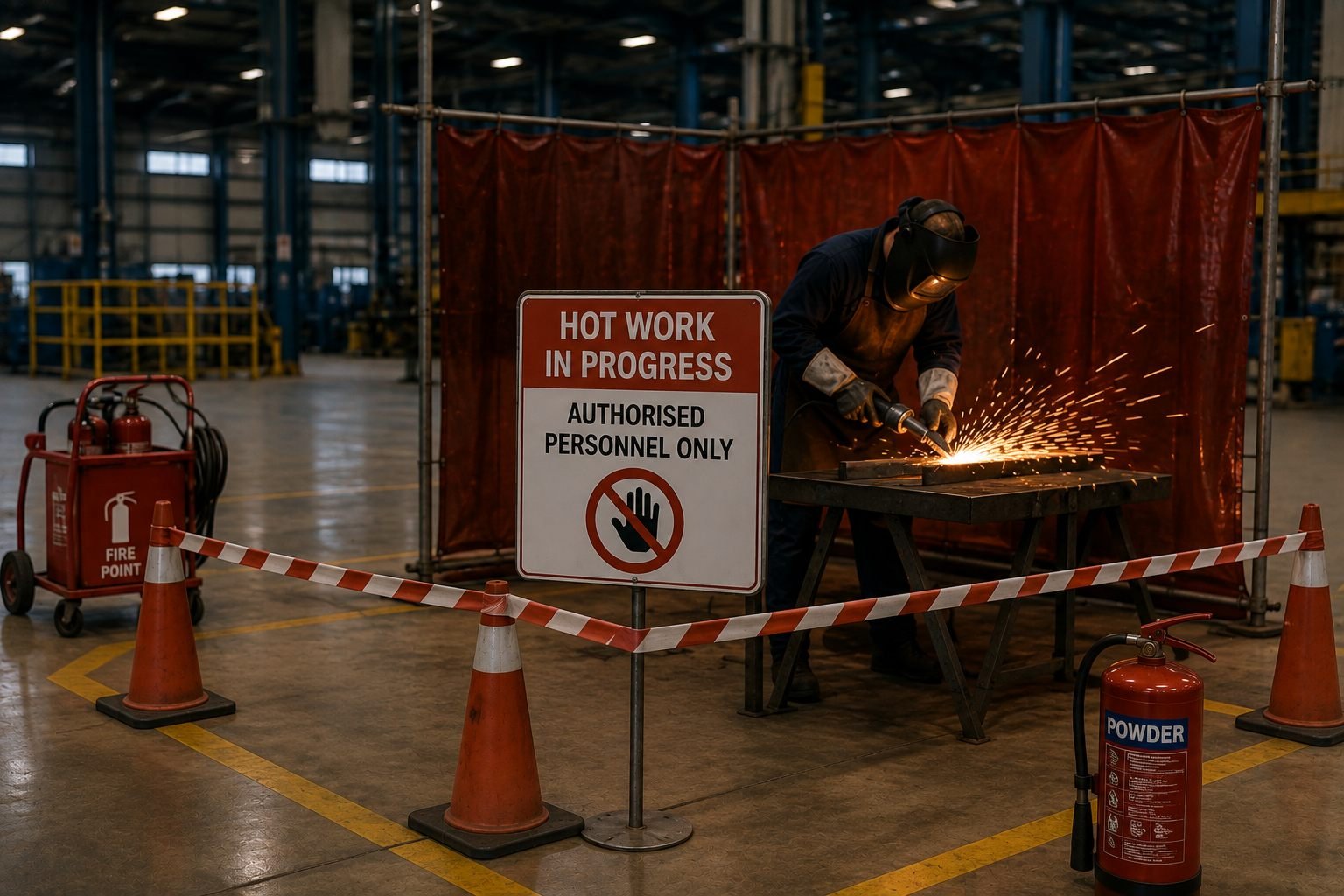
A hot work permit controls any activity producing flame, spark or heat capable of igniting something nearby. Welding, cutting, grinding, brazing, soldering and torch work all qualify. So does angle grinding, which crews frequently treat as ordinary work because it happens constantly.
A large share of hot work fires start after the work finishes. A spark lands in a void, smoulders for an hour, and the crew has left. The permit system exists to close that gap, along with the more obvious ones.
Why Hot Work Needs a Permit at All
Sparks travel further than people expect
Grinding sparks and welding spatter can travel a considerable horizontal distance and fall much further vertically. A spark falling through a floor opening lands somewhere nobody assessed.
Ignition is often delayed
Smouldering combustible material can burn undetected for an extended period before flaming. The person who created the ignition source is usually gone by then.
The hazard is not only fire
Welding and cutting generate fume, ultraviolet radiation, hot metal, compressed gas hazards and, in enclosed spaces, oxygen displacement. The permit addresses the full set.
The regulatory position
Dubai Civil Defence and the UAE Fire and Life Safety Code of Practice govern fire safety on premises in the Emirate, and Abu Dhabi applies its own framework. Contractors carrying out hot work in occupied buildings are commonly required to operate a permit system as a condition of access.
Requirement 1. Ask Whether the Hot Work Is Necessary
The first control is elimination.
Consider cold alternatives
Mechanical cutting, bolted connections, threaded fittings and cold-applied sealants remove the ignition source entirely. Where a cold method exists, the permit process should record why it was rejected.
Move the work to a designated area
A dedicated hot work bay with non-combustible surfaces, proper extraction and no adjacent storage removes a large share of the risk. Move the component instead of taking the torch to the component wherever possible.
Reserve permits for work that cannot be relocated
Permits are for the jobs that must happen in place. Treating every workshop weld as a permit job devalues the permit for the jobs that genuinely need it.
Requirement 2. Clear and Protect the Area Before Work Starts
Area preparation is the section of the permit completed poorly more often than any other.
Establish the clearance radius
Remove combustible material from the area around and below the work. The radius depends on the process, the height and the direction of spark travel. Grinding throws further than many people assume.
Protect what cannot be moved
Fixed combustible material, cable runs, insulation and stored product need covering. A fibreglass fire blanket draped over the item contains spark contact without adding a combustible layer.
Seal openings below and beside the work
Floor openings, drains, wall penetrations, cable trays and gaps in decking all channel sparks into spaces nobody is watching. Seal them before work begins, not after the first spark falls through.
Check the far side of walls and floors
Conduction through steel and concrete ignites material on the opposite face. Someone must inspect that side and confirm it is clear.
Cordon the work zone
Ultraviolet radiation from arc welding causes eye injury to bystanders who never look directly at the arc. Danger tape and screens keep passers-by outside the exposure zone.
| PREPARATION STEP | WHAT TO CHECK | COMMON FAILURE |
|---|---|---|
| Clearance radius | Combustibles removed around and below | Radius measured on the floor only |
| Fixed combustibles | Covered with non-combustible material | Plastic sheeting used as a cover |
| Openings | Drains, floor gaps, cable trays sealed | Openings below the work not inspected |
| Far side | Opposite face of wall or floor inspected | Nobody assigned to check |
| Cordon | Barriers and screens in place | Zone set for fire only, not for arc flash to eyes |
Requirement 3. Test the Atmosphere Where Flammables May Be Present
Gas testing applies wherever residual vapour is possible.
Test before issuing the permit
Tanks, vessels, drainage, pits and any area that has held flammable product require atmospheric testing before hot work is authorised.
Retest at intervals during the work
Conditions change. Vapour can migrate from adjacent systems or be released by the heat of the work itself.
Isolate connected systems
Blank pipework instead of relying on valves. A leaking valve into a vessel under hot work is a direct route to explosion.
Apply confined space controls where they apply
Hot work inside a tank or vessel is confined space entry as well as hot work. Both permit systems apply together, and our gas detector selection guide covers sensor selection for those atmospheres.
Requirement 4. Post a Fire Watch Who Does Nothing Else
The fire watch is the control that catches what preparation missed.
One person, one job
The fire watch does not hold the workpiece, fetch consumables or answer unrelated tasks. They watch the area for ignition and nothing else.
Position them where the sparks land
The fire watch stands where sparks fall, which is frequently a different level from where the welder stands. On multi-level work, more than one fire watch may be needed.
Equip them to intervene
Extinguishing capability within arm’s reach. A CO2 fire extinguisher suits electrical and equipment risk without leaving residue, while dry chemical powder covers a broader range of combustibles.
Give them authority to stop the work
A fire watch who must ask permission to stop the job is not a control. Authority to halt work must be explicit and unchallenged.
Confirm the alarm route
The fire watch must know how to raise the alarm and where the nearest hose reel and alarm point sit.
Requirement 5. Specify the Full PPE Ensemble
Welding PPE is a system. Gaps in it produce burns.
| BODY AREA | PROTECTION | SELECTION NOTE |
|---|---|---|
| Eyes and face | Welding helmet or handshield | Shade number matched to process and current |
| Eyes, cutting and grinding | Goggles or face shield | Impact rating for grinding, filter shade for gas cutting |
| Torso and arms | Leather or treated jacket | Must not carry synthetic outer layers |
| Hands | Leather welding gloves | Gauntlet length to cover the wrist gap |
| Forearms | Sleeves | Where a jacket is not worn |
| Legs and feet | Leg guards and boots | Trousers over boots so spatter cannot enter |
| Respiratory | Filter matched to fume | Fume extraction preferred over respiratory protection alone |
Match the lens to the process
An underspecified shade causes arc eye. Auto-darkening lenses simplify this and remove the flip-up habit that causes flash exposure. Our comparison of auto darkening welding helmets against passive lenses covers the selection in detail.
Cover the wrist and neck gap
The gap between glove cuff and jacket sleeve takes a large share of welding burns. Leather welding gloves with adequate gauntlet length close it.
Welding hand sleeves extend the cover where a full jacket is impractical in UAE heat.
Protect the legs on overhead and downhand work
Spatter falls. Welding leg guards protect the shin and instep where trouser fabric alone burns through.
Control fume at source
Extraction removes fume before it reaches the breathing zone. Where extraction is impractical, respiratory protection must match the fume type, and our guide to respiratory protection for welding fume exposure covers filter selection.
AAA Safe Team supplies welding protection, fire blankets, extinguishers, barriers and respiratory equipment for hot work operations across Dubai, Abu Dhabi, Sharjah and the wider UAE. Contact our technical team for process-specific recommendations.
Requirement 6. Monitor After the Work Stops
This is the requirement more often skipped and more often the reason a fire starts.
Keep the fire watch in place after work ends
The fire watch remains for a defined period after the last spark. A minimum of sixty minutes is common practice, extended where combustible material could not be fully cleared.
Inspect the area after the watch period
A final walk of the area, including the level below and the far side of any wall or floor worked on, before the permit closes.
Check with thermal detection where available
A thermal camera reveals residual heat in structures and voids that visual inspection cannot.
Close the permit formally
Signed by the fire watch and the permit issuer, confirming the area was inspected and left safe. An open permit at end of shift means nobody has confirmed the area is cold.
Restore fire systems
Detection heads isolated to prevent nuisance alarms during the work must be reinstated and confirmed operational. A disabled detector left disabled overnight has removed the building’s protection.
Requirement 7. Manage the Permit as a Live Document
The permit is a control, not a record.
Time-limit every permit
One shift maximum. Conditions, personnel and adjacent activity all change.
Name the individuals
The permit names the person doing the work, the fire watch and the issuer. Roles without names are unassigned.
Display it at the work location
A permit filed in the site office controls nothing. It sits at the job, visible to anyone who approaches.
Coordinate with other permits
Hot work adjacent to a chemical transfer, a confined space entry or an isolation creates combined risk. The permit issuer must see what else is live on the same area.
Audit permits in use
Walking the site and checking that live permits match live conditions reveals more than reviewing closed permits at a desk. Findings feed into the wider fire protection equipment for industrial premises provision and into the site’s inspection cycle.
Frequently Asked Questions
Welding, cutting, brazing, soldering, grinding, torch work and any activity producing flame, spark or sufficient heat to ignite nearby material. Grinding is frequently overlooked despite producing substantial spark travel.
A minimum of sixty minutes is common practice, extended where combustible material could not be fully removed or where sparks may have entered voids. The area should be inspected again before the permit closes.
A competent person who has assessed the area, verified the preparation and holds the authority to control the work. The person carrying out the work should not issue their own permit.
No. The fire watch has one task, which is watching for ignition. Assigning any other duty removes the control.
Further than many people estimate, and much further vertically than horizontally. The clearance radius must account for spark travel below the work as well as around it.
Provision should match the materials present. Carbon dioxide suits electrical and equipment risk without residue, while dry chemical powder covers a broader range of combustibles. Both should be within immediate reach of the fire watch.
Yes. Hot work inside a vessel or tank is both hot work and confined space entry. Both permit systems apply together, along with atmospheric testing and rescue provision.
Isolation must be recorded, time-limited and reinstated before the permit closes. A detector left isolated after work ends removes protection from the building for as long as it stays off.
Disclaimer
This article provides general guidance on hot work permit systems for worksites in the UAE. It is not legal, regulatory or fire engineering advice and does not replace a site-specific hot work procedure prepared by a competent person.
Hot work is a high-hazard activity with fire, explosion, burn and respiratory risks. Requirements vary by Emirate, by premises type and by process, and regulations change over time. Confirm current obligations with the relevant authority before commencing work.
Engage qualified fire safety and health and safety professionals when designing or auditing a permit to work system.