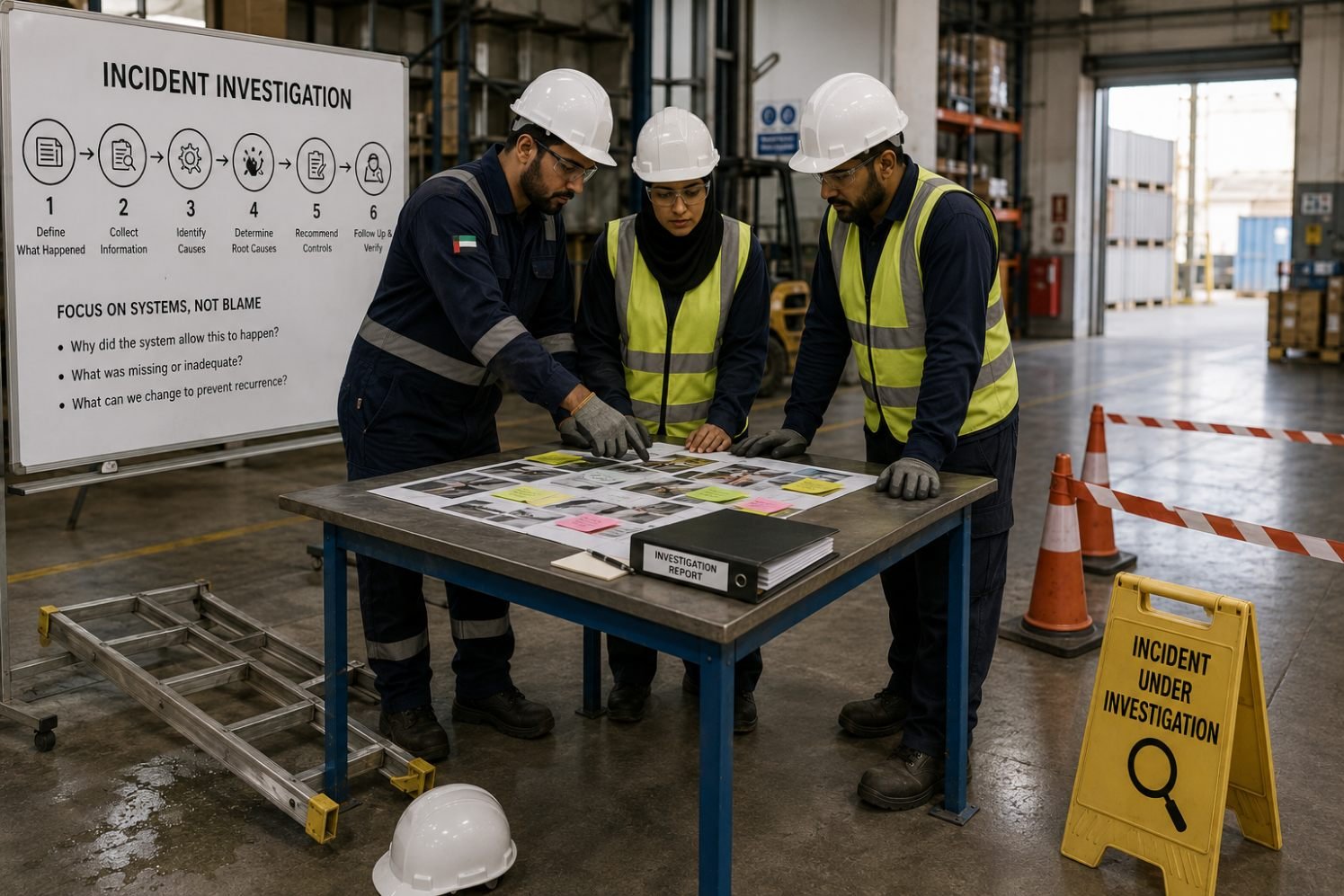
Incident investigation exists to stop the same accident happening twice. Many investigations fail at that because they stop at the immediate cause. A worker fell. The guardrail was missing. Install the guardrail. Case closed. Six months later a different worker falls somewhere else, because the reason guardrails go missing was never examined.
The techniques below move an investigation past the immediate cause to the system conditions that allowed it. They apply across UAE workplaces from Jebel Ali warehouses to Abu Dhabi process plants.
Why Investigations Fail to Prevent Recurrence
Stopping at human error
“Worker was careless” is a description, not a finding. It generates no corrective action beyond a reminder, and reminders do not prevent recurrence.
Investigating to allocate blame
Once an investigation feels like a search for someone to punish, witnesses become defensive and evidence quality collapses.
Weak corrective actions
Retraining and toolbox talks are the default output of weak investigations. They are the least effective controls available and rarely address the condition that produced the incident.
Investigating too late
Evidence degrades within hours. Scenes get cleared, memories reshape and equipment gets repaired.
Technique 1. Control the Scene in the First Hour
Everything else depends on what you preserve now.
Make the area safe first
Casualty care comes before evidence. Then eliminate any hazard that could injure someone else.
Preserve instead of clear
Do not repair the equipment. Do not clean the area. Do not return tools to store. Production pressure to restart is intense and must be resisted until evidence capture is complete.
Photograph widely then narrowly
Wide shots establishing context, then progressively closer. Include a scale reference. Photograph the surrounding area too, including things that appear irrelevant.
Record what will change
Weather, lighting, noise, shift pattern, staffing level and material state all change quickly. Note them now.
Collect physical evidence
Failed components, damaged equipment, the protective gear worn. A helmet that cracked tells you the impact energy. A harness with a deployed shock absorber tells you the fall occurred and the system worked.
| FIRST HOUR ACTION | PURPOSE | COMMON FAILURE |
|---|---|---|
| Make area safe | Prevent second incident | Rushed, leaving hazard live |
| Preserve scene | Protect evidence | Cleared for production restart |
| Photograph | Fix conditions in time | Only close shots, no context |
| Identify witnesses | Capture accounts before drift | Names not taken, workers dispersed |
| Secure equipment | Enable technical examination | Repaired before examination |
Technique 2. Interview to Gather Information, Not Confessions
Interview quality decides investigation quality.
Interview early and separately
Memory drifts within hours and converges once workers discuss the event. Take accounts individually and quickly.
Open with an open question
Ask the witness to describe what happened in their own words, without interruption. Only then move to clarifying questions.
Avoid loaded questions
“Was he wearing his harness” invites a yes. “What was he wearing” produces evidence.
State the purpose clearly
Explain that the interview seeks to prevent recurrence, not assign blame. Say it at the start and mean it.
Interview in the witness's own language
UAE sites commonly run multilingual crews. A witness giving evidence in a second language will give less detail and may agree with statements they do not fully understand. Use an interpreter where needed.
Walk the scene with the witness
Standing in the location prompts recall that a meeting room does not. Ask the witness to show instead of describe.
Technique 3. Build a Timeline Before You Analyse
Analysis without a timeline produces guesswork.
Sequence every event
Work back from the incident. What happened immediately before. What preceded that. Continue until you reach a normal state.
Include the days before
Many incidents have roots in decisions made days earlier. A late material delivery, a shift swap, an equipment substitution, a permit issued in a hurry.
Mark what is fact and what is inference
Distinguish confirmed events from assumed ones. Investigations go wrong when an assumption enters the timeline as fact.
Identify the decision points
Every point where a different choice would have broken the chain. Those points are where controls belong.
Technique 4. Apply Root Cause Analysis Properly
Root cause analysis is where investigations either earn their value or waste it.
Use five whys with discipline
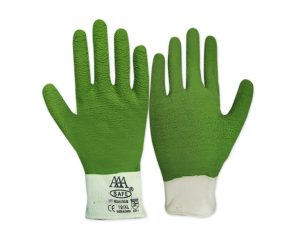
Keep asking why until you reach a system condition instead of a person. A worker used the wrong glove. Why. The correct type was out of stock. Why. The reorder point was never set. Why. Stores had no process for consumable PPE. That last answer is the fix.
Use a cause and effect structure for complex incidents
Group contributing factors under people, equipment, materials, environment, method and management. It stops investigations fixating on the first plausible cause.
Look for the three cause layers
Immediate cause is the unsafe act or condition. Underlying cause is what allowed it. Root cause is the management system gap behind that.
Test each cause
Ask whether removing this factor would have prevented the incident. If not, it is a contributing factor instead of a cause.
| CAUSE LAYER | EXAMPLE | CORRECTIVE ACTION TYPE |
|---|---|---|
| Immediate | Guardrail missing at edge | Install guardrail |
| Underlying | Guardrail removed for delivery, not replaced | Permit for temporary removal, sign-back |
| Root | No procedure governing temporary edge protection removal | Written procedure, supervisor accountability, audit |
Technique 5. Write Corrective Actions That In practice Control
The hierarchy of control decides whether a corrective action works.
Prefer elimination and engineering
Remove the hazard or engineer it out. A physical barrier works whether or not anyone remembers the rule.
Treat administrative controls as support
Procedures, permits and training help, but they depend on human compliance every time. They are not a substitute for a physical fix.
Use protective equipment as the last layer
Equipment protects the individual and fails silently when worn incorrectly or degraded. It belongs in the control set, not at the front of it. Where equipment is the corrective action, specify it precisely and verify condition through your the monthly equipment verification routine.
Assign owner and date to every action
An action without a named owner and a deadline does not happen. Track it to closure.
Verify effectiveness after closure
Return in three months and check the control is still in place and still working. Many corrective actions decay quietly.
AAA Safe Team supplies barrier and marking systems, first aid provision and personal protective equipment used as corrective actions across the UAE. Contact our technical team for specification advice.
Technique 6. Close the Loop Across the Whole Organisation
An investigation that only fixes one site has done half the job.
Share findings across all sites
If a hazard existed on one site, assume it exists on the others until checked. Companies operating across Dubai, Abu Dhabi and Sharjah should circulate findings to every location.
Feed findings into procurement
Repeated glove failures should change the glove specification. Repeated respirator fit failures should change the model or the fit testing process. Investigation output should influence what the company buys, and the selection across manufacturing safety equipment categories should follow the evidence.
Update risk assessments
The incident proved the risk assessment was incomplete. Revise it instead of filing the investigation separately.
Brief the workforce honestly
Workers know an incident happened. Silence breeds rumour and reduces future reporting. Share what happened, what caused it and what changed.
Prepare for regulatory follow-up
Serious incidents attract MOHRE and Emirate-level attention. A complete investigation file with evidence, analysis and closed corrective actions demonstrates control. Our guidance on the regulatory sequence after an inspection failure covers what follows.
Where legal responsibility sits is set out separately in our note on employer duties following a workplace injury.
The Investigation Toolkit
Investigators need equipment ready before an incident, not sourced afterwards.
Camera or phone with adequate resolution. Measuring tape and scale markers. Barrier tape and cones to cordon the scene. Evidence bags and labels. Notebook and witness statement forms. Torch, since many incidents happen in poor light. An inspection mirror for examining machinery interiors and confined areas without dismantling.
Adequate first aid provision sized for the site population, since casualty care precedes everything.
AAA Safe Team supplies barrier and marking systems, first aid provision, inspection equipment and personal protective equipment across Dubai, Abu Dhabi, Sharjah and the wider UAE. Browse the site safety equipment catalogue or contact our specialists for a site supply assessment.
Frequently Asked Questions
The purpose is to identify the causes of an incident and implement controls that prevent recurrence. It is not to establish blame, and investigations conducted as blame exercises produce poor evidence.
Immediately after the scene is made safe and casualties are treated. Physical evidence degrades within hours and witness memory drifts and converges within a day.
Root cause analysis is the process of working past the immediate cause of an incident to the underlying and system-level conditions that allowed it. Five whys and cause and effect diagrams are common methods.
The immediate cause is the unsafe act or condition directly involved. The root cause is the management system gap that allowed that condition to exist and persist.
Investigation depth should match potential severity. A supervisor can handle minor events. Serious incidents warrant a team including HSE personnel, a technical specialist and someone independent of the area involved.
Individually, early, in their own language, starting with an open question and avoiding loaded questions. Explain that the purpose is prevention instead of blame.
One that sits high in the hierarchy of control, has a named owner and a deadline, and is verified for effectiveness some months after closure. Retraining alone is rarely sufficient.
Yes. Workers already know an incident occurred. Sharing what happened, what caused it and what changed builds trust and supports future reporting.
Disclaimer
This article provides general guidance on incident investigation for workplaces in the UAE. It is not legal, regulatory or forensic advice and does not replace formal investigation carried out by competent persons.
Serious incidents may carry statutory reporting obligations and legal consequences. Requirements vary by Emirate and by sector, and regulations change over time. Verify current reporting duties with the relevant authority.
Engage qualified health and safety professionals and, where appropriate, legal counsel following a serious workplace incident.