Gas leaks or oxygen-deficient environments can be fatal. In UAE industries ranging from oil and gas to construction, manufacturing, and wastewater treatment, selecting the right gas detection equipment is a critical safety decision that directly affects worker protection and regulatory compliance.
Industries in the UAE are subject to stringent safety regulations from OSHAD (Occupational Safety and Health Abu Dhabi), Dubai Municipality, and other emirate-specific authorities. By using properly certified gas detection equipment, you ensure that devices meet both local and international safety codes including ATEX and IECEx requirements.
This gas detector selection guide covers the sensor technologies available, certification requirements, application considerations, and maintenance factors that UAE safety managers must understand to make informed procurement decisions.
Understanding UAE Regulatory Requirements
Before selecting gas detection equipment, safety managers must understand which regulations apply to their operations. Compliance requirements depend on which emirate you operate in and what sector you work in.
Federal and Emirate-Level Requirements
UAE Federal Decree Law No. 33 of 2021 on Regulation of Labour Relations establishes the foundation for workplace safety requirements. Employers must provide a safe and appropriate work environment, provide the necessary means of protecting workers from occupational injuries, and provide appropriate training to workers.
Abu Dhabi operates under the OSHAD System Framework (Occupational Safety and Health Abu Dhabi). OSHAD has issued specific Codes of Practice including COP 17.0 for confined space requirements that directly relate to gas detection needs. The framework requires risk assessments to determine underlying hazards and classify entities in terms of their overall risk level.
Dubai Municipality enforces additional requirements through its building and construction safety codes. Projects within Dubai must comply with local technical guidance that may exceed federal minimums.
Sharjah and other emirates apply their own municipal safety regulations on top of federal law, each with their own interpretation and enforcement approach.
Industry-Specific Considerations
Different industries face unique gas detection requirements based on their specific hazards.
Oil and gas operations involve risks from flammable gases, hydrogen sulfide, and oxygen-deficient atmospheres in confined spaces like storage tanks, vessels, and pipelines. These facilities require equipment meeting specific hazard ratings for explosive atmospheres.
Construction operations encounter confined spaces in excavations, trenches, and building voids. Gas detectors must address atmospheric hazards including oxygen deficiency, combustible gases, and toxic gases that may accumulate in poorly ventilated areas.
Manufacturing plants have silos, hoppers, mixing tanks, and ventilation ducts that qualify as confined spaces requiring atmospheric monitoring before and during entry.
Wastewater facilities face hydrogen sulfide exposure, which is heavier than air and tends to build up in enclosed spaces like sewage systems.
Gas Detection Sensor Technologies
A gas detector selection guide must address the different sensor technologies available, as each has specific strengths and limitations for particular applications. Choosing the right sensing technology requires balancing accuracy, cost, and environmental suitability.
Catalytic Bead Sensors
Catalytic sensors are the most common type of sensor used for detecting and measuring combustible gases such as methane, propane, hydrogen, and butane. The catalytic sensor consists of two platinum wire coils connected in a Wheatstone bridge circuit. The active bead contains a catalyst that allows combustible compounds to oxidize, heating the bead and changing its electrical resistance.
These sensors measure gases as a percentage of Lower Explosive Limit (LEL), which indicates how close the concentration is to the level at which ignition could occur. If a gas concentration is below its LEL, it cannot ignite.
Important limitations: Catalytic sensors require a minimum of 12% oxygen in the atmosphere for oxidation. They can be poisoned by compounds such as silicones, mineral acids, chlorinated organic compounds, and sulfur compounds. They respond broadly to combustible gases but cannot distinguish between different combustible species.
Catalytic sensors work well in underground spaces such as mines for methane monitoring and provide timely warnings for combustible gas leaks in most industrial environments.
Electrochemical Sensors
Electrochemical sensors measure the concentration of a target gas by oxidizing or reducing the target gas at an electrode and measuring the resulting electrical current output. These types of sensors are used for detecting oxygen and toxic gases such as carbon monoxide (CO), hydrogen sulfide (H2S), ammonia (NH3), chlorine (Cl2), nitrogen dioxide (NO2), and sulfur dioxide (SO2).
The amount of current produced is proportional to the gas concentration, providing accurate readings at parts-per-million levels. Different target gases require specific electrolyte and electrode materials, giving electrochemical sensors high specificity.
Electrochemical sensors are valued for their high sensitivity, selectivity, stability, and low-power operation, making them ideal for personal, portable, and fixed gas detection applications. However, cross-sensitivity can occur if other gases interfere with target gas detection.
In chemical plants where toxic gases may be present, electrochemical sensors’ high sensitivity and specificity provide valuable protection for personnel.
Infrared (IR) Sensors
Infrared sensors measure hydrocarbons and other infrared-active gases such as carbon dioxide by determining the absorption of an emitted infrared light source through an air sample. Gas molecules absorb specific infrared wavelengths corresponding to their molecular vibration modes. The sensor measures the reduction in transmitted intensity and converts absorption into gas concentration.
A significant advantage: Infrared gas detectors do not require oxygen to function, making them suitable for detecting combustible gases in inert or oxygen-deficient atmospheres where catalytic sensors would not work. They offer strong resistance to false alarms triggered by environmental changes.
Infrared sensors have no risk of sensor poisoning from atmospheric contaminants. They provide accurate and fast detection, are durable with relatively long service life, and maintain performance even at high concentrations.
For pipeline transport, oil and gas extraction, or process control requiring accurate gas composition data, infrared sensors provide stable, high-precision long-term measurements.
Photoionization Detectors (PID)
Photoionization sensors detect volatile organic compounds (VOCs), toxic gases, and vapors by using an ultraviolet lamp to ionize gas molecules. The resulting ionization produces an electric current directly correlated with VOC concentration. PID sensors can detect gases at concentrations from very low to very high, expressed in parts per million (ppm).
PID sensors have no risk of sensor poisoning and can detect a wide range of compounds. However, they are sensitive to humidity in their environment.
PIDs are commonly used for environmental investigations, industrial hygiene assessments, and hazardous materials response where rapid detection of VOC levels is required.
Gas Detector Sensor Technology Comparison
| Sensor Type | Primary Application | Advantages | Limitations |
|---|---|---|---|
| Catalytic Bead | Combustible gases (LEL) | Reliable, cost-effective, broad response | Requires oxygen, can be poisoned |
| Electrochemical | Toxic gases, oxygen | High sensitivity, gas-specific | Cross-sensitivity possible |
| Infrared | Combustibles, CO2 | No oxygen required, long life, no poisoning | Higher cost |
| PID | VOCs, toxic vapors | Wide detection range, fast response | Humidity sensitive |
Single-Gas vs. Multi-Gas Detectors
Your gas detector selection guide decision includes choosing between single-gas monitors and multi-gas instruments based on your specific hazard profile and operational requirements.
Single-Gas Monitors
Single-gas detectors provide focused protection where hazards are known and consistent. They are ideal for monitoring a specific gas in routine operations where that particular hazard is the primary concern.
Single-gas monitors are typically smaller, lighter, and less expensive than multi-gas units. They work well when a single specific toxic gas like hydrogen sulfide is the known hazard, when combustible gas monitoring is the only requirement, or when oxygen monitoring in a controlled environment is sufficient.
Multi-Gas Detectors
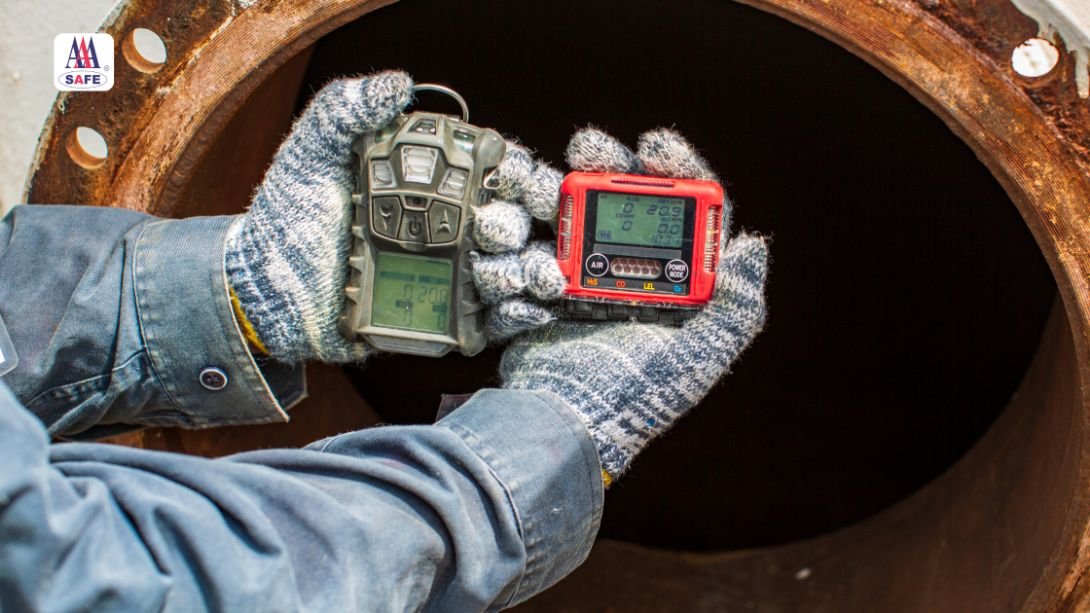
Multi-gas monitors, commonly called 4-gas monitors, detect multiple gases simultaneously. A typical 4-gas monitor detects carbon monoxide (CO), oxygen (O2), hydrogen sulfide (H2S), and combustibles (LEL). These monitors are crucial for ensuring personal safety when working in confined spaces where multiple hazards may be present.
For confined space entry, OSHA standard 1910.146 states that before an employee enters the space, the internal atmosphere shall be tested with a calibrated direct-reading instrument. The necessary confined space gas detector should detect at least four gases: oxygen, combustibles, hydrogen sulfide, and carbon monoxide.
More advanced multi-gas instruments can monitor up to six or seven atmospheric hazards simultaneously, adding sensors for PID, infrared CO2, or substance-specific toxic gases beyond the standard four.
Selection Criteria
Choose a single-gas detector when you have a known, consistent gas hazard in your environment and need focused monitoring for that specific risk.
Choose a multi-gas detector for confined space entry where multiple hazards may be present, for environments where gas hazards vary or are unknown, and for compliance with confined space entry requirements that mandate testing for oxygen, combustibles, and toxic gases.
For comprehensive gas detection programs supporting confined space operations and industrial safety across Dubai, Abu Dhabi, and Sharjah, AAA Safe Dubai provides equipment consultation and support.
Confined Space Gas Detection Requirements
Confined spaces present some of the most dangerous gas hazards in any workplace. Understanding acceptable and dangerous gas levels is essential for anyone selecting detection equipment.
Defining Safe Atmospheric Conditions
The minimum safe level of oxygen in a confined space is 19.5%, while the maximum safe level is 23.5%. Low oxygen levels are the most frequent cause of gas-related deaths in confined spaces, making accurate oxygen measurement essential.
Hydrogen sulfide has a permissible exposure limit (PEL) of 20 parts per million (ppm). This severely toxic gas can cause harmful side effects even at relatively low exposure limits and has a workplace exposure limit of 5 ppm for an 8-hour time-weighted average.
Carbon monoxide has a PEL of 50 ppm. The risk of CO exposure is greater for workers operating fuel-burning tools or arc welders in enclosed spaces.
Combustible gas levels are measured as a percentage of Lower Explosive Limit. An atmosphere free of combustible gas would show 0% LEL on the detector. When gas concentration reaches 100% LEL, the atmosphere has reached the point at which ignition is possible.
Required Detector Features for Confined Space
A confined space gas detector should allow you to test the space before entry, measure continuously while in the space, be easy to use to prevent misuse, and be reliable under varying conditions.
The sample draw method is the most common form of sampling a confined space. The advantage is that monitoring is performed outside the space before workers enter. Detectors should either have an internal pump to pull the gas sample or include a sample-draw kit for remote sampling.
Diffusion-type monitors rely on natural gas diffusion to the sensing element and are suitable for continuous personal monitoring once workers are inside the space.
Pre-Entry and Continuous Monitoring
Atmospheric testing is required for two distinct purposes: evaluation of the hazards of the permit space and verification that acceptable entry conditions exist. Workers should be constantly aware of gas levels while in confined spaces because conditions could change over time.
A gas far above its Upper Explosive Limit (UEL) will not ignite because it is too rich to burn, but ventilation could dilute the gas and its concentration could quickly enter the combustible range.
Certification Requirements
Gas detection equipment used in potentially explosive atmospheres must carry appropriate certifications. Understanding these certifications is essential for your gas detector selection guide.
ATEX Certification
ATEX (Atmosphères Explosibles) refers to two European Union directives that establish minimum safety requirements for equipment in explosive atmospheres. ATEX Directive 2014/34/EU applies to manufacturers of equipment used in explosive atmospheres, while ATEX Directive 99/92/EC applies to employers and workplace use.
ATEX certification is mandatory within the European Union. Products must be CE marked and labeled with the Ex symbol. While ATEX is a European requirement, many UAE facilities operating under international standards specify ATEX-certified equipment.
IECEx Certification
IECEx (International Electrotechnical Commission System for Certification to Standards Relating to Equipment for Use in Explosive Atmospheres) is a global certification system. IECEx certification ensures that equipment complies with IEC 60079 series standards covering intrinsic safety, explosion protection, and pressurization.
IECEx is increasingly accepted worldwide, including in the Middle East. The system provides single testing standards that simplify international approvals, and certification reports are publicly accessible via the IECEx online database.
For UAE operations, the Middle East generally recognizes the IECEx scheme. However, some facilities also reference their own standards, such as ADNOC standards for oil and gas operations.
Hazardous Area Classification
Both ATEX and IECEx classify environments by zones based on the likelihood and duration of explosive atmospheres:
- Zone 0: Explosive atmosphere present continuously or for long periods (gas)
- Zone 1: Explosive atmosphere likely during normal operation (gas)
- Zone 2: Explosive atmosphere not likely during normal operation (gas)
- Zone 20, 21, 22: Corresponding classifications for dust hazards
Selecting equipment with the appropriate zone rating for your application is essential for both safety and regulatory compliance.
Gas Detection Certifications Summary
| Certification | Geographic Scope | Requirement Type | Key Standards |
|---|---|---|---|
| ATEX | European Union | Mandatory in EU | EU Directive 2014/34/EU |
| IECEx | International | Voluntary, widely recognized | IEC 60079 series |
| CENELEC | European | Harmonized standards | EN 60079 series |
Environmental Considerations for UAE
The UAE climate presents specific challenges for gas detection equipment that safety managers must consider.
Extreme Heat and Humidity
Due to the extreme heat and humidity in the UAE, calibration should be performed regularly to maintain accuracy. Standard equipment suitable for temperate climates often proves inadequate in UAE conditions.
Look for equipment with operating temperature ranges appropriate for your environment. Many industrial areas in the UAE can experience temperatures exceeding 45°C during summer months.
Humidity can affect certain sensor types, particularly PID sensors. Select equipment rated for the humidity levels expected in your operating environment.
Dust and Particulates
Construction sites and industrial facilities may have significant dust exposure. Equipment should have appropriate ingress protection ratings (IP ratings) for dust resistance. IP65 and IP67 ratings provide protection against dust ingress and water exposure.
Calibration and Maintenance in UAE Conditions
All gas detection sensors and gauges need to be inspected, calibrated, maintained, and have parts replaced frequently. The UAE environment may require more frequent calibration intervals than temperate climate operations.
Oxygen sensors typically last between 24 to 36 months depending on usage and environment. Electrochemical sensors for toxic gases have varying lifespans, typically 2 to 3 years. Catalytic sensors can last several years but may require more frequent calibration if exposed to poisoning compounds.
For gas detection equipment support tailored to UAE industrial environments, AAA Safe Dubai provides calibration services and maintenance programs across Dubai, Abu Dhabi, and Sharjah.
Practical Selection Process
Developing a systematic approach ensures your gas detector selection guide decisions address all relevant factors for your specific operations.
Step 1: Identify Potential Gas Hazards
Determine which gases are likely to be present in your work environment. Common hazards include oxygen deficiency or enrichment, combustible gases measured as LEL, carbon monoxide, hydrogen sulfide, and volatile organic compounds.
Consider all areas where workers may encounter these hazards, including confined spaces, process areas, storage facilities, and maintenance activities.
Step 2: Assess Application Requirements
Confined space entry requires a multi-gas monitor with internal pump capability to sample atmospheres remotely before entry. The detector should measure O2, LEL, CO, and H2S at minimum.
Personal monitoring typically involves compact, diffusion-based monitors worn by workers to continuously monitor their breathing zone.
Area monitoring requires larger, more robust monitors placed in specific work areas to provide continuous surveillance for multiple workers.
Leak detection often requires highly sensitive single-gas monitors or specialized multi-gas units to pinpoint gas leaks.
Step 3: Verify Regulatory Requirements
Ensure the monitor meets applicable UAE regulations, international standards, and any industry-specific requirements. Verify that equipment carries appropriate certifications such as ATEX or IECEx for use in explosive atmospheres.
Step 4: Evaluate Environmental Conditions
Consider factors like temperature extremes, humidity, dust exposure, and potential for water exposure. Select equipment rated for the actual conditions in your operating environment.
Step 5: Consider Operational Factors
Battery life should support your required shift lengths. Data logging capabilities may be necessary for compliance documentation. Alarm characteristics including audible, visual, and vibrating alarms ensure workers notice dangerous conditions. Ease of use prevents misuse and ensures proper operation by your workforce.
Maintenance and Calibration
Proper maintenance ensures gas detection equipment performs reliably when needed.
Bump Testing
Bump testing exposes the detector to a known concentration of test gas to verify that sensors respond and alarms activate. This quick functional check should be performed before each use or at the start of each shift.
If bump testing fails, calibration is required to verify that sensors and monitors are functioning properly.
Calibration
Calibration adjusts the detector’s response to match a known gas concentration. Calibration should be performed according to manufacturer specifications, typically every 3 to 6 months depending on use and environment.
Calibration is required when bump testing fails, when the detector is alarming in fresh air (indicating sensor drift), when using the device as an analytical tool where accuracy is paramount, when using the device in extreme environments, and when undertaking hazardous applications.
For multi-gas monitors, calibration typically uses a gas mixture containing the target concentrations for each sensor. For 4-gas monitors, a common calibration mixture includes CO at 200 ppm, H2S at 25 ppm, O2 at 18%, and methane at 50% LEL.
Sensor Replacement
Sensors have finite lifespans and must be replaced periodically. Oxygen sensors typically last 2 to 3 years. Electrochemical toxic sensors last 2 to 3 years depending on exposure. Catalytic sensors may last longer but are subject to poisoning that can shorten life.
Maintain records of sensor installation dates and replacement schedules to ensure timely replacement before sensors fail.
Frequently Asked Questions
A confined space gas detector should measure at least four gases: oxygen (O2), combustibles as LEL, hydrogen sulfide (H2S), and carbon monoxide (CO). These represent the most common atmospheric hazards in confined spaces. More advanced units can add PID sensors for VOCs, infrared CO2 sensors, or additional toxic gas sensors based on specific workplace hazards.
ATEX is mandatory within the European Union and follows EU directives, while IECEx is a voluntary international system based on IEC standards. ATEX allows manufacturer self-declaration in some cases, whereas IECEx always requires third-party testing. In the UAE, IECEx certification is generally recognized, though some facilities may specify ATEX or both certifications.
Calibration frequency depends on manufacturer recommendations, use intensity, and environmental conditions. Most manufacturers recommend calibration every 3 to 6 months. In UAE conditions with extreme heat and humidity, more frequent calibration may be necessary. Bump testing should be performed before each use to verify sensor response between calibrations.
Bump testing is a quick functional check that verifies sensors respond to gas and alarms activate properly. Calibration adjusts the detector’s readings to match known gas concentrations. Bump testing should be done daily or before each use, while calibration is performed less frequently according to manufacturer schedules.
Catalytic bead sensors are the most common choice for combustible gas detection. They are reliable, cost-effective, and respond to a broad range of combustible gases. Infrared sensors are preferred when oxygen may be deficient, when sensor poisoning is a concern, or when higher accuracy is required. Infrared sensors cost more but offer longer life and immunity to poisoning.
Select single-gas detectors when you have a known, specific gas hazard and need focused monitoring. Choose multi-gas detectors for confined space entry, environments with multiple or varying hazards, and when regulations require monitoring for multiple atmospheric conditions. Confined space entry typically requires at least a 4-gas monitor.
The minimum safe oxygen level is 19.5% and the maximum safe level is 23.5%. Below 19.5%, the atmosphere is oxygen deficient and presents asphyxiation risk. Above 23.5%, the atmosphere is oxygen enriched and presents increased fire and explosion risk. Continuous monitoring is essential as oxygen levels can change during work activities.
Hydrogen sulfide has a permissible exposure limit of 20 ppm and a workplace exposure limit of 5 ppm for 8-hour time-weighted average. H2S is severely toxic and can cause harmful effects at relatively low concentrations. It is heavier than air and accumulates in low-lying and enclosed spaces.
UAE extreme heat and humidity require equipment rated for high operating temperatures and regular calibration to maintain accuracy. Dust exposure requires appropriate IP ratings for ingress protection. Select equipment specifically rated for the environmental conditions in your operating areas, and plan for more frequent calibration than temperate climate operations require.
Documentation should include calibration records, bump test logs, maintenance records, training records for personnel, and inspection reports. UAE regulations require employers to maintain records related to occupational hazards. Equipment records should be maintained on site and available for regulatory inspection.
Important Notice
This gas detector selection guide provides general information for educational purposes. It is not a substitute for professional safety consultation, manufacturer guidance, or official regulatory requirements.
Gas detection requirements vary based on specific industries, workplace hazards, and local regulations. Always verify requirements with OSHAD, Dubai Municipality, MOHRE, or your local regulatory authority.
Consult equipment manufacturers for specific product capabilities, limitations, and maintenance requirements. Proper training on gas detector use and interpretation of readings is essential for worker safety.
Making Your Selection
Effective gas detection protects workers from invisible atmospheric hazards that can cause injury or death within seconds. Your gas detector selection guide process should systematically address hazard identification, regulatory requirements, sensor technology selection, certification verification, and environmental considerations.
Using this gas detector selection guide framework, start by identifying all potential gas hazards in your operations. Match sensor technologies to those specific hazards. Verify that equipment carries appropriate certifications for your application. Consider UAE environmental conditions in your selection. Establish calibration and maintenance programs that account for local conditions.
For comprehensive gas detection solutions supporting industrial safety programs across Dubai, Abu Dhabi, Sharjah, and the wider UAE region, AAA Safe Dubai provides equipment consultation, calibration services, and training programs tailored to UAE industrial environments.