You know that moment when an ICU nurse walks into a patient’s room and you realize they’re wearing the bare minimum protection in one of the most contaminated environments in the hospital? That’s when understanding essential ICU PPE items every hospital needs becomes more than just a safety checklist – it becomes the difference between going home healthy or carrying an infection that could destroy someone’s life.
I’ve worked with ICU operations across the UAE for years, and honestly, the hospitals that treat protective equipment selection like an afterthought are the ones that see their staff getting infected unnecessarily. Essential ICU PPE items every hospital needs isn’t about following a generic safety protocol – it’s about understanding that intensive care environments are exponentially more dangerous than regular hospital floors.
Look, intensive care work is complex enough without worrying whether your protection is adequate. The UAE’s extreme heat combined with the intense physical demands of ICU work creates unique challenges that require specialized hospital staff safety equipment. This guide walks you through the ten critical components of proper ICU protective equipment, specifically tailored to UAE healthcare conditions.
Understanding ICU-Specific Respiratory Hazards
Professional ICU PPE programs start with understanding that intensive care environments present respiratory hazards far more serious than general hospital floors.
ICU Environment Risk Assessment
OSHA’s Healthcare Workers and Employers guidance identifies ICU environments as high-risk for aerosol-generating procedures including intubation, extubation, suctioning, and ventilator management. These procedures create concentrated clouds of potentially infectious particles.
The Dubai Health Authority (DHA) Health Facility Guidelines require ICU staff to use appropriate respiratory protection, isolation gowns, eye protection, and gloves based on specific procedures and patient conditions. OSHA identifies ICU environments as requiring enhanced protective equipment due to aerosol-generating procedures and high patient acuity.
UAE Healthcare Regulatory Requirements
The Dubai Health Authority (DHA) Health Facility Guidelines establish complete infection prevention and control standards for ICU operations. These guidelines mandate specific PPE availability and staff training on proper use.
The UAE Federal Decree Law No. 33 of 2021 requires employers to provide appropriate protective equipment based on specific workplace hazards. For ICU environments, this includes complete systems designed for high-contamination scenarios.
Need expert guidance on UAE ICU compliance?
AAA Safe Dubai specializes in helping healthcare facilities across Dubai, Abu Dhabi, and Sharjah set up complete ICU PPE programs that meet DHA requirements while addressing extreme heat challenges.
The 10 Essential ICU PPE Items Every Hospital Needs
Professional intensive care protective equipment includes ten critical components that work together to provide complete protection.
1. Respiratory Protection (N95 and FFP2 Respirators)
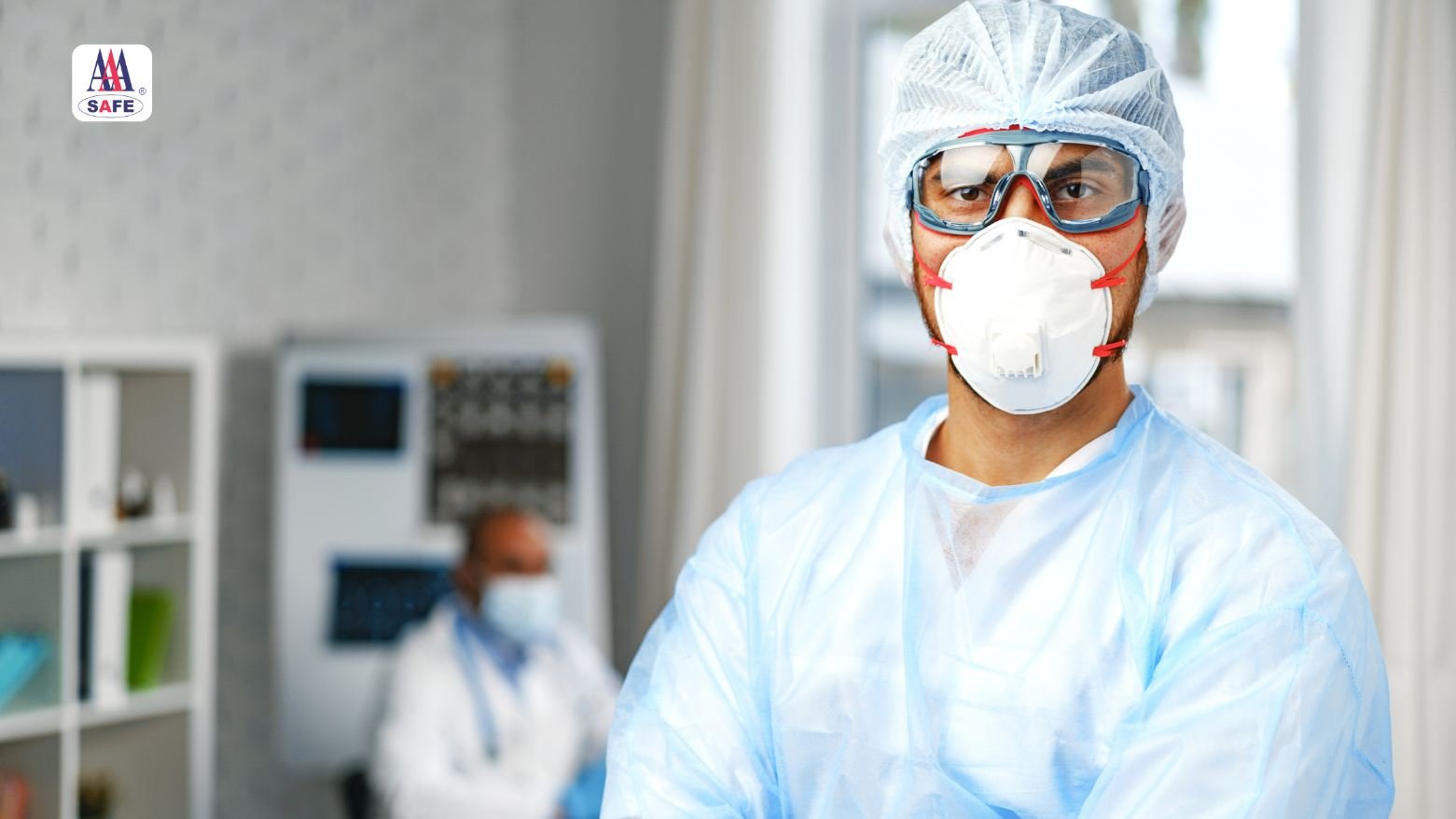
N95 or FFP2 masks form the foundation of respiratory protection for ICU staff working with infectious disease patients. These respirators filter at least 95% of airborne particles, including virus-laden respiratory droplets from coughing, sneezing, and ventilator management.
Respiratory Mask Specifications
N95 and FFP2 respirators cost AED 8-18 per unit for standard masks and AED 15-30 for mask-integrated systems. These masks must fit properly to provide adequate protection, requiring proper seal around nose and mouth without gaps, correct fit over facial contours, comfortable wear allowing extended use, and easy removal preventing self-contamination.
Fit Testing Requirements
OSHA requires fit testing for all tight-fitting respirators, including N95 masks used in ICU settings. Fit testing for ICU staff costs AED 150-250 per person and must be renewed annually or when facial changes occur.
Fit testing includes qualitative testing using taste or odor agents, quantitative measurement of actual face seal leakage, documentation of proper seal achievement, and individual customization to worker facial anatomy.
2. Eye and Face Protection (Goggles and Face Shields)
Eye protection prevents contamination through mucous membranes when respiratory droplets or blood spray occurs during high-risk procedures.
Eye Protection Options
Safety goggles cost AED 35-75 per pair and provide direct eye protection. Goggles must seal around eye orbits preventing particle entry, allow comfortable wear for extended periods, maintain clarity for precise medical procedures, and resist fogging in humid ICU environments.
Face shields cost AED 45-95 each and protect both eyes and face from splashing. Face shields must extend from forehead to below chin, provide side protection from splash hazards, allow clear visibility for clinical care, and allow easy decontamination between uses.
Combination Systems
Integrated face shield and goggle systems provide enhanced protection, costing AED 85-150 per unit. These systems allow workers to maintain full visibility while reducing contamination exposure during aerosol-generating procedures.
3. Full-Body Protection (Isolation Gowns)
Isolation gowns protect against blood and bodily fluid splashing that represents serious contamination risk in ICU environments where patients have multiple lines and frequent secretions.
Gown Material and Construction
Water-resistant gowns cost AED 25-45 per unit and provide basic splatter protection. These gowns feature liquid-resistant front panels, knit wrist and neck closures preventing entry, back closure systems preventing gaping, and full-length protection to shoe level.
Reinforced surgical gowns cost AED 40-65 per unit and provide enhanced protection for high-splash procedures. Reinforced gowns include full liquid impermeability in splash zones, reinforced seams preventing fluid penetration, extended coverage at high-splash areas, and improved durability for repeated wear procedures.
Sizing and Fit
Essential ICU PPE items every hospital needs includes correctly fitting gowns that prevent gaps during movement. Gown sizing should accommodate worker body type with length covering from neck to ankles, sleeve length reaching to wrist joints, waist sizing preventing excess fabric that could contact contamination, and adequate width allowing unrestricted movement during patient care.
4. Hand Protection (Nitrile Gloves)
Gloves prevent direct contact with blood and bodily fluids while allowing precise manual dexterity required for ICU procedures.
Glove Selection and Specifications
Double-gloving protocols are recommended for high-risk ICU procedures, using outer and inner glove layers costing AED 1-3 per pair combined. Double gloves provide contamination barrier between layers, protection if outer glove tears during procedures, ease of removing contaminated outer glove leaving inner protection intact, and enhanced protection during complex resuscitation scenarios.
Single glove systems cost AED 0.50-1.50 per pair for standard latex-free nitrile gloves used in less high-risk situations. Standard gloves must maintain tactile sensitivity for clinical procedures, resist puncture from needles and sharp equipment, provide adequate length covering wrist area, and allow rapid application and removal.
Glove Changing Protocols
Hospital staff safety equipment protocols require strict glove changing where gloves are changed between patients, changed before leaving contaminated areas, changed during procedures if torn, and followed by hand hygiene between changes.
5. Head and Hair Protection (Surgical Caps)
Head coverings prevent contamination of hair from blood spray and aerosol exposure while preventing hair from contacting sterile fields during procedures.
Cap Specifications and Materials
Disposable surgical caps cost AED 3-8 per unit and provide adequate head protection for routine ICU care. Caps must fully cover hair preventing strands from becoming exposed, feature elastic fitting maintaining position during movement, use breathable materials preventing excess heat buildup, and allow rapid application and removal.
Reinforced surgical caps with chin guards cost AED 8-15 per unit and provide enhanced protection for splash-prone procedures. These caps include full hair coverage with reinforced materials, chin coverage protecting lower face areas, extended back protection to neck base, and integrated face shield attachment options.
Heat Stress Considerations
UAE ICU environments often involve intensive care work in air-conditioned spaces where heat buildup from protective equipment becomes a concern. Lightweight, breathable head coverings help prevent excessive heat accumulation while maintaining adequate protection.
6. Foot Protection (Shoe Covers and Protective Footwear)
Foot protection prevents contamination of shoes that could carry pathogens outside patient care areas.
Shoe Cover Systems
Disposable shoe covers cost AED 5-12 per pair and slip over regular shoes providing immediate contamination barrier. Covers must fit snugly around shoe perimeter preventing gaps, feature non-slip soles preventing falls on wet floors, use breathable materials preventing moisture buildup, and allow rapid application and removal.
Permanent protective footwear cost AED 120-200 per pair and provides reusable foot protection. ICU-appropriate shoes must feature non-slip soles suitable for wet environments, allow rapid cleaning and decontamination, provide adequate support for extended standing, and allow quick removal during emergencies.
7. Respiratory Droplet and Splatter Barriers
Beyond individual items, ICU environments may require environmental controls for respiratory droplet management.
Protective Barriers and Screens
Mobile splash barriers cost AED 280-450 per unit and provide workplace engineering controls during high-risk procedures. Barriers must remain transparent allowing clinician visibility, protect from respiratory droplet splash during intubation and extubation, resist fogging in humid ICU conditions, and allow rapid repositioning for different procedures.
Transparent protective gowns with integrated shields cost AED 60-95 per unit and combine gown and barrier functions. These specialized gowns provide full-body liquid protection, integrated face shield preventing droplet exposure, clear visibility for precise care procedures, and enhanced protection during aerosol-generating procedures.
8. Glove and Gown Combinations (Full Arm Protection)
Extended arm protection prevents contamination exposure on forearms and upper arms during procedures.
Extended Sleeve Systems
Extended-cuff gowns cost AED 35-55 per unit with sleeve extensions reaching upper arm. Extended sleeves provide protection for forearms and upper arms during splashing procedures, coverage of the gown-to-glove interface preventing exposure, enhanced security where gloves overlap gown sleeves, and full arm protection during manual procedures.
Integrated sleeve-glove systems cost AED 45-75 per unit and connect gown sleeves directly to glove systems. These specialized systems ensure no gaps at wrist-to-glove junction, secure overlap preventing contamination exposure, improved comfort during extended wear, and enhanced protection during high-splash procedures.
9. Hand Hygiene and Disinfection Supplies
Proper hand hygiene before and after protective equipment use prevents self-contamination and cross-contamination.
Hand Hygiene Products
Antimicrobial soap and water represent the most effective hand cleaning method for visibly contaminated hands. Healthcare facilities must provide sinks with elbow or foot controls in all ICU areas, antimicrobial soap complying with healthcare standards, single-use paper towels for hand drying, and accessible hand washing stations near patient care areas.
Alcohol-based hand sanitizers (cost AED 20-40 per liter) work effectively for non-visibly soiled hands and are essential for rapid hand decontamination between glove changes, hand hygiene during periods when hand washing is impractical, portable use within patient care areas, and compliance with standard precautions.
Personal Decontamination
Essential ICU PPE items every hospital needs includes personal decontamination capability where staff can clean exposed skin during emergency removal. Supplies should include alcohol wipes (AED 15-30 per box of 100), hand sanitizing stations throughout ICU, and access to facilities for immediate shower or wash if significant exposure occurs.
10. Training and Proper Donning and Doffing Protocols
The most critical component of professional ICU PPE is proper training on equipment use and contamination prevention.
Donning Sequence
Correct application follows standardized sequences to prevent self-contamination.
Recommended donning sequence:
- Hand hygiene before application
- Gown application first
- N95 or FFP2 mask with proper face seal
- Eye protection (goggles or face shield)
- Gloves overlapping gown sleeves
- Head covering if not already applied
- Shoe covers if required
Doffing Sequence
Removing protective equipment requires special care to prevent self-contamination during the doffing process.
Recommended doffing sequence:
- Remove and dispose of outer gloves carefully
- Remove gown without contaminating underlying clothing
- Remove goggles or face shield
- Remove N95 or FFP2 mask handling only by straps
- Remove inner gloves if double-gloved
- Remove head coverage
- Remove shoe covers
- Hand hygiene after complete removal
Training Requirements
OSHA and DHA guidelines emphasize that proper training significantly improves protective equipment effectiveness and reduces self-contamination. Training costs typically include initial ICU PPE training at AED 400-750 per worker, annual refresher training at AED 300-500 per worker, and specialized procedure training at AED 200-400 per training type.
Looking to set up complete fit testing and training for your UAE ICU operation? AAA Safe Dubai offers certified services that meet OSHA and DHA requirements while addressing regional challenges and multilingual healthcare workforce needs.
Essential ICU PPE Components with Costs and Specifications
| PPE Component | Type and Grade | Cost per Unit (AED) | Replacement Frequency | Critical Features |
|---|---|---|---|---|
| 1. Respiratory Protection | N95 and FFP2 mask | 8–30 | Per shift or procedure | 95%+ filtration, proper seal |
| 2. Eye Protection | Safety goggles | 35–75 | 2–3 years | Full eye coverage, fog-resistant |
| 3. Face Protection | Face shield | 45–95 | 1–2 years | Forehead-to-chin coverage |
| 4. Body Protection | Isolation gown | 25–65 | Per shift or procedure | Liquid-resistant, full coverage |
| 5. Hand Protection | Nitrile gloves | 0.50–3.00 | Per procedure | Latex-free, puncture-resistant |
| 6. Head Coverage | Surgical cap | 3–15 | Per shift | Full hair coverage |
| 7. Foot Protection | Shoe covers | 5–12 | Per shift or procedure | Non-slip, full foot coverage |
| 8. Arm Protection | Extended-sleeve gown | 35–75 | Per shift or procedure | Upper arm coverage included |
| 9. Hygiene Supplies | Hand sanitizer | 20–40 per liter | Ongoing | 60%+ alcohol content |
| 10. Training and Certification | Donning and doffing course | 400–750 | Annual refresh | Hands-on practice included |
Costs represent general UAE market estimates as of 2025, including 5% VAT
Heat Stress Management for ICU Staff Wearing PPE in UAE
Hospital staff safety equipment in UAE environments must address the unique challenge of wearing full protective gear in air-conditioned ICU spaces that can trap excessive heat buildup.
Physiological Impact of Extended Use
Healthcare workers in UAE conditions face significant heat stress when wearing full protective equipment, even in air-conditioned environments. The UAE Federal Decree Law No. 33 of 2021 requires employers to put in place measures preventing heat-related illness among workers wearing protective equipment for extended periods.
Heat Management Strategies
Duty rotation schedules every 2-3 hours allow removal and recovery time. Shorter exposure periods reduce cumulative heat stress while maintaining continuous ICU staffing.
Cooling stations with air conditioning and hydration access help staff recover between rotations. Cost for basic cooling station setup is AED 2,500-4,500.
Personal cooling systems like cooling vests (AED 280-450) can be worn under protective equipment during high-stress periods, though they must not interfere with gown seals.
Better hydration protocols with electrolyte replacement drinks (AED 20-50 per liter) help maintain worker performance and prevent heat-related illness.
ICU-Specific Scenarios and Equipment Selection
Essential ICU PPE items every hospital needs vary by specific clinical scenario and risk level.
Routine ICU Care Scenario
For standard patient monitoring and care that doesn’t involve aerosol-generating procedures, equipment includes N95 mask (AED 8-15), isolation gown (AED 25-35), gloves (AED 0.50-1.50 per pair), head coverage (AED 3-8), and optional shoe covers (AED 5-12). Total per shift per worker is AED 45-80.
Aerosol-Generating Procedure Scenario
For procedures like intubation, extubation, and manual ventilation, equipment includes FFP2 respirator with fit testing (AED 15-30 per mask), full-face shield or integrated system (AED 85-150), waterproof surgical gown (AED 40-65), double gloves (AED 1-3 per pair), head covering with chin guard (AED 8-15), and shoe covers (AED 5-12). Total per procedure per worker is AED 155-275.
High-Contamination and Infectious Disease Scenario
For patients with highly infectious diseases requiring maximum protection, equipment includes Powered Air-Purifying Respirator (PAPR) system (AED 1,200-2,500), full-body protective suit (AED 75-150), double gloves with extended arm protection (AED 3-8), head and neck protection with integrated shield (AED 15-30), boot covers (AED 8-15), and hand sanitizer and hygiene supplies (AED 10-20 per use). Total per shift per worker is AED 1,324-2,748.
Investment Planning for ICU PPE Programs
Professional ICU PPE represents substantial investment in worker safety and regulatory compliance.
Annual Equipment Costs per ICU Worker
Routine ICU nursing staff require daily equipment (5 shifts per week) at AED 45-80 multiplied by 250 shifts equaling AED 11,250-20,000 annually, training and refreshers at AED 500-750 annually, and protective equipment maintenance at AED 200-300 annually. Total annual cost is AED 11,950-21,050 per worker.
ICU physicians and specialist staff require enhanced protection for procedures at AED 100-150 multiplied by 250 shifts equaling AED 25,000-37,500 annually, specialized training at AED 750-1,200 annually, and equipment maintenance and fit testing at AED 400-500 annually. Total annual cost is AED 26,150-39,200 per worker.
Infection Prevention Value
Healthcare-associated infections create significant medical, legal, and operational costs for facilities. The Dubai Health Authority emphasizes infection prevention as a critical component of healthcare quality and patient safety programs.
Proper ICU protective equipment reduces occupational exposure to infectious agents, protecting healthcare workers while maintaining high standards of patient care. OSHA identifies proper PPE as essential for preventing healthcare-associated infections and protecting worker health in high-risk environments.
Equipment Investment Justification
Healthcare facilities should evaluate protective equipment programs based on regulatory compliance, staff safety requirements, and institutional policies. The Dubai Health Authority and UAE Federal Decree Law No. 33 of 2021 require appropriate protective equipment for all healthcare workers exposed to biological hazards.
Investment in complete ICU protective equipment demonstrates institutional commitment to staff safety and supports regulatory compliance across UAE healthcare operations. Facilities should conduct regular risk assessments to ensure protective equipment programs meet current regulatory standards and clinical needs.
Ready to set up complete ICU PPE programs for your UAE healthcare facility?
AAA Safe Dubai provides full packages that maximize protection while improving costs through bulk procurement and integrated training across Dubai, Abu Dhabi, and Sharjah.
Frequently Asked Questions
The ten essential components are N95 and FFP2 respiratory masks, eye protection (goggles and face shields), isolation gowns, nitrile gloves, surgical caps, shoe covers, extended-sleeve protection, hand hygiene supplies, training materials, and proper donning and doffing protocols. Essential ICU PPE items every hospital needs includes all these components working together for complete protection.
Daily costs per worker range from AED 45-80 for routine ICU care, up to AED 155-275 for high-risk procedures, and AED 1,324-2,748 for maximum protection scenarios. Annual per-worker costs typically range from AED 11,950-39,200 depending on work intensity and risk exposure level. These represent general market estimates and should be verified with current suppliers.
Yes, certain items like protective footwear (AED 120-200 per pair), eye protection (AED 35-95), and head coverings can be reused with proper decontamination. However, respiratory masks, gowns, and gloves should be single-use to prevent contamination. Hospital staff safety equipment primarily relies on disposable components for safety.
OSHA requires fit testing annually and whenever facial changes occur, such as weight loss, dental work, or facial reconstruction. Fit testing for ICU staff costs AED 150-250 per person in UAE healthcare facilities. Proper fit verification is required annually for all respirator users.
OSHA and DHA guidelines require training covering hazard recognition, donning and doffing procedures, equipment limitations, and emergency removal protocols. Training costs AED 400-750 per worker initially, with annual refresher training at AED 300-500. Essential ICU PPE items every hospital needs must include hands-on practice with actual equipment.
The UAE Federal Decree Law No. 33 of 2021 requires heat stress management for workers wearing protective equipment. Management includes duty rotation every 2-3 hours, cooling stations with hydration access, personal cooling systems (AED 280-450), and scheduled rest breaks in air-conditioned areas. Work schedules should limit continuous wear to 4-6 hours maximum during peak heat periods.
FFP2 masks provide slightly higher filtration efficiency (95-99%) compared to N95 masks (95%), making them preferable for higher-risk procedures. Both meet international standards for respiratory protection in ICU environments. Cost difference is minimal (N95 is AED 8-15, FFP2 is AED 12-30).
No, PAPR systems (costing AED 1,200-2,500) are reserved for maximum protection scenarios involving highly infectious patients or extended aerosol-generating procedure exposure. Most routine ICU work uses standard N95 or FFP2 masks. Selection depends on specific risk scenario and DHA guidelines for the particular clinical situation.
Important Notice
This information provides general guidance on ICU protective equipment and should not be considered a substitute for professional safety consultation or regulatory advice. Requirements vary based on specific patient populations, procedures performed, and institutional policies.
UAE healthcare facilities must comply with Dubai Health Authority regulations, Department of Health Abu Dhabi requirements, Ministry of Health and Prevention directives, and applicable international standards. Requirements change frequently, and facilities must verify current compliance obligations with relevant authorities.
Essential ICU PPE items every hospital needs must be designed by qualified occupational health professionals familiar with intensive care operations, UAE environmental conditions, and international infection prevention standards. Improper equipment selection or use can result in inadequate protection, healthcare-associated infections, and worker illness.
ICU environments present complex biological hazards requiring specialized expertise. Professional safety consultation is essential for developing effective programs that protect both healthcare workers and patients. Staff must receive complete training on proper use, maintenance, and disposal of all protective equipment.
Equipment specifications, regulatory requirements, and pricing information change frequently. Information reflects general UAE healthcare market conditions as of 2025 and should be verified with current suppliers and authorities.
For professional consultation on ICU protective equipment programs designed specifically for UAE healthcare operations, contact qualified providers with demonstrated experience in intensive care environments and UAE regulatory compliance.
Conclusion
Professional ICU PPE represents your commitment to protecting the people who literally hold patients’ lives in their hands every single day. The reality is that intensive care work is extraordinarily demanding in ways most people outside healthcare can’t even imagine.
Your ICU staff are exposed to some of the most serious biological hazards in any workplace. They’re managing critically ill patients with serious infections, performing procedures that generate infectious aerosols, and often working under extreme stress with inadequate rest. Quality hospital staff safety equipment is how you show that you understand their sacrifice and you’re willing to invest in their protection.
Dubai Health Authority guidelines and UAE Federal Decree Law No. 33 of 2021 establish clear requirements for protective equipment in healthcare settings. But beyond regulatory compliance, essential ICU PPE items every hospital needs investment is about something more fundamental – it’s about trust.
Your ICU staff trust that when they come to work, they have the equipment they need to stay safe. They trust that management takes their health as seriously as they take patient care. Professional protective equipment is how you prove that trust is well-founded and that their sacrifices are valued.
I’ve learned that the best ICU operations aren’t the ones with the fanciest facilities or the newest equipment. They’re the ones where staff feels protected, supported, and valued. Where management understands that protecting workers protects patients. Where equipment selection is based on clinical need and regulatory requirements, not budget constraints alone. That’s when essential ICU PPE items every hospital needs becomes what it should be – a genuine commitment to worker and patient safety.
Your ICU staff are counted on by families who trust you with their most vulnerable loved ones. They’re counted on by your institution to maintain your reputation for clinical excellence. Complete protective equipment is the foundation of that trust and reputation. Make sure you get it right.