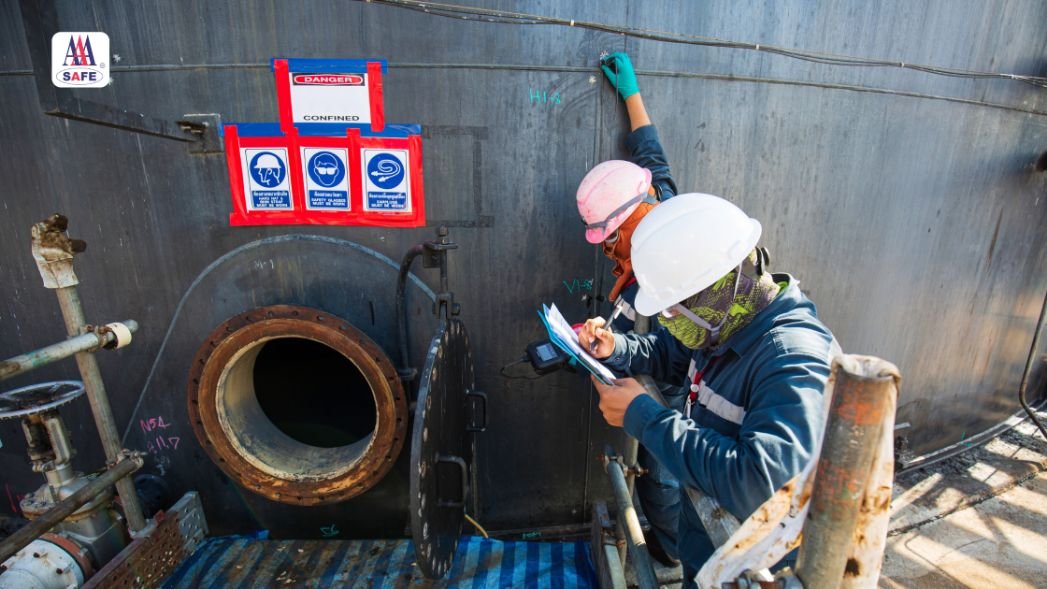
You know that moment when a worker climbs down into a storage tank to clean residue, and nobody realizes the atmosphere inside has already become deadly? It happens faster than most employers expect. One breath of hydrogen sulfide, one moment of oxygen deficiency, and what seemed like routine maintenance becomes a workplace fatality. I have seen too many incident reports from UAE operations where proper procedures could have prevented tragedy.
Here is what I have learned after years working with construction sites, oil refineries, and industrial facilities across the UAE. The companies that take these procedures seriously are the ones that never make the news for the wrong reasons. The ones that treat it as just another checkbox? They are the ones dealing with MOHRE investigations, worker compensation claims, and the lasting weight of preventable deaths.
This guide breaks down everything UAE employers need to know about working in confined spaces. We will cover the regulatory framework that applies to your operations, the permits and procedures that protect your workers, and the practical steps that separate compliant companies from those taking unnecessary risks. Whether you manage facilities in Dubai, Abu Dhabi, or anywhere across the Emirates, understanding these requirements is not optional. It is your legal and moral obligation.
Understanding Confined Spaces in UAE Operations
A confined space is not simply a small area. The definition matters because it determines which safety requirements apply to your workplace. Under UAE regulations and international standards referenced by MOHRE, a confined space has three defining characteristics. It must be large enough for a worker to enter and perform work. It must have limited or restricted means of entry or exit. And it must not be designed for continuous occupancy.
Common Confined Spaces in UAE Industries
Operations in the region encounter confined spaces in virtually every sector. Construction sites feature excavations, trenches, and building voids that meet the definition. Oil and gas facilities contain storage tanks, vessels, pipelines, and separator units. Manufacturing plants have silos, hoppers, mixing tanks, and ventilation ducts. Even commercial buildings contain elevator shafts, utility vaults, and mechanical rooms that qualify.
The regional industrial landscape creates unique challenges for working in enclosed areas. Extreme temperatures affect atmospheric conditions inside enclosed areas. High humidity accelerates corrosion that can compromise structural integrity. The diversity of industries operating across Dubai, Abu Dhabi, Sharjah, and the Northern Emirates means employers face varied confined space hazards requiring tailored approaches.
Why Confined Spaces Are Dangerous
The hazards inside confined spaces are often invisible until it is too late. Atmospheric hazards account for the majority of confined space fatalities in the UAE and globally. These include oxygen-deficient atmospheres where breathable air drops below safe levels, oxygen-enriched atmospheres that increase fire and explosion risks, and toxic gases that can incapacitate or kill within seconds.
Physical hazards compound atmospheric dangers. Workers face engulfment from loose materials like grain, sand, or liquids. Mechanical hazards from equipment that activates unexpectedly cause crush injuries. Electrical hazards from unguarded conductors create electrocution risks. Thermal hazards from extreme temperatures or steam cause burns. Falls from elevated entry points or slippery surfaces result in serious injuries.
The combination of these hazards makes working in enclosed spaces one of the most dangerous activities in any workplace. employers must recognize that these risks demand systematic controls, not casual approaches.
UAE Regulatory Framework for Confined Space Entry
The UAE Federal Decree Law No. 33 of 2021 on Regulation of Labour Relations establishes the foundation for workplace safety requirements, including confined space entry. This law places direct responsibility on employers to protect workers from occupational hazards through appropriate safety measures, training, and equipment.
Federal Requirements
Under UAE federal law, employers must conduct risk assessments for all hazardous activities including work in enclosed spaces. They must provide appropriate personal protective equipment at no cost to workers. Training in the worker’s native language is mandatory for all safety-critical tasks. Medical surveillance programs must identify workers unfit for confined space work.
MOHRE inspectors have authority to investigate incidents and issue penalties for non-compliance. Violations can result in fines, work stoppages, and in severe cases, criminal prosecution of responsible individuals.
Emirate-Specific Regulations
Dubai Municipality enforces additional requirements through its building and construction safety codes. Projects within Dubai must comply with local technical guidance that often exceeds federal minimums. Abu Dhabi follows the OSHAD System Framework which provides detailed codes of practice for these operations. OSHAD CoP 17.0 specifically addresses confined space requirements for Abu Dhabi operations.
For complete respiratory protection programs tailored to regional industrial environments, AAA Safe Dubai provides specialized solutions that meet international safety standards while addressing local challenges like extreme heat and multilingual workforces across Dubai, Abu Dhabi, and Sharjah.
Sharjah, Ajman, and the other Emirates generally follow federal requirements with local enforcement through municipal authorities. Employers operating across multiple Emirates must ensure compliance with both federal and the applicable local regulations.
International Standards in Practice
UAE authorities frequently reference international standards to establish technical requirements. OSHA’s Permit-Required Confined Spaces Standard (29 CFR 1910.146) provides detailed procedural guidance that many UAE employers adopt. British Standard BS 6164 offers specific guidance for confined space work in construction. ISO 45001 requirements for occupational health and safety management systems include confined space controls.
These international references do not replace local law but supplement it with technical specifications where regional regulations provide general requirements.
The Permit-to-Work System
The confined space entry permit is the central document controlling access to hazardous areas. This permit system ensures that every entry follows established procedures, that hazards have been identified and controlled, and that responsible parties have authorized the work.
Permit Requirements
A valid confined space entry permit must contain specific information before any worker enters the space. The following elements are mandatory.
Permit Identification Elements
| Element | Requirement | Purpose |
|---|---|---|
| Location | Exact identification of the confined space | Prevents confusion between similar spaces |
| Date and Time | Valid period with specific start and end times | Limits exposure duration and ensures fresh assessments |
| Purpose | Clear description of work to be performed | Ensures appropriate controls for specific tasks |
| Authorization | Signatures of entry supervisor and responsible manager | Establishes accountability chain |
Hazard Control Documentation
| Control Measure | Documentation Required | Verification Method |
|---|---|---|
| Atmospheric Testing | Recorded readings for oxygen, combustibles, toxics | Calibrated instruments with current certification |
| Isolation | Lock-out/tag-out verification | Physical inspection and signed isolation certificate |
| Ventilation | Airflow rate and configuration | Anemometer readings and ventilation diagram |
| Emergency Equipment | Rescue equipment location and condition | Pre-entry inspection checklist |
Permit Duration and Renewal
Permits have strict time limits. Standard practice limits permits to single shifts, typically 8 to 12 hours maximum. Any permit must be cancelled and reissued if work extends beyond the original timeframe, if atmospheric conditions change, if the scope of work changes, or if there is an emergency evacuation.
Continuous monitoring throughout the entry period ensures conditions remain within acceptable parameters. Changes in readings require immediate reassessment and potential permit cancellation.
Who Issues Permits
The permit issuing authority depends on the operation’s structure. In construction projects, the project safety officer or site manager typically holds this responsibility. In industrial facilities, the area supervisor or operations manager authorizes entry. In oil and gas operations, control room operators often coordinate permit issuance within integrated permit-to-work systems.
Regardless of the specific authority, permit issuers must have documented training in confined space hazard recognition, atmospheric monitoring, and emergency procedures.
Atmospheric Testing and Monitoring
Atmospheric hazards kill more workers in these environments than any other danger. Proper testing before and during confined space entry is not merely recommended. It is the most critical safety measure protecting your workers.
Required Tests
Every entry into a confined space requires testing for three atmospheric conditions at minimum.
- Oxygen Levels
Normal atmospheric oxygen is 20.9%. UAE regulations align with international standards requiring oxygen levels between 19.5% and 23.5% for safe entry. Levels below 19.5% indicate oxygen deficiency that can cause impaired judgment, loss of coordination, unconsciousness, and death. Levels above 23.5% create oxygen-enriched atmospheres with dramatically increased fire and explosion risks.
- Combustible Gases
Testing measures the percentage of lower explosive limit (LEL) present. Safe entry requires combustible gas concentrations below 10% of the LEL. Hot work permits require levels below 1% of LEL. Any reading above these limits demands additional ventilation, source elimination, or entry prohibition.
- Toxic Gases
Specific toxic gas testing depends on the space’s history and contents. Common requirements include hydrogen sulfide (H2S) testing for spaces that contained petroleum products, sewage, or organic materials, and carbon monoxide (CO) testing for spaces near combustion sources or vehicle exhaust.
Testing Procedures
The testing sequence matters as much as the tests themselves. Test atmospheric conditions before removing any entry covers or barriers. Test at multiple levels within the space, as gases stratify with heavier-than-air gases settling at the bottom and lighter-than-air gases rising to the top. Continue testing throughout the entry period, not just before entry begins.
Atmospheric Monitoring Equipment Costs
| Equipment Type | Cost Range (AED) | Calibration Frequency | Typical Lifespan |
|---|---|---|---|
| 4-gas portable monitor | 2,500 – 5,500 | Monthly with bump test before each use | 3–5 years |
| Single-gas H₂S monitor | 800 – 1,500 | Monthly | 2–3 years |
| Oxygen analyzer | 1,200 – 2,800 | Quarterly | 3–5 years |
| Calibration gas kit | 350 – 750 | Replace when empty | Single use |
Prices reflect UAE market conditions including 5% VAT as of 2025
Ventilation Requirements
Mechanical ventilation is often necessary to establish and maintain safe atmospheric conditions. Forced air ventilation using blowers provides the most effective control for most confined spaces. Exhaust ventilation removes contaminated air from the space. A combination of supply and exhaust creates directional airflow that continuously replaces the atmosphere.
The region’s extreme temperatures create additional ventilation challenges. Outdoor air supplied to confined spaces during summer months may exceed 50°C, creating heat stress risks even when atmospheric contaminants are controlled. Pre-cooling supply air or scheduling entries during cooler periods addresses this challenge.
Roles and Responsibilities
Effective confined space entry programs require clearly defined roles. Each person involved must understand their specific duties and the authority they hold.
Entry Supervisor
The entry supervisor holds overall responsibility for the entry operation. This individual must verify that pre-entry conditions are met, that permits are properly completed, and that all personnel understand their roles. The entry supervisor has absolute authority to cancel permits and order evacuations when conditions warrant.
Specific duties include ensuring atmospheric testing is complete and documented, verifying isolation and lock-out procedures are implemented, confirming rescue services and equipment are ready, and authorizing worker entry only when all conditions are satisfied.
Attendant
The attendant remains outside the confined space throughout the entry operation. This person maintains continuous communication with entrants, monitors for hazards external to the space, summons rescue services when needed, and prevents unauthorized entry.
Critical requirements for attendants include remaining at the entry point continuously without performing other duties, maintaining an accurate count of entrants, and never entering the space under any circumstances, even to attempt rescue.
Entrant
Workers who enter confined spaces must be trained to recognize hazards, use required equipment, and respond to emergencies. Entrants must use personal protective equipment as specified in the permit, maintain communication with the attendant, exit immediately when ordered or when they detect dangerous conditions, and alert the attendant to any problems.
Rescue Team
Does your facility have workers trained and equipped for confined space rescue? AAA Safe Dubai offers rescue equipment packages and training programs designed for UAE industrial operations, ensuring your team is prepared for emergencies across your Dubai, Abu Dhabi, or Sharjah facilities.
Rescue capabilities must be established before any entry begins. Options include on-site rescue teams trained specifically in confined space rescue, arrangements with external emergency services capable of confined space rescue, or retrieval systems that enable non-entry rescue. The choice depends on the space configuration, hazards present, and response time requirements.
Training Requirements
Worker training is a legal requirement under local law and an operational necessity for safe operations. Training must be provided before workers are assigned to these duties and refreshed periodically.
Training Content
Thorough training covers hazard recognition including atmospheric, physical, and environmental hazards. Workers learn equipment operation for monitoring devices, ventilation systems, and personal protective equipment. Permit procedures ensure workers understand documentation requirements and their specific roles. Emergency response training prepares workers to react appropriately when conditions deteriorate.
Language Requirements
The region’s multinational workforce creates language challenges for safety training. UAE Federal Decree Law No. 33 of 2021 requires training in languages workers understand. For many worksites, this means providing training materials and instruction in Hindi, Urdu, Tagalog, Bengali, and other languages common among construction and industrial workers.
Effective programs use visual aids, hands-on demonstrations, and practical exercises to overcome language barriers. Written tests should verify comprehension rather than English proficiency.
Documentation
Training records must document each worker’s participation, the topics covered, practical demonstrations completed, and competency verification. Maintain these records for the duration of employment and make them available for MOHRE inspection.
Confined Space Training Cost Estimates
| Training Type | Duration | Cost Per Worker (AED) | Validity Period |
|---|---|---|---|
| Basic awareness | 4 hours | 400 – 650 | Annual |
| Entrant certification | 8 hours | 850 – 1,200 | Annual |
| Supervisor certification | 16 hours | 1,500 – 2,200 | 2 years |
| Rescue team training | 24 hours | 2,500 – 3,800 | Annual |
Prices reflect UAE market conditions including 5% VAT as of 2025
Emergency Response and Rescue
Planning for emergencies is not pessimism. It is professional responsibility. These incidents deteriorate rapidly, and effective rescue requires advance preparation.
Rescue Planning
Every entry into these areas requires a rescue plan specific to that space. The plan must address how rescuers will reach incapacitated workers, what equipment is needed for extraction, how atmospheric hazards will be managed during rescue, and communication protocols for summoning assistance.
The plan should also identify the nearest medical facility capable of treating confined space injuries, particularly hyperbaric treatment for toxic gas exposure when applicable.
Non-Entry Rescue
Where possible, configure entries to allow non-entry rescue. This means using harnesses and retrieval lines that enable the attendant to extract an incapacitated worker without entering the space. Non-entry rescue eliminates the risk of additional casualties during rescue attempts.
Vertical entries require tripod-mounted retrieval systems or equivalent overhead anchor points. Horizontal entries may use mechanical retrieval winches or manual hauling systems depending on distance and configuration.
Entry Rescue
Some confined space configurations require rescuers to enter the space for extraction. Entry rescue teams must be trained specifically in rescue techniques, equipped with self-contained breathing apparatus or supplied air systems, and capable of reaching entrants within a timeframe appropriate to the hazards.
Employers should verify that local civil defense units have rescue capabilities before relying on external emergency services. Not all fire stations maintain this specialized capability.
Equipment Requirements
Proper equipment is essential for safe confined space entry. Cutting corners on equipment directly increases worker risk.
Personal Protective Equipment
Respiratory protection requirements depend on atmospheric conditions. For oxygen deficiency or toxic atmospheres, supplied air respirators or self-contained breathing apparatus are mandatory. Air-purifying respirators are only appropriate when the atmosphere contains adequate oxygen and specific, identified contaminants within the respirator’s protection capability.
Fall protection is required for entries with fall hazards. Full-body harnesses with attachment points compatible with retrieval systems protect workers during entry and enable rescue if needed.
Communication devices ensure continuous contact between entrants and attendants. Voice communication, hand signals, or electronic systems must be established and tested before entry.
Monitoring Equipment
Atmospheric monitors must be calibrated according to manufacturer specifications and bump tested before each use. Intrinsically safe monitors are required in potentially explosive atmospheres.
Ventilation equipment must provide adequate airflow for the space volume. Calculations should determine minimum air changes per hour based on space dimensions and contaminant generation rates.
Rescue Equipment
Retrieval systems including tripods, winches, and harnesses must be rated for the anticipated loads and tested periodically. Self-contained breathing apparatus for rescue teams requires regular inspection and maintenance.
First aid equipment appropriate to anticipated injuries should be positioned near the entry point. This typically includes oxygen administration equipment for respiratory emergencies.
Contractor Management
Many employers engage contractors for work involving enclosed spaces. This does not transfer safety responsibility entirely to the contractor. Host employers retain obligations to inform contractors of known hazards, coordinate safety requirements between multiple contractors, and monitor contractor compliance with safety procedures.
Pre-Qualification
Before engaging contractors for this type of work, verify their safety programs, training documentation, and equipment maintenance records. Request evidence of previous work in these environments without incidents.
Coordination
When multiple contractors work near confined spaces, establish clear protocols for communication and coordination. One contractor’s activities can create hazards affecting another’s workers. Welding near a confined space, for example, can deplete oxygen or introduce toxic fumes.
Monitoring
Host employers should conduct periodic verification that contractors follow established procedures. This includes observing entries, reviewing permits, and checking that trained personnel fill required roles.
Developing Your Confined Space Entry Program
Creating an effective program requires systematic assessment of your operations and development of site-specific procedures.
Inventory and Assessment
Identify all confined spaces in your operation. For each space, document the following details. What is the space used for? What hazards might be present based on that use? What are the entry and exit configurations? What work activities might require entry?
This inventory becomes the foundation for developing specific procedures and permit requirements.
Written Procedures
Document your confined space entry procedures in writing. Include general requirements applicable to all confined spaces and specific procedures for frequently entered spaces. Address atmospheric testing protocols, ventilation requirements, isolation procedures, permit processes, and emergency response.
Implementation
Train all affected personnel before implementing the program. Provide equipment and ensure calibration schedules are established. Conduct practice entries under controlled conditions to identify procedure gaps before they matter.
For comprehensive confined space safety programs tailored to UAE regulatory requirements and operational conditions, AAA Safe Dubai delivers equipment, training, and consultation services that protect your workforce across facilities in Dubai, Abu Dhabi, and throughout the UAE.
Review and Improvement
Review your program at least annually and after any incident or near-miss. Incorporate lessons learned and update procedures as operations change. Solicit feedback from workers who perform entries into these spaces, as they often identify practical improvements.
Cost Considerations
Implementing proper procedures requires investment. However, the costs of compliance are modest compared to incident consequences.
Compliance Costs
Equipment costs for a typical industrial operation range from AED 15,000 to AED 50,000 for initial setup depending on the number of spaces and frequency of entries. Annual training costs run AED 800 to AED 2,500 per worker depending on their role. Ongoing calibration and maintenance add AED 3,000 to AED 8,000 annually.
Non-Compliance Costs
MOHRE penalties for safety violations can reach AED 50,000 or more per violation. Work stoppage orders halt revenue-generating operations. Civil liability for worker injuries or deaths can extend to millions of dirhams. Criminal prosecution of responsible individuals is possible in cases of gross negligence.
The arithmetic strongly favors compliance.
Frequently Asked Questions
A confined space is any area large enough for a worker to enter and perform work, with limited or restricted means of entry or exit, that is not designed for continuous occupancy. Common examples include storage tanks, vessels, silos, pits, trenches, tunnels, and utility vaults. The definition does not depend on physical size but on these three characteristics.
Initial testing is required before entry and must be documented on the permit. Continuous monitoring throughout the entry period is strongly recommended and required by many UAE facility operators. At minimum, testing should be repeated whenever there is a break in work, when new workers enter, when work activities change, or when ventilation conditions change. Most operations in Dubai and Abu Dhabi require continuous monitoring with alarming instruments.
No. UAE regulations require documented authorization for all confined space entries. The permit system ensures hazards are identified, controls are implemented, and responsible parties have verified conditions before entry. Some operations distinguish between permit-required confined spaces with serious hazards and spaces where simplified procedures apply, but documentation is always required.
Permit issuers must be trained in confined space hazard recognition, atmospheric monitoring interpretation, and emergency procedures. In construction, the project safety officer or site manager typically holds this authority. In industrial facilities, area supervisors or operations managers authorize entry. The specific authority depends on company procedures, but the issuer must have documented competency.
MOHRE can impose fines up to AED 50,000 or more per violation depending on severity. Repeated violations can result in work stoppages, license suspensions, and increased inspection frequency. In cases of worker injury or death, criminal prosecution of company officials is possible. Civil liability for damages can reach substantial amounts depending on circumstances.
Contractors performing work in confined spaces must have their own documented programs, trained personnel, and appropriate equipment. However, host employers retain responsibility to inform contractors of known hazards, coordinate safety requirements, and monitor compliance. When contractors and host employer personnel work together, clear protocols must establish who holds what responsibilities.
Rescue capability must be established before entry begins. Options include trained on-site rescue teams, arrangements with external emergency services, or retrieval systems enabling non-entry rescue. The appropriate choice depends on space configuration, hazards present, and response time requirements. Many UAE fire departments have limited confined space rescue capability, so employers should verify external service capabilities before relying on them.
Local regulations require periodic refresher training, typically annually for entrants and attendants. Supervisor training may have longer validity periods of two years or more depending on the certifying organization. Practical skills including atmospheric monitor operation and rescue equipment use require regular reinforcement. Documentation must show current training for all personnel assigned to confined space duties.
Required PPE depends on identified hazards. Respiratory protection ranges from air-purifying respirators to self-contained breathing apparatus depending on atmospheric conditions. Fall protection is mandatory where fall hazards exist. Heat stress considerations in UAE climate often require cooling vests or scheduled rest breaks. Communication devices ensure continuous contact with attendants. Specific requirements must be documented on entry permits.
Start by identifying all confined spaces in your operation and assessing hazards for each. Develop written procedures covering atmospheric testing, ventilation, isolation, permits, and emergency response. Train all affected personnel before implementation. Ensure equipment is available and properly maintained. Review the program annually and after any incidents. Consider engaging qualified safety consultants familiar with UAE regulatory requirements for program development.
Important Notice
This information provides general guidance on working in confined spaces and should not be considered a substitute for professional safety consultation or regulatory advice. Requirements vary based on specific industry sectors, workplace conditions, and local regulations.
UAE operations must comply with Federal Decree Law No. 33 of 2021, applicable emirate-level regulations, and industry-specific standards. Requirements change periodically, and employers must verify current compliance obligations with relevant authorities including MOHRE and local municipalities.
Confined space entry programs must be designed by qualified professionals familiar with atmospheric hazards, rescue procedures, and UAE regulatory requirements. Improper procedures can result in worker fatalities, regulatory penalties, and civil liability.
Equipment specifications, costs, and availability change frequently. Pricing information reflects general UAE market conditions and should be verified with current suppliers.
For professional consultation on these requirements, contact qualified safety professionals with demonstrated experience in UAE industrial operations and regulatory compliance.
Looking Ahead
The companies that treat confined space entry as a core operational discipline rather than a paperwork exercise are the ones protecting their workers effectively. They invest in proper equipment, train their people thoroughly, and follow procedures consistently. They understand that the few thousand dirhams spent on compliance prevents the millions in liability, the regulatory penalties, and most importantly, the preventable loss of human life.
UAE employers have clear obligations under Federal Decree Law No. 33 of 2021 and applicable emirate regulations. Meeting these obligations is not complicated when approached systematically. The requirements exist because confined spaces have killed workers who were not protected by proper procedures. Your workers deserve that protection.
Take the time to assess your operations, develop appropriate procedures, train your personnel, and implement the controls that confined space entry demands. The investment is modest compared to the value of returning every worker home safely at the end of each shift.