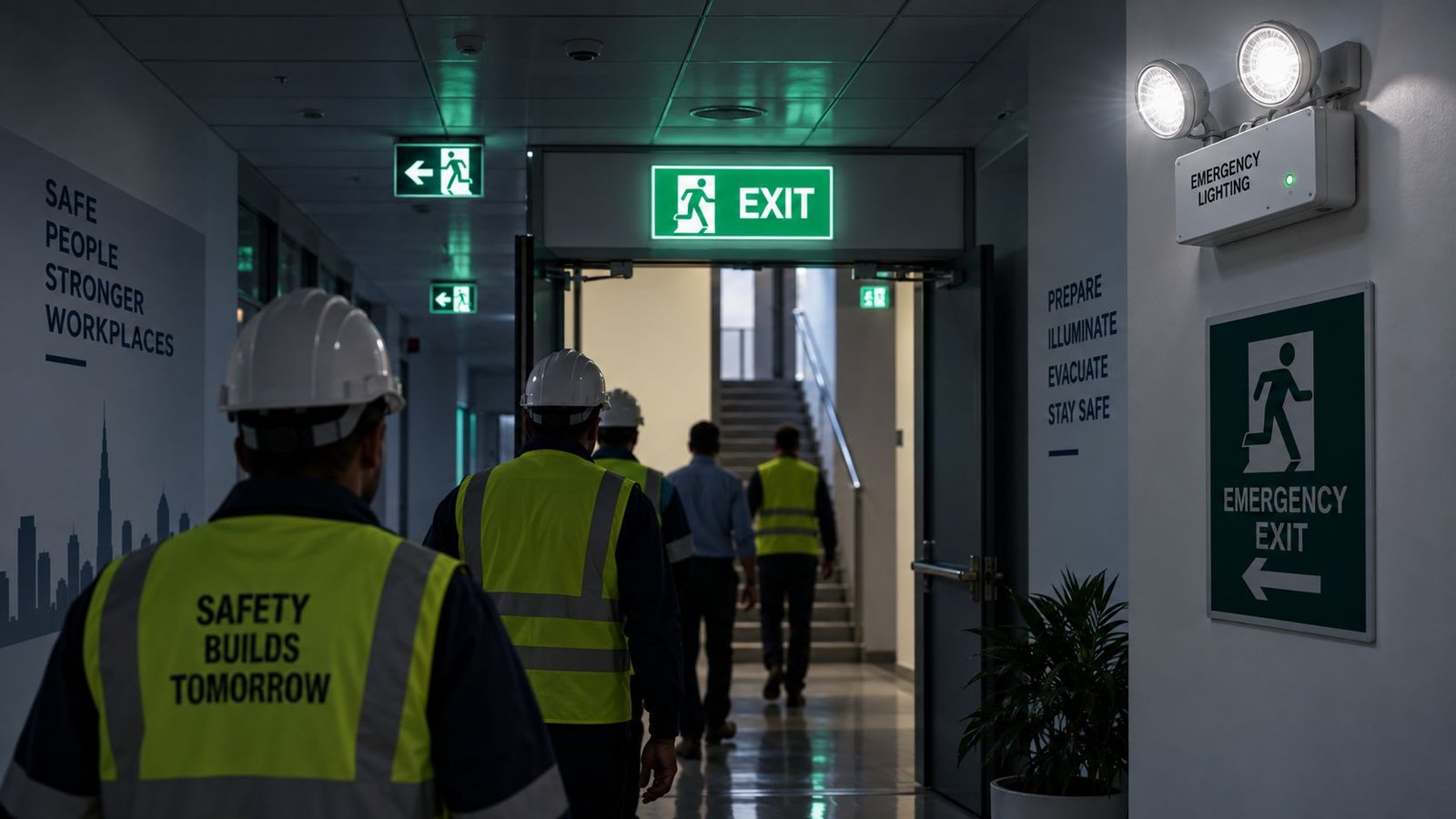
A fire alarm means little to people who cannot see the exit. Emergency lighting is the system that keeps escape routes visible the moment normal power fails, whether the cause is a fire, an electrical fault, or a grid outage. In a commercial tower, hotel, or industrial facility across the UAE, the interval between power loss and full evacuation is often measured in seconds of usable light, not minutes of planning.
Many facility managers treat emergency lighting as a fit and forget system installed once during construction. That approach fails because batteries degrade, fittings get blocked by later fit outs, and testing schedules lapse once the building is occupied and operational.
What Emergency Lighting Actually Needs to Do
Emergency lighting is not a single fixture type. It covers escape route lighting along corridors and stairwells, open area or anti panic lighting in larger undivided spaces, and high risk task area lighting wherever a process needs to be safely shut down before anyone leaves. Internationally referenced standards such as EN 1838, which many UAE consultants and civil defence approved contractors design against, set a minimum illumination along the centre line of an escape route and a maximum to minimum uniformity ratio so that light levels do not drop into unusable dark patches partway down a corridor.
Escape Route Lighting
This is the lighting most people picture, fittings above doors, at turns, and along the length of corridors and stairwells. Its job is narrow and specific, to keep the route to a final exit visible enough to walk quickly and safely.
Open Area Lighting
Larger undefined spaces such as warehouse floors, retail floors, and open plan offices need broader illumination so that people are not funnelled into panic at a single doorway. This is often the most overlooked category during retrofits because open floor plans get subdivided by furniture and partitions after the original design was approved.
High Risk Task Area Lighting
Any workstation involved in a hazardous process such as machine operation, chemical handling, or hot work needs enough light for the operator to safely stop the task before joining the general evacuation. This category is frequently missed in offices that later add a workshop, lab, or plant room without updating the lighting plan.
Backup Power and Testing
An emergency light is only as reliable as the power source behind it. Most systems rely on self-contained batteries inside each fitting or a centralised battery bank feeding multiple fittings. Either approach depends on a testing regime, since a battery that has silently failed provides no warning until the moment it is needed most.
Routine Testing Intervals
A short functional test, briefly interrupting mains supply to confirm each fitting switches over, should run monthly. A full duration test, confirming the system holds adequate illumination for its rated period, typically one to three hours depending on building use, should run annually at minimum. Facilities with higher occupancy or 24 hour operations often test more frequently.
Recordkeeping
Dubai Civil Defence and equivalent civil defence authorities in other emirates expect testing records to be available on request during inspections and licence renewals. A logbook or digital record showing test dates, results, and any corrective action taken is the standard evidence requested.
Equipment That Supports an Evacuation Beyond Lighting
Lighting shows people the way out. It works best paired with equipment that helps staff confirm an evacuation is underway and coordinate movement once power is lost.
Audible and Visual Alarms
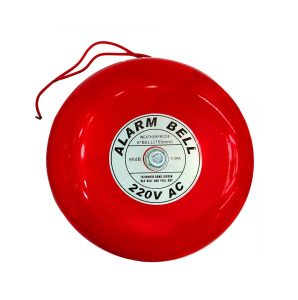
A smoke alarm integrated with the building system is the first trigger, but standalone facilities and temporary sites often supplement this with a portable hand siren for manual activation where automatic detection has not yet been installed or during construction phases before permanent systems are commissioned.
Wayfinding for Larger Sites
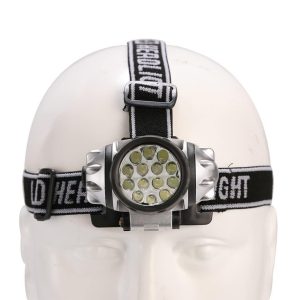
On sites where the evacuation route crosses open yards or between buildings, a rechargeable head lamp kept at fire warden stations lets marshals move through unlit areas to confirm rooms are clear, a task that fixed emergency lighting alone cannot cover.
Communication During Evacuation
For larger facilities, a megaphone at the assembly point lets marshals direct movement and issue instructions once occupants are outside, particularly useful when normal PA systems lose power along with the rest of the building.
UAE Fire and Life Safety Requirements
Dubai Civil Defence enforces the UAE Fire and Life Safety Code, which sets requirements for fire detection, alarm, and emergency lighting systems in buildings across the emirate, with equivalent codes applied by Abu Dhabi Civil Defence and other emirate authorities. Compliance is checked at building completion and again during periodic licence renewal inspections, and any change of use or internal fit out that affects escape routes typically requires the emergency lighting layout to be reassessed rather than assumed to still be adequate.
Facilities undergoing renovation, a change of tenant, or the addition of new internal partitions should treat emergency lighting review as part of that project scope, not an afterthought handled after occupancy. AAA Safe Dubai stocks smoke alarms, sirens, and emergency lighting support equipment meeting recognised standards. Our team provides itemised quotations covering equipment and installation coordination across the UAE.
Frequently Asked Questions
This depends on building classification and use, but one to three hours of sustained illumination is the common range referenced by civil defence approved designs in the UAE, with high occupancy buildings often specified at the higher end.
Responsibility is usually set out in the lease agreement, but ultimate compliance with civil defence requirements rests with the building owner or the licensed occupier of the space, so this should be confirmed in writing rather than assumed.
The illumination categories are the same in principle, but the layout and number of fittings scale with the size and complexity of the space. A small office may need only escape route lighting, while a large warehouse typically needs open area and high risk task lighting as well.
Depleted or failed batteries that were not caught by a routine test, followed by fittings obstructed or removed during later renovations without updating the lighting plan.
Yes. Emergency lighting must activate on any loss of normal power supply regardless of time of day, since windows and skylights do not reliably provide safe evacuation lighting in every part of a building.
Disclaimer
This article provides general information on emergency lighting practices and does not replace a fire safety engineer’s assessment or legal advice. For authoritative requirements, refer to Dubai Civil Defence, Abu Dhabi Civil Defence, and Dubai Municipality. Always engage a licensed fire safety contractor for design, installation, and certification.