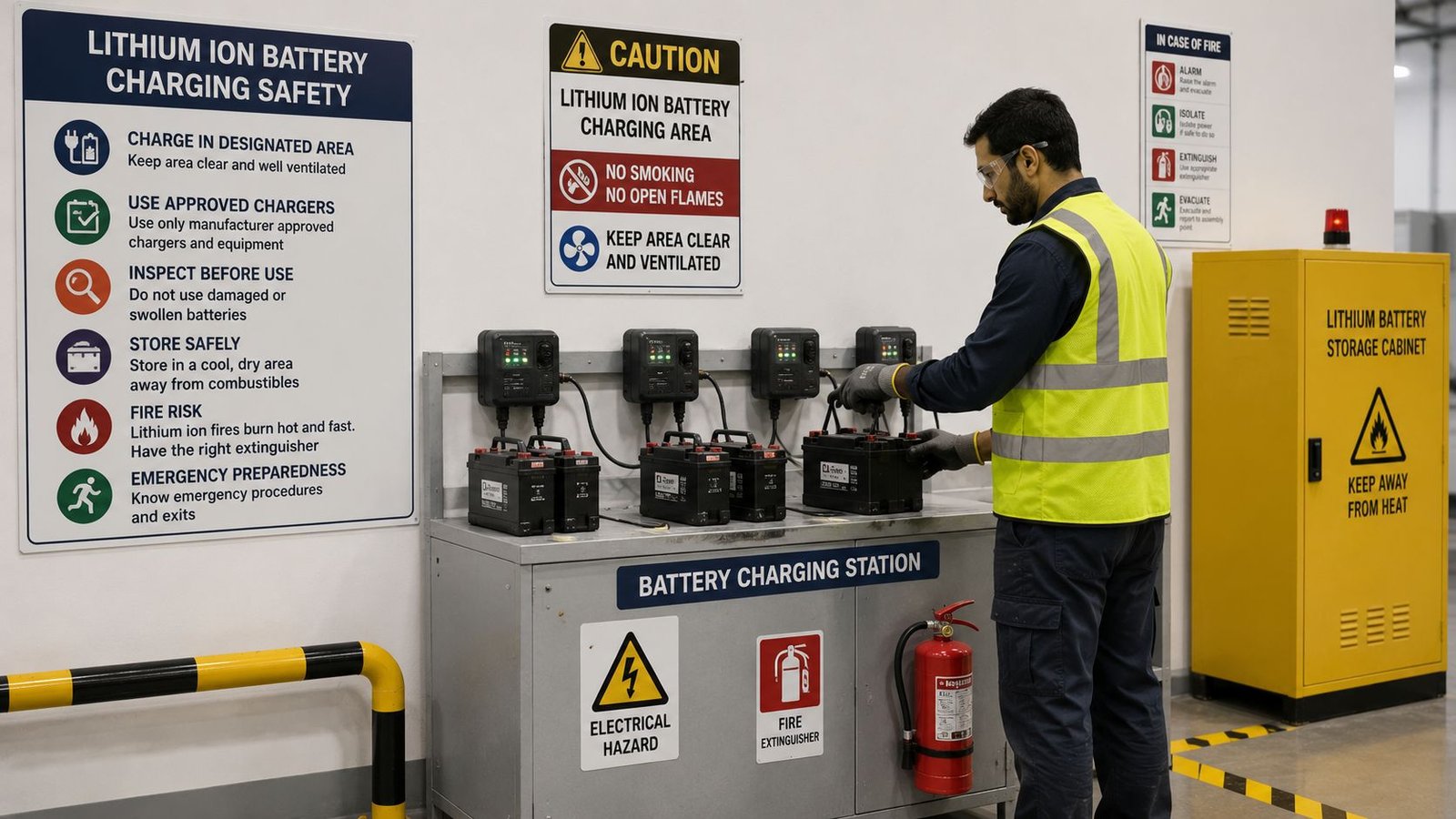
Lithium-ion batteries power an increasing share of UAE warehouse and logistics equipment, from electric forklifts and pallet trucks to handheld scanners and cordless tools. They are efficient and low maintenance compared to older battery chemistries, but they carry a fire risk that behaves differently from a conventional fire, and most sites that adopt this equipment do not update their fire response planning to match.
Why Lithium Ion Battery Fires Are Different
A lithium-ion battery fire is driven by a process called thermal runaway, where a cell overheats, triggers a chemical reaction that generates more heat, and that heat cascades to neighbouring cells. Once thermal runaway starts in earnest, it is very difficult to stop with conventional firefighting methods, since the reaction generates its own oxygen internally and can reignite even after the visible flame appears extinguished. This is why prevention and early detection matter far more for lithium battery fires than for most other workplace fire risks, where suppression alone is often sufficient.
What Triggers Thermal Runaway
Physical Damage
A battery that has been dropped, crushed, or punctured can suffer internal damage that is not visible from the outside, and that damage can trigger thermal runaway hours or even days after the impact. Any battery involved in a drop or impact should be treated as suspect and isolated, not returned immediately to normal charging and use.
Overcharging and Incorrect Chargers
Using a charger not matched to the specific battery, or a charger with a faulty charge-cut-off function, can push a battery beyond its safe voltage limit. Only chargers supplied or approved for the specific battery and equipment should be used, and mismatched chargers found on site should be removed immediately.
Extreme Heat Exposure
Charging or storing batteries in direct sun exposure or in an unventilated space that traps heat, both realistic conditions across much of the UAE outside of climate-controlled facilities, increases the baseline temperature the battery is operating at, reducing its safety margin before thermal runaway conditions are reached.
Designing a Safer Charging Area
Location and Ventilation
Charging areas should be located away from high-occupancy zones and combustible material storage, with ventilation adequate to prevent heat and any off-gassing from accumulating. A dedicated charging bay, rather than charging equipment scattered wherever a power outlet happens to be available, makes both ventilation and fire response planning far more manageable.
Spacing Between Charging Units
Spacing charging equipment apart, rather than clustering multiple units close together, reduces the chance that a single failing battery ignites its neighbours through radiant heat, which is a key mechanism in how a single-cell failure escalates into a larger fire.
Fire Detection in the Charging Area
Early detection matters more than suppression once thermal runaway has started, which makes a functioning smoke alarm in the charging area a priority control, giving staff the earliest possible warning to isolate other equipment and evacuate the immediate area.
Fire Response Equipment for Lithium Battery Fires
Extinguisher Selection
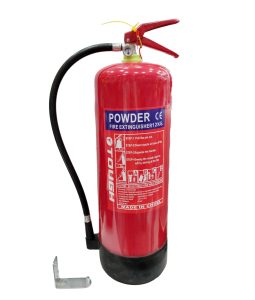
Conventional dry chemical extinguishers can help control surface flame but do not reliably stop thermal runaway inside the cells themselves. A CO2 fire extinguisher is commonly used as a first response for battery-related electrical fires because it does not leave a conductive residue, though facilities with significant lithium battery inventory should discuss specialist extinguishing agents with a fire safety consultant given how differently these fires behave compared to conventional combustible material fires.
Containment Equipment
A fire blanket can help contain and smother a small, contained battery fire in its early stage, and having one positioned near handheld device charging stations gives staff an immediate first response option before a larger extinguisher or evacuation is needed.
Fixed Suppression for Larger Facilities
Warehouses running fleets of electric forklifts or pallet trucks should have a fire hose reel accessible near the charging bay as part of the broader fire response plan, since a fire involving multiple battery units at once can exceed what a portable extinguisher can control.
Storage and Damaged Battery Handling
Batteries not currently in use or charging should be stored in a cool, ventilated area away from combustible material, and any battery showing swelling, unusual heat, an odd smell, or visible damage should be removed from service immediately and isolated in a non-combustible container away from other stock rather than left in place pending disposal. Damaged batteries should never be charged, and disposal should follow the battery supplier’s or a licensed hazardous waste handler’s guidance rather than standard waste streams.
Staff Training and Emergency Procedure
Staff working around battery charging areas need to know the early warning signs of a failing battery, including unusual heat, swelling, hissing, or smoke, and understand that the correct response is to evacuate the immediate area and raise the alarm rather than attempt to move or handle a battery showing these signs. A rehearsed evacuation procedure specific to the charging area, distinct from the general building evacuation plan if the charging bay is in a separate location, ensures staff know the fastest safe route out if a battery fire develops quickly.
UAE Regulatory Context
Fire safety obligations for facilities handling lithium-ion battery equipment fall under the UAE Fire and Life Safety Code enforced by Dubai Civil Defence and equivalent codes applied by civil defence authorities in other emirates, alongside general workplace safety obligations under MOHRE and emirate occupational safety frameworks such as OSHAD-SF. As lithium battery equipment adoption grows across UAE logistics and warehousing, facilities should confirm with their civil defence approved fire safety consultant whether their current fire risk assessment and suppression provisions have been updated to reflect this equipment, since many existing assessments predate large-scale battery equipment adoption on site.
AAA Safe Dubai supplies fire extinguishers, fire blankets, and detection equipment suited to battery charging areas. Contact our technical team for a fire response equipment recommendation matched to your charging setup.
Frequently Asked Questions
Water can help cool surrounding material and reduce fire spread but does not reliably stop thermal runaway inside the battery cells themselves. Specialist guidance should be sought for facilities with significant battery inventory rather than relying on water alone as the primary response.
Thermal runaway can be triggered hours or even days after physical damage occurs, which is why any battery involved in a drop or impact should be isolated and monitored rather than assumed safe simply because no immediate problem was visible.
Unattended overnight charging increases risk because a developing fault has no one present to notice early warning signs. Facilities should weigh this against practical charging schedules and ensure detection equipment such as smoke alarms is in place to compensate for reduced supervision.
Unusual heat, swelling of the battery casing, a hissing sound, an unusual smell, or visible smoke are all early warning signs. Any of these should trigger immediate evacuation of the immediate area and isolation of the battery rather than continued monitoring at close range.
The same thermal runaway mechanism applies regardless of battery size, though the scale of a resulting fire differs. Handheld device charging stations still warrant the same core precautions around ventilation, spacing, and detection, scaled to the smaller footprint involved.
Disclaimer
This article provides general information on lithium-ion battery charging safety and does not replace a professional fire risk assessment or legal advice. For authoritative fire safety requirements, refer to Dubai Civil Defence and Abu Dhabi Civil Defence. Always consult a licensed fire safety consultant to assess your specific charging setup and battery inventory.