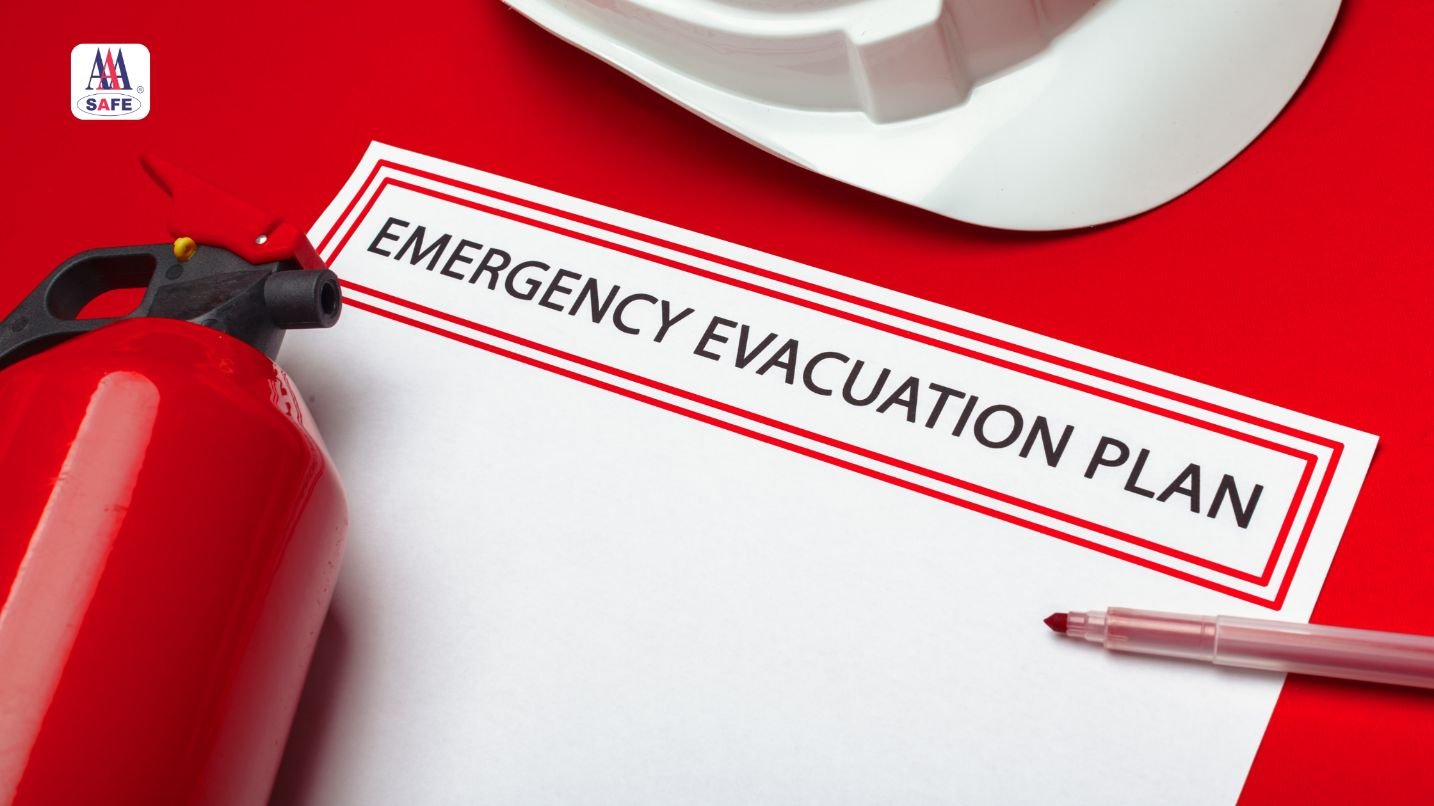
When the alarm sounds and workers need to exit your building, the difference between a controlled, safe evacuation and dangerous chaos comes down to one thing: a proper emergency evacuation plan. I learned this lesson watching a warehouse in Dubai Industrial City empty in under four minutes during a drill last year. Every worker knew exactly where to go. Compare that to a facility I visited the following month where an unannounced drill took 12 minutes and left three workers unaccounted for because nobody had assigned assembly point responsibilities.
Here is what separates workplaces that handle emergencies well from those that create additional danger through poor preparation. The companies with strong safety records treat their evacuation procedures as a living document that gets practiced, refined, and taken seriously. The ones that struggle? They created a plan once, filed it away, and forgot about it until an actual emergency exposed every gap.
This guide walks you through exactly how to create evacuation procedures that meet UAE regulations, protect your workforce, and actually work when emergencies happen. Whether you operate in Dubai, Abu Dhabi, Sharjah, or elsewhere in the Emirates, these requirements apply to your facility.
Understanding Your Legal Obligation in the UAE
Before diving into practical steps, you need to understand that creating evacuation procedures is not optional. It is a mandatory legal requirement under UAE law that carries significant penalties for non-compliance.
The Regulatory Framework
UAE Federal Decree Law No. 33 of 2021 on labor relations obligates employers to provide safe work environments and take all necessary precautions to protect employees from hazards including fire, explosion, and injury. This legal obligation directly requires development of evacuation procedures.
The Abu Dhabi Occupational Safety and Health System Framework establishes detailed requirements through ADOSH-SF Element 6 for emergency management. ADOSH-SF specifically requires that employers develop plans commensurate with their operations and risks, include appropriate procedures and escalation tiers, and conduct periodic testing and review.
The UAE Fire and Life Safety Code of Practice mandates that all commercial, residential, and industrial buildings maintain clearly marked emergency exits, evacuation plans displayed prominently on every floor, and functioning fire alarms with voice evacuation systems. This code applies throughout the Emirates regardless of emirate.
Each emirate maintains its own Civil Defence authority. Dubai Civil Defence, Abu Dhabi Civil Defence, and Sharjah Civil Defence each have specific requirements for emergency preparedness. These authorities must approve plans for high-risk facilities.
Consequences of Non-Compliance
Workplaces operating without approved plans face regulatory fines ranging from AED 5,000 to AED 50,000, potential facility closures, and civil liability for injuries occurring during emergencies. Insurance coverage may be denied for incidents in facilities without documented evacuation procedures. MOHRE inspectors verify compliance during workplace visits, and violations result in citations requiring immediate corrective action.
Step 1: Conduct a Hazard Assessment
Creating effective evacuation procedures starts with understanding what emergencies your specific workplace might face. Different facilities have different risks, and your plan must address actual hazards rather than generic possibilities.
Identify Potential Emergency Scenarios
Walk through your entire facility with a focused goal of identifying every scenario that could require rapid evacuation. Consider fire from electrical equipment, machinery, chemicals, or human error as the most common emergency requiring evacuation. Evaluate explosions from pressurized containers, chemical reactions, or accumulation of flammable vapors in enclosed spaces.
Assess chemical spills or releases affecting air quality, gas leaks from natural gas or industrial gases, structural failures from building damage or equipment collapse, flooding from burst pipes or extreme weather, and medical emergencies requiring emergency services access.
For UAE-specific considerations, evaluate sandstorms affecting visibility and air quality, extreme heat events that may affect building systems, and flash flooding in vulnerable areas during winter months.
Document High-Risk Areas
Identify specific areas where hazards are concentrated. High-risk zones typically include equipment rooms with machinery or electrical systems, chemical storage areas, kitchens with fire hazards, mechanical rooms with natural gas or pressurized equipment, electrical switchrooms or generator areas, and areas near loading docks where vehicle accidents could occur.
For each high-risk area, note what emergency scenarios are most likely, document existing safety systems already in place, and identify gaps where additional measures are needed.
Consider Your Workforce Composition
Planning must account for the specific population you are evacuating. Consider workers with mobility limitations who may need additional assistance, non-Arabic or non-English speaking workers who may not understand standard announcements, pregnant workers or those with temporary mobility restrictions, workers with hearing or vision impairments, and visitors or contractors unfamiliar with the facility.
ADOSH-SF specifically requires development of Personal Emergency Evacuation Plans for workers with special needs. Each person needing additional support must have a documented plan detailing their normal location, specific assistance needed, designated buddy persons, and customized step-by-step procedures.
Step 2: Map Evacuation Routes and Assembly Points
With hazards documented, you can now identify how people will safely exit your building and where they will gather once outside.
Design Multiple Evacuation Routes
The UAE Fire and Life Safety Code requires at least two independent exit routes from every occupied area. Exit routes must be continuous from the occupied area to a safe public way. Routes cannot pass through kitchens, bathrooms, or other dead-end areas.
| Requirement | Standard | Notes |
|---|---|---|
| Doorway width | Minimum 0.9 meters | All exit doors |
| Corridor width | Minimum 1.1 meters | Clear passage required |
| Emergency lighting | Minimum 10.8 lux | Battery backup required |
| Signage | English and Arabic | Illuminated EXIT signs |
| Door operation | Outward swing | Panic bars for 50+ occupants |
Identify Assembly Points
An assembly point is a designated outdoor area where evacuated occupants gather for headcount and accountability. Assembly points must be positioned at least 30 meters from the building exterior to avoid falling debris or returning smoke. They should be located upwind of the building when possible and large enough to accommodate all building occupants simultaneously.
Facilities should identify both primary and secondary assembly points. If an emergency affects the primary point, staff must be able to move to the secondary location. Document assembly points on evacuation maps and communicate them regularly to staff.
For professional assistance developing evacuation routes and assembly point configurations for your facility, AAA Safe Dubai provides emergency planning consultation services for workplaces across Dubai, Abu Dhabi, and Sharjah.
Create Evacuation Maps
Evacuation maps must show floor layout with room labels, exit locations and escape routes clearly marked with arrows, fire extinguisher locations, first aid kit locations, AED defibrillator locations, fire alarm pull stations, and assembly areas.
Maps must be posted prominently at main entrances, on every floor in visible locations, in break rooms, on each elevator lobby, and in common areas where people congregate. Use standard symbols and directional arrows with both English and Arabic text.
Step 3: Develop Written Procedures
Documentation is non-negotiable. ADOSH-SF requires that evacuation procedures be documented in writing with clear, detailed steps that any worker can follow during high-stress situations.
Define Step-by-Step Procedures
Your written procedures should detail exactly what happens from the moment an emergency is discovered.
Initial Response
Anyone discovering an emergency situation must immediately raise the alarm. Define what raising the alarm means at your facility. This could mean pulling the fire alarm, activating voice announcement systems, or calling specific personnel.
Staff who are in immediate danger must evacuate immediately without waiting for confirmation. Staff who discover emergencies in non-threatening locations should follow communication procedures to alert others while moving toward exits.
Alarm Communication
Define what message will be announced. Standard practice uses fire alarm systems with voice evacuation capability providing clear instructions such as: “Attention all personnel. A fire emergency has been reported. Evacuate the building immediately. Do not use elevators. Proceed to your designated assembly point.”
Designate specific personnel trained in emergency communication. Define how information will be relayed to different areas including isolated spaces like storage rooms, maintenance areas, and outdoor work zones.
Systematic Evacuation
Define how evacuation will be organized and controlled. Floor wardens are responsible for ensuring all persons in their areas evacuate, conducting headcounts, and directing personnel toward exits. Upon hearing the evacuation alarm, personnel must stop work, close non-essential doors, and proceed to the nearest exit.
Assembly Point Procedures
Upon reaching the designated assembly point, personnel must report to their supervisor or department representative. Floor wardens and supervisors conduct headcounts and account for all personnel in their areas. Report any missing persons immediately to the Evacuation Coordinator. Personnel remain at assembly point until authorized to return to the building.
Define Roles and Responsibilities
Every person in your organization should understand their role during an emergency.
Key Evacuation Roles
| Role | Primary Responsibilities | Backup Required |
|---|---|---|
| Evacuation Coordinator | Overall coordination, emergency services liaison, re-entry authorization | Yes |
| Floor Wardens | Area sweeps, headcounts, personnel direction, missing person reports | Yes (per area) |
| Evacuation Assistants | Support for workers with mobility limitations per PEEP requirements | Yes |
| First Aid Personnel | Medical assistance during and after evacuation | Yes |
| Communications Officer | Internal announcements, external emergency contact | Yes |
Every employee should understand their primary and secondary evacuation routes, location of their nearest exit, assembly point location, who their floor warden is, and what they should bring or leave behind.
Develop Personal Emergency Evacuation Plans
ADOSH-SF mandates Personal Emergency Evacuation Plans for any worker with disabilities or special needs affecting evacuation ability. For each person requiring a PEEP, document their specific needs and limitations, identify two designated buddies who will provide assistance, define exactly what assistance is needed, and develop step-by-step procedures specific to that person.
Ensure the person is consulted on plan development and agrees with procedures. Practice PEEP procedures during all drills.
Step 4: Install and Maintain Emergency Equipment
Evacuation procedures are only as good as the equipment and systems supporting them. UAE regulations specify minimum requirements for all workplace facilities.
Fire Alarm Systems
Fire alarms must be installed throughout your facility per UAE Fire and Life Safety Code requirements. Systems should include manual pull stations in accessible locations near exits and hallways, automatic detection systems with heat and smoke detectors, voice evacuation capability providing clear announcements, audible alarm signals at 85+ decibels heard throughout the facility, and visual alarm signals for hearing-impaired workers.
Systems require battery backup ensuring function during power loss, professional monitoring by licensed contractors, and regular testing per code requirements with documented inspection records.
Emergency Lighting
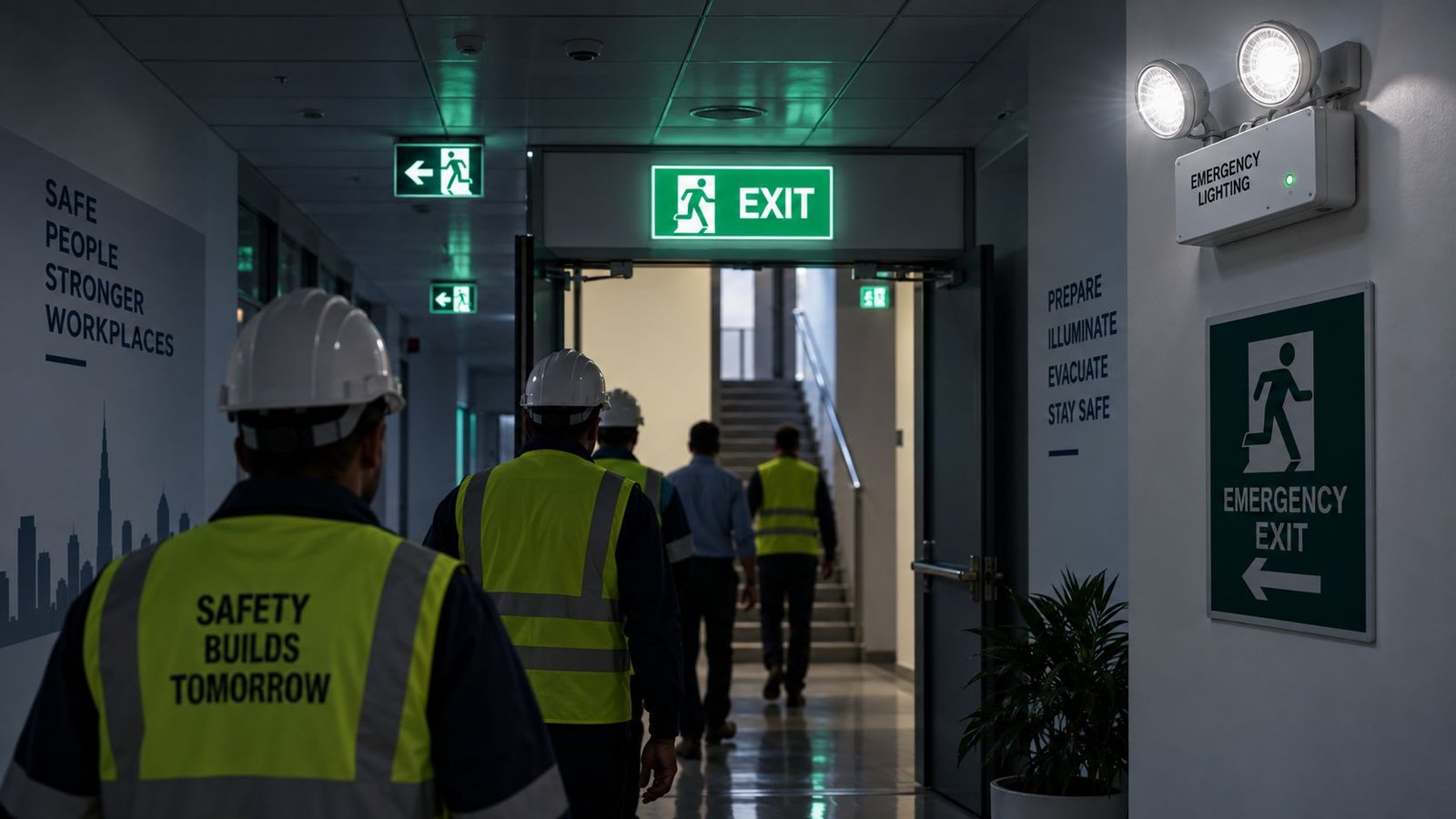
Emergency lighting must illuminate evacuation routes during power loss. Exit sign lights require battery backup. Pathway emergency lights must be positioned along evacuation routes and in stairwells. Emergency lighting must provide minimum 10.8 lux of illumination and operate for minimum 90 minutes during power loss.
Fire Suppression Equipment
Fire extinguishers must be installed throughout the facility in easily accessible locations identified with appropriate signage. Different extinguisher types are required based on fire hazards present.
Fire Extinguisher Requirements
| Extinguisher Type | Hazard Class | Placement | Cost Range (AED) |
|---|---|---|---|
| ABC Dry Chemical | Multi-purpose | General areas | 80–150 |
| CO2 | Electrical fires | Equipment rooms | 200–400 |
| Wet Chemical | Kitchen fires | Food preparation areas | 300–500 |
| Clean Agent | Electronics | Server rooms, data centers | 500–1,200 |
Prices reflect UAE market conditions including 5% VAT as of 2025
Does your facility need a complete emergency equipment assessment? AAA Safe Dubai provides fire safety audits and equipment supply for workplaces throughout Dubai, Abu Dhabi, and Sharjah, ensuring compliance with Civil Defence requirements.
Step 5: Train All Employees
Evacuation procedures exist on paper only until people understand them and practice them. Training is legally required and absolutely essential for effective emergency response.
Initial Induction Training
Every new employee must receive emergency evacuation training before beginning work. Training should cover location of emergency exits and alternative exits, evacuation route from their specific work area, assembly point location and procedures, fire alarm locations and operation, procedure for alerting others to emergencies, and prohibition on using elevators during evacuation.
Time required is minimum 15-30 minutes incorporated into new employee induction. Document all training completion with date, trainer name, and trainee signature for MOHRE compliance verification.
Refresher Training
Employees require refresher training minimum annually, when plans change, when facility modifications occur, and when new emergency equipment is installed. Training updates should reinforce understanding of evacuation routes, specific roles and responsibilities, and any changes to procedures since previous training.
Role-Specific Training
Floor wardens, evacuation coordinators, and other key roles require additional training on emergency communication procedures and system operation, conducting headcounts and personnel accountability, assisting persons with mobility limitations, first aid basics for designated responders, and communicating with emergency services.
This training should be provided by qualified professional trainers and documented thoroughly for regulatory inspection.
Step 6: Conduct Regular Drills
Hands-on drills are essential. The UAE Fire and Life Safety Code mandates regular evacuation drills with specific requirements for frequency and documentation.
Drill Requirements
Conduct minimum annual drills for standard facilities and quarterly drills for high-risk operations. Drills must be unannounced so personnel respond as they would to real emergencies. All personnel must participate including those with special needs.
Drills should test actual evacuation procedures including assembly point accountability. Time all drills to identify bottlenecks or procedural issues. Include testing of communication systems and emergency equipment. Conduct post-drill reviews to identify improvements needed.
Drill Documentation
Record date and time of drill, duration from alarm to full accountability, number of participants, any issues or problems identified, corrective actions taken, and improvements to procedures. Maintain these records for MOHRE and Civil Defence inspection.
Conducting regular drills transforms abstract understanding into muscle memory. Personnel who have actually walked their evacuation routes and reported to assembly points will react more effectively during real emergencies.
Drill Frequency by Facility Type
| Facility Type | Minimum Drill Frequency | Notes |
|---|---|---|
| Standard office | Annually | All shifts must participate |
| Industrial / manufacturing | Quarterly | Include all hazard scenarios |
| Chemical storage | Quarterly | Include spill response |
| High-rise buildings | Semi-annually | Test stairwell capacity |
| Schools / education | Quarterly | Per ADEK requirements |
Step 7: Establish Communication Procedures
During emergencies, clear communication is critical. Define exactly how information will be shared internally and externally.
Internal Communication
Define how people will know to evacuate. Options include fire alarm activation as the most common and reliable method, voice evacuation system announcements, notification through supervisor or floor warden, and emergency signals for areas without alarm systems.
Define communication with specific personnel groups including managers, workers in isolated areas, visitors, and contractors. Include procedures for communicating evacuation requirements to contractors and visitors upon arrival at your facility.
External Communication
Define procedures for contacting emergency services. The primary emergency number in the UAE is 999. Designate who is authorized to call emergency services and what information will be provided including building location, type of emergency, number of occupants, and any injuries.
Define where emergency vehicles will stage and how responders will access the building. Designate personnel to meet emergency responders and provide facility information.
Post-Evacuation Communication
Define how re-entry authorization will be communicated, who has authority to authorize re-entry, how missing persons are reported to emergency services, how incident information is communicated to staff after the emergency, and what communication goes to families of affected employees if needed.
Step 8: Document Your Plan Formally
All planning must be compiled into a formal written document. Your emergency evacuation plan should include facility information with building layout diagrams and floor plans, hazard analysis with identified scenarios and risk assessments, detailed evacuation procedures, roles and responsibilities with contact information, personnel with special needs and their PEEP documents, equipment inventory and maintenance schedules, training procedures and records, drill schedules and documentation, communication procedures, and business continuity plans.
The document should be clear and easy to understand, written at reading level appropriate for diverse workforce, available in multiple languages if needed, accessible to all personnel who need it, and kept current with regular reviews and updates.
For assistance developing documented plans that meet UAE regulatory requirements, AAA Safe Dubai provides emergency planning services for businesses across Dubai, Abu Dhabi, and Sharjah.
Step 9: Review and Update Regularly
Evacuation procedures are not documents to create and file away. They must be actively maintained and continuously improved based on drills, incidents, and changing conditions.
Schedule Regular Reviews
Conduct formal plan reviews annually at minimum and more frequently for high-risk facilities. Review after any emergency whether real or false alarm, after any facility modification, after equipment changes, after personnel changes affecting key roles, and after any incidents or near-misses.
Monitor and Test Systems
Regularly test and maintain fire alarm systems with monthly activation and annual professional testing, emergency lighting with monthly testing and annual certification, voice evacuation systems, backup power systems, first aid equipment and supplies, and emergency supplies and equipment.
Update Based on Experience
After each drill or incident, identify what worked well, identify procedures or systems that were inadequate, document needed improvements, implement procedural changes, update staff training to reflect changes, and communicate changes to all personnel.
Cost of Emergency Preparedness
Investing in proper emergency planning provides significant return through risk reduction, regulatory compliance, and workforce protection.
Emergency Planning Cost Estimates
| Component | Initial Cost (AED) | Annual Maintenance (AED) |
|---|---|---|
| Professional plan development | 5,000–15,000 | 2,000–5,000 |
| Emergency equipment (per floor) | 3,000–8,000 | 500–1,500 |
| Training program development | 3,000–8,000 | 1,500–3,000 |
| Drills (per event) | 500–2,000 | 2,000–8,000 annually |
| Signage and maps | 2,000–5,000 | 500–1,000 |
| Total (medium facility) | 15,000–40,000 | 8,000–20,000 |
Costs reflect UAE market conditions including 5% VAT as of 2025
Compare these costs to potential penalties for non-compliance ranging from AED 5,000-50,000, insurance claim denials, civil liability for injuries, and reputational damage from poorly handled emergencies. The investment in proper planning is minimal relative to the consequences of inadequate preparation.
Frequently Asked Questions
UAE Federal Decree Law No. 33 of 2021 requires employers to provide safe work environments and implement necessary precautions. ADOSH-SF Element 6 specifically requires emergency management and evacuation plans. The UAE Fire and Life Safety Code mandates evacuation procedures for all buildings. Each emirate’s Civil Defence authority enforces these requirements through inspections and approvals.
The UAE Fire and Life Safety Code requires regular drills with minimum annual drills for most facilities. High-risk facilities including chemical storage, large occupancy buildings, and facilities with significant hazards should conduct quarterly drills. Drills must be unannounced to test actual emergency response. After any real emergency situation, conduct a follow-up drill to refresh procedures.
ADOSH-SF specifically requires PEEPs for any person with disabilities who has special needs affecting evacuation ability. These plans are mandatory, not recommended. PEEPs must document specific needs, designated buddies, assistance required, and step-by-step evacuation procedures. The person with disability must be consulted in plan development and agree with procedures.
Evacuation means leaving the building and proceeding to assembly points outside. Shelter-in-place means remaining in the building in designated safe areas when external conditions are hazardous such as during external chemical releases, hazardous weather, or security threats. Your plan must document both procedures and define when each is appropriate.
The UAE Fire and Life Safety Code requires at least one designated assembly point per facility. However, facilities should identify both primary and secondary assembly points located in different directions from the building. If an emergency affects the primary point, staff must be able to move to secondary location. Assembly points must be positioned at minimum 30 meters from building exterior.
Staff should attempt to persuade non-compliant individuals verbally. However, floor wardens should not force physical confrontation. Priority is ensuring safety of compliant personnel. Non-evacuating individuals should be reported to emergency responders upon arrival so rescue personnel can be directed to their likely location. Document the incident for post-emergency investigation.
All contractors and temporary workers must receive emergency evacuation orientation before beginning work including evacuation maps, emergency exit locations, assembly point locations, and instructions to follow directions of regular facility personnel. Contractors bringing specialized equipment must verify shutdown procedures. List contractors in accountability procedures for headcount purposes.
This situation is exactly why Personal Emergency Evacuation Plans are required. Plans might include designated buddy assistance to relocate to a safe area, use of evacuation chairs designed for stair descent, relocation to designated shelter-in-place areas, assignment to ground-floor work areas where possible, or coordination with emergency responders for assisted evacuation. Training and practice of these procedures is essential.
False alarms are valuable training opportunities. Complete evacuation procedures should still be executed with personnel proceeding to assembly points, floor wardens conducting headcounts, and procedures operating as if the alarm were real. This ensures that real emergencies trigger automatic response. After false alarms, conduct brief reviews to identify procedural issues.
Each emirate’s Civil Defence authority has authority over fire safety and emergency preparedness. Plans should be coordinated with local Civil Defence to ensure alignment with requirements. High-risk facilities may require formal plan approval. Contact your local Civil Defence authority to understand specific approval requirements for your building type and occupancy classification.
Important Notice
This guide provides general information about developing evacuation plans for educational purposes. It is not a substitute for professional safety consultation, official regulatory compliance, or consultation with your local Civil Defence authority.
Requirements vary based on specific building types, occupancy classifications, hazard levels, and emirate-specific regulations. Employers must develop plans compliant with ADOSH-SF requirements and applicable Civil Defence regulations.
For specific regulatory requirements, consult UAE Federal Decree Law No. 33 of 2021 and your emirate’s Civil Defence authority including Dubai Civil Defence, Abu Dhabi Civil Defence, or Sharjah Civil Defence.
Professional safety consultants or fire safety engineers experienced with UAE requirements should review all plans before implementation. This guide is informational only and does not replace professional safety consultation.
Building a Culture of Emergency Preparedness
The workplaces across the UAE that handle emergencies effectively share common characteristics. They treat their emergency evacuation plan as a living document rather than a compliance checkbox. They train workers thoroughly and conduct realistic drills that identify weaknesses before real emergencies expose them. They invest in proper equipment and maintain it consistently. They assign clear responsibilities and hold people accountable for their roles.
Your workers depend on the decisions you make about emergency preparedness. Every shift, they trust that if something goes wrong, the systems and procedures are in place to protect them. That trust must be earned through genuine preparation.
Start with honest hazard assessment of your facility. Design evacuation routes that actually work for your building layout and workforce. Document clear procedures that anyone can follow under stress. Train thoroughly and practice regularly. Maintain systems continuously. Review and improve based on experience.
When the alarm sounds, you want staff confident in knowing exactly what to do, where to go, and how to help others reach safety. That confidence comes from preparation. Start your evacuation planning today. Your workforce is counting on it.