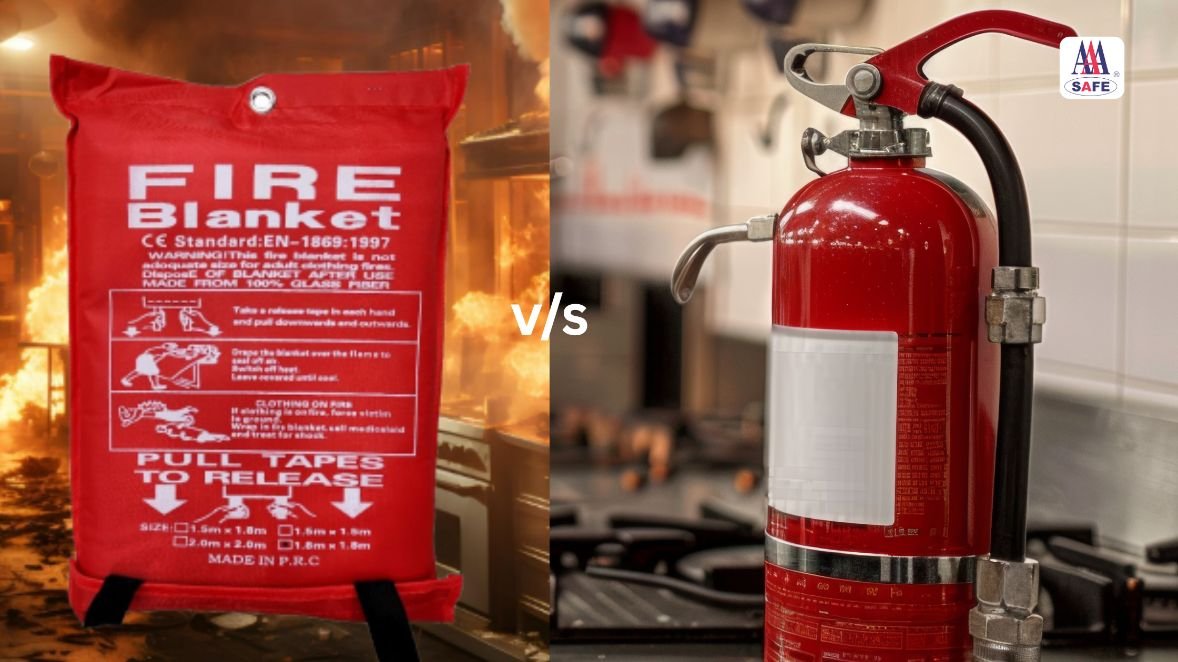
You know that moment when a small kitchen fire starts and you freeze, uncertain whether to reach for the fire blanket vs fire extinguisher sitting on the wall next to each other? The critical difference between these two fire safety tools can mean the difference between quickly suppressing a minor fire and watching it develop into an uncontrollable emergency.
Understanding fire blanket vs fire extinguisher distinctions becomes essential when you recognize that these tools serve fundamentally different purposes requiring different techniques and training. Reaching for the wrong tool during a fire emergency wastes precious seconds while the fire grows, potentially turning a manageable situation into catastrophic property damage.
I’ve worked with venue fire safety across the UAE for years, and honestly, the properties that don’t understand when to use each tool are the ones dealing with serious fire damage that proper tool selection could have prevented. Fire blanket vs fire extinguisher isn’t about choosing one over the other – it’s about understanding when each tool provides the best response for specific fire types.
This guide walks you through the critical differences between these fire safety tools, when and how to use each one, and how to build complete fire protection strategies for venues across Dubai, Abu Dhabi, Sharjah, and other UAE locations.
Understanding Fire Types and Appropriate Response Methods
Fire blanket vs fire extinguisher effectiveness depends entirely on understanding which fires respond better to smothering versus chemical suppression.
Fire Classification and Tool Selection
Class A fires (ordinary combustibles like wood, paper, cloth) respond well to both tools, though extinguishers prove more effective for larger fires. These fires burn at surface level and spread relatively slowly.
Class B fires (flammable liquids like gasoline, oil, grease) require careful tool selection. Extinguishers with appropriate agents work well, while blankets only succeed on very small, contained fires.
Class C fires (electrical equipment) demand extinguisher use only. Never use blankets on electrical fires due to electrocution risks.
Class K fires (cooking oils and fats) represent ideal blanket applications. These fires reach extreme temperatures where blankets’ smothering action prevents dangerous spreading reactions.
Fire Suppression Mechanisms
Fire blankets work through oxygen deprivation, reflecting radiant heat away from fuel, preventing vapor reignition, and creating physical barriers between flames and fuel sources.
Fire extinguishers work through chemical reaction disruption, cooling flames below ignition temperature, oxygen displacement with suppressant agents, and protective coating creation on fuel sources.
Understanding these mechanisms guides instant tool selection during emergency moments when hesitation allows fires to grow beyond manageable stages.
Tool Selection Factors
Environmental considerations affect tool performance significantly. UAE’s high humidity can impact extinguisher pressure, while extreme heat affects blanket deployment safety.
Fire location accessibility determines tool choice. Confined spaces may favor blankets, while electrical panel fires require extinguisher reach and non-conductive suppressants.
For professional fire safety consulting tailored to UAE venue requirements, AAA Safe Dubai provides specialized solutions ensuring proper equipment selection and staff training across Dubai, Abu Dhabi, and Sharjah operations.
Fire Blanket vs Fire Extinguisher: Core Differences and Applications
Fire Blanket Characteristics and Usage
Fire blankets cost AED 85-150 per unit and measure typically 1.0 to 1.2 meters square. Made from treated fiberglass or aramid materials, they hang in accessible frames for quick deployment.
Proper blanket deployment requires pulling the blanket from its holder, approaching fire from the side (never directly in front), throwing or wrapping the blanket completely over flames, and keeping it in place for at least 10 minutes until completely cool.
Best applications include cooking oil fires in pans or fryers, small fires in single locations, situations where chemical residue damages equipment, and enclosed spaces with poor ventilation.
Fire Extinguisher Types and Costs
ABC dry chemical extinguishers cost AED 120-280 per unit and handle multiple fire classes effectively. These versatile units work for most venue applications but create powder residue.
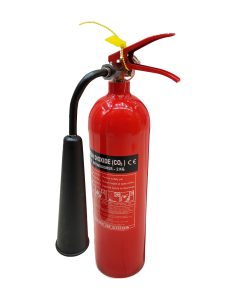
CO2 extinguishers cost AED 150-320 per unit and excel at electrical fires without leaving residue. Essential for computer rooms, electrical panels, and sensitive equipment areas.
Wet chemical extinguishers cost AED 200-450 per unit and specifically target Class K cooking fires. Required in commercial kitchens throughout UAE hospitality operations.
PASS Technique for Extinguisher Use
Pull the safety pin from the handle to prepare the extinguisher for discharge.
Aim the nozzle at the base of flames, not at the upper flames, to disrupt combustion most effectively.
Squeeze the handle lever slowly to discharge suppressant while maintaining proper aim.
Sweep side-to-side at the fire base while advancing gradually until flames are suppressed.
Deployment Distance and Safety
Fire blanket deployment requires approaching within 1 meter of fire for effective coverage while maintaining escape route access.
Extinguisher operation works best from 1-2 meters distance, providing suppressant reach while maintaining operator safety from heat and smoke.
Venue-Specific Applications in UAE
Fire blanket vs fire extinguisher selection varies significantly across different UAE venue types.
Restaurant and Kitchen Applications
UAE restaurant kitchens require both tools working together. Fire blankets serve as primary response for cooking oil fires in pans, grills, and small fryers. Wet chemical extinguishers provide backup when blankets prove insufficient.
Kitchen placement strategy positions blankets near cooking equipment and extinguishers near exits and electrical equipment. Staff training emphasizes blanket use first for oil fires, followed by extinguishers if needed.
Cost for typical UAE restaurant includes 3-4 fire blankets (AED 255-600), 2-3 wet chemical extinguishers (AED 400-1,350), and 2-3 ABC extinguishers (AED 240-840) for complete kitchen protection.
Hotel and Hospitality Venues
UAE hotels face diverse fire risks across guest rooms, kitchens, laundries, and maintenance areas. Each zone requires specific protection approaches.
Guest room areas rely primarily on detection and sprinkler systems with evacuation procedures. Extinguishers in corridors provide backup protection.
Kitchen operations follow restaurant guidelines with blankets for cooking fires and extinguishers for backup and electrical fires.
Laundry facilities emphasize extinguisher use due to equipment fire risks and limited blanket effectiveness on machinery fires.
Need help developing complete fire protection strategies for your UAE venue?
AAA Safe Dubai offers full consultation ensuring proper equipment selection, strategic placement, and staff training across Dubai, Abu Dhabi, and Sharjah hospitality operations.
Warehouse and Storage Facilities
UAE warehouses prioritize evacuation over fire suppression due to fire growth potential and material storage risks.
Fire extinguishers serve as primary tools for initial suppression attempts on manageable fires. Fire blankets have limited warehouse applications due to typical fire scale.
Protection strategy emphasizes early detection, immediate extinguisher use on small fires, and rapid evacuation when fires exceed initial suppression capability.
Office and Administrative Buildings
UAE office environments face electrical equipment fires and paper-based combustible materials requiring targeted approaches.
Fire extinguishers provide primary protection for electrical equipment and spreading fires. Fire blankets handle small waste basket fires and equipment protection during suppression.
Placement considerations include positioning equipment near electrical panels, break rooms, and high-risk areas while ensuring accessibility during emergencies.
Table 1: Fire Suppression Tool Selection by Venue Type
| Venue Type | Primary Fire Risks | Blanket Applications | Extinguisher Priority | Estimated Cost (AED) |
|---|---|---|---|---|
| UAE Restaurants | Cooking oils, electrical | High for cooking fires | Backup and electrical | 895-2,790 |
| UAE Hotels | Mixed risks by area | Kitchen areas only | General building protection | 1,500-4,200 |
| UAE Warehouses | Storage materials | Limited effectiveness | Primary suppression tool | 800-2,100 |
| UAE Offices | Electrical, paper | Small waste fires | Primary tool | 450-1,200 |
Costs include basic protection for typical venue sizes including 5% VAT
Training and Maintenance Requirements
Effective fire blanket vs fire extinguisher programs require systematic training and maintenance ensuring equipment functions when needed.
Staff Training Components
All UAE venue staff need training covering fire type recognition, appropriate tool selection, evacuation procedures, and emergency communication protocols.
Department-specific training addresses particular risks where kitchen staff learn cooking fire suppression, maintenance staff learn electrical fire response, and managers learn incident documentation.
Training costs range from AED 200-400 per worker for basic fire safety to AED 500-800 for specialized department training. Annual refresher training maintains competency and updates procedures.
Hands-on Practice Requirements
Blanket deployment practice includes proper removal, approach techniques, coverage methods, and timing for effective suppression.
Extinguisher operation practice covers PASS technique, distance management, sweep patterns, and recognizing when suppression becomes ineffective.
Scenario-based training presents realistic fire situations requiring instant tool selection and proper deployment techniques under time pressure.
Equipment Maintenance Schedules
Fire blankets require monthly visual inspection for tears or damage, quarterly condition checks for material degradation, and annual professional evaluation. Replacement occurs every 2-3 years or when damage appears.
Fire extinguishers need monthly pressure gauge checks, annual professional inspection and service, 5-year hydrostatic testing, and immediate recharging after any use.
Maintenance costs include AED 75-125 per extinguisher annually for professional service and AED 45-85 per blanket for periodic replacement.
Struggling to coordinate fire safety training across multiple UAE venues?
AAA Safe Dubai provides complete training programs ensuring consistent protection standards while managing complex hospitality and commercial operations throughout the Emirates.
Cost-Benefit Analysis for UAE Venues
Fire blanket vs fire extinguisher investment provides substantial returns through property protection and regulatory compliance.
Initial Equipment Investment
Basic fire protection for 200-square-meter UAE restaurant:
- Fire blankets (4 units): AED 340-600
- Wet chemical extinguishers (3 units): AED 600-1,350
- ABC extinguishers (3 units): AED 360-840
- Installation and signage: AED 300-500 Total initial investment: AED 1,600-3,290
Medium hotel fire protection (100 rooms):
- Fire blankets (8 units): AED 680-1,200
- ABC extinguishers (15 units): AED 1,800-4,200
- CO2 extinguishers (8 units): AED 1,200-2,560
- Wet chemical extinguishers (4 units): AED 800-1,800
- Professional installation: AED 800-1,200 Total investment: AED 5,280-10,960
Annual Operational Costs
Ongoing maintenance and replacement:
- Extinguisher service and testing: AED 450-750
- Blanket replacement (every 2-3 years): AED 115-200 annually
- Staff training and refreshers: AED 800-1,500
- Inspection and documentation: AED 200-300 Total annual cost: AED 1,565-2,750
Value Protection
Fire damage prevention averages AED 75,000-500,000 per incident in UAE commercial properties. Proper suppression equipment prevents 85-95% of fires from reaching major damage levels.
Insurance premium reductions of 10-25% often apply to properties with complete fire protection systems and documented training programs.
Business continuity value includes prevented revenue loss during closure, maintained customer confidence, and avoided reconstruction costs.
3-Year ROI: Investment of AED 6,295-11,540 preventing damage worth AED 75,000-500,000 provides ROI of 550-7,800%.
Strategic Equipment Placement
Optimal Positioning Guidelines
Fire blankets belong near cooking equipment, welding areas, small equipment rooms, and anywhere Class K fires commonly occur.
Extinguishers require positioning near exits, electrical equipment, potential fire spread paths, and central locations ensuring 23-meter maximum travel distance.
Visibility requirements include clear signage, unobstructed access, appropriate mounting height, and lighting ensuring equipment remains visible during emergencies.
Environmental Protection
UAE climate considerations require weatherproof enclosures for outdoor equipment, temperature-controlled storage preventing degradation, and humidity protection maintaining functionality.
Access maintenance includes regular checking that equipment remains unblocked, mounting systems stay secure, and identification signage remains visible and accurate.
Frequently Asked Questions
Use fire blankets for small cooking oil fires confined to pans or equipment, particularly Class K fires involving cooking fats and oils. Use extinguishers for electrical fires, fires spreading beyond single locations, or when blankets don’t suppress flames within 30 seconds. Never use blankets on electrical equipment. If uncertain, evacuate immediately and call emergency services rather than attempting suppression.
Fire blankets work best on Class A (ordinary combustibles) and Class K (cooking oils) fires. They’re ineffective on electrical fires (Class C) due to shock risks and limited effectiveness on flammable liquid fires (Class B) unless very small and contained. Always match suppression tools to fire types through proper training and clear procedures.
Fire extinguishers typically last 5-15 years depending on type and storage conditions. UAE’s high heat and humidity can accelerate degradation, requiring more frequent inspection and potential replacement. Monthly pressure checks and annual professional service ensure reliability. Replace immediately if pressure drops or visible damage appears.
Using wrong methods can worsen fires dramatically. Water on grease fires causes violent spreading. Blankets on electrical fires risk electrocution. Wrong extinguisher types can spread fires or fail to suppress them. Proper training prevents these dangerous mistakes that turn manageable fires into major emergencies.
UAE building codes and municipal regulations vary by emirate but generally require fire protection equipment meeting international standards. Dubai Municipality, Abu Dhabi Department of Municipal Affairs, and Sharjah authorities enforce specific requirements for different venue types. Consult local fire departments for current requirements.
Basic fire safety training covering tool selection and evacuation takes 2-4 hours. Specialized training for kitchen or maintenance staff requires 4-8 hours. UAE venues often need multilingual training accommodating diverse workforces. Training must include hands-on practice with actual equipment.
Document monthly equipment inspections, annual professional service, staff training completion, any equipment use or incidents, and replacement schedules. UAE authorities may request these records during inspections. Poor documentation can result in violations even with proper equipment.
Fire blankets may be reusable if minimally exposed to heat and showing no damage. However, most venues replace blankets after any use rather than risk compromised effectiveness. Professional inspection determines reusability, but replacement often proves more cost-effective than testing.
Outdoor venues face wind and weather challenges affecting suppression effectiveness. Extinguishers generally work better outdoors than blankets due to wind dispersion risks. Position equipment in weather-protected enclosures and train staff on wind-affected deployment techniques.
Establish consistent standards, equipment types, and training programs across all locations. Centralize purchasing for cost savings and standardization. Document procedures clearly for consistent application. Regular audits ensure compliance across different venues and staff populations.
Safety Disclaimer
This information provides general guidance on fire blanket vs fire extinguisher selection and should not be considered a substitute for professional fire safety consultation. Specific requirements vary based on venue type, local regulations, and fire risk assessment.
UAE venues must comply with emirate-specific fire codes, building regulations, and municipal requirements. Dubai Municipality, Abu Dhabi Department of Municipal Affairs, and Sharjah authorities maintain specific standards that change regularly.
Fire protection systems must be designed by qualified professionals familiar with UAE building codes, venue-specific risks, and current regulatory requirements. Improper equipment selection or maintenance can result in inadequate protection during actual fires.
Equipment specifications, training requirements, and costs change frequently. Information reflects general UAE market conditions and should be verified with current suppliers and local authorities.
For professional consultation on fire protection programs tailored to specific UAE venues, contact certified fire safety providers with demonstrated experience in UAE building codes and regulatory compliance.
Conclusion
Understanding fire blanket vs fire extinguisher differences represents critical knowledge protecting lives and property in every UAE venue. Rather than choosing between these tools, successful fire protection deploys both strategically throughout your facility, matching each tool to appropriate fire types and situations.
The venues succeeding in UAE’s competitive market aren’t the ones cutting corners on fire protection. They’re the ones understanding that proper suppression equipment, systematic staff training, and regular maintenance create environments where small fires stay small and major damage gets prevented.
I’ve learned that the best venue operations treat fire protection as fundamental to business continuity, not just regulatory compliance. When management invests in proper equipment and creates organized safety programs, fires get suppressed quickly, property damage minimizes, and operations continue smoothly.
The financial return on investment is compelling and measurable. Yes, proper fire protection requires initial equipment investment and ongoing maintenance costs. But a single prevented major fire easily justifies program investment many times over. Fire blanket vs fire extinguisher programs consistently provide returns exceeding 500% through damage prevention alone.
More fundamentally, this is about protecting the people who work in and visit your venue. Staff and guests trust you to provide safe environments where fire emergencies get handled effectively. Proper suppression equipment demonstrates that commitment in practical, protective form.
Your venue’s success depends on maintaining safe, operational environments where business continues despite occasional fire risks. Give your team the tools and training to respond effectively to actual fire emergencies. Make informed decisions based on systematic fire risk assessment. Invest in programs that demonstrate genuine commitment to safety.
Your people, your property, and your business continuity will all benefit from this commitment to excellence.