Fire extinguisher selection in the UAE requires more than simply buying the cheapest option available. The UAE’s unique combination of extreme heat, modern high-tech buildings, diverse industrial operations, and strict regulatory requirements creates specific challenges for fire safety equipment selection. Choosing the right fire extinguisher ensures your fire protection investment actually works when seconds count, while meeting Dubai Civil Defence compliance standards that can mean the difference between operational continuity and costly shutdowns.
Understanding these seven critical considerations enables informed decisions that provide effective protection when emergencies occur while maintaining full regulatory compliance across all UAE emirates.
Understanding UAE Fire Classification Systems and Local Requirements
The Five-Class Fire System Used in UAE
Choosing the right fire extinguisher begins with understanding that the UAE follows international fire classification standards adapted for local conditions and risks. Each class represents different fuel types that require specific extinguishing agents to be effective rather than dangerous.
| Fire Class | Fuel Type | Typical UAE Locations | Recommended Extinguisher | Why Others Fail |
|---|---|---|---|---|
| Class A | Paper, wood, textiles, plastics | Offices, hotels, retail stores | Water, foam, or ABC dry powder | N/A – most extinguishers work |
| Class B | Flammable liquids, petrol, oils | Gas stations, workshops, kitchens | Foam, CO₂, or dry powder | Water spreads liquid fires |
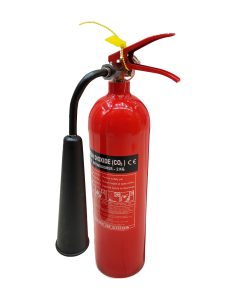
| Class C | Electrical equipment fires | Server rooms, control panels, appliances | CO₂ or dry powder only | Water conducts electricity |
| Class D | Combustible metals | Industrial facilities, laboratories | Specialized dry powder | Wrong agents can react violently |
| Class K/F | Cooking oils and fats | Restaurant kitchens, food courts | Wet chemical systems only | Other agents don’t prevent re-ignition |
The UAE Fire and Life Safety Code of Practice states that portable fire extinguishers are “the best available first response to tackle the fire at its incipient stage,” emphasizing the importance of proper classification matching.
Multi-Class Rating Benefits and Limitations
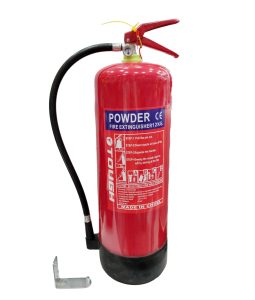
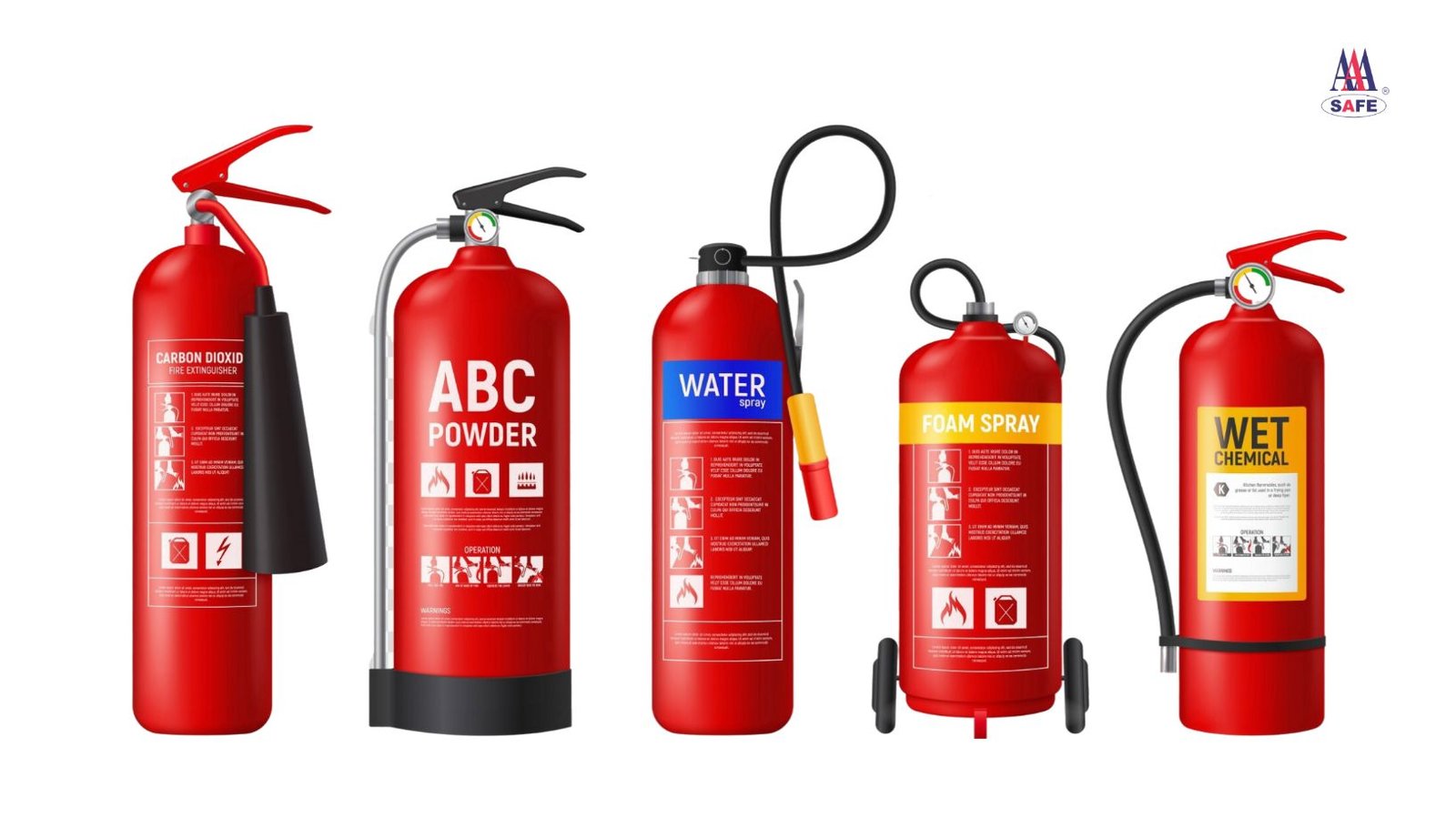
ABC-rated dry powder extinguishers cover Classes A, B, and C fires, making them popular choices for general-purpose applications throughout the UAE. However, this versatility comes with significant drawbacks in specific environments.
ABC Dry Powder Performance Analysis
Advantages and Disadvantages of ABC Systems
- Advantages. Effective on most common fires, single extinguisher covers multiple hazards, cost-effective for small businesses
- Disadvantages. Corrosive powder damages electronics, creates visibility-reducing clouds, requires extensive cleanup
ABC powder deployment in electronics environments can result in significant additional damage from powder contamination, highlighting the importance of environment-specific selection when choosing the right fire extinguisher.
Dubai Civil Defence Compliance and Certification Requirements
Mandatory Approval Standards for Fire Safety Equipment
The UAE Fire and Life Safety Code, enforced through Dubai Civil Defence and other emirate authorities, establishes strict requirements for fire extinguisher specifications, installation, and maintenance that affect selection decisions.
Key Compliance Requirements
- Civil Defence Approval. All fire extinguishers must carry UAE Civil Defence certification marks
- International Standards. Equipment must meet EN3, UL, or equivalent international standards
- Installation Specifications. Placement height (0.3-1.5m above floor), visibility, and accessibility requirements
- Maintenance Protocols. Monthly inspections, annual servicing, and replacement schedules
Dubai Civil Defence Inspection Checklist Items
- Proper extinguisher type for identified fire hazards
- Current certification labels and expiration dates
- Correct mounting height and clear access paths
- Maintenance record documentation and inspection tags
- Staff training records for extinguisher operation
Building-Type Specific Requirements
Different building classifications throughout the UAE carry specific fire extinguisher requirements that go beyond basic fire class considerations when choosing the right fire extinguisher for your facility.
| Building Type | Minimum Extinguisher Rating | Special Requirements | Coverage Area | UAE Considerations |
|---|---|---|---|---|
| Residential | 2A.10B.C minimum | Kitchen K-class recommended | One per floor | Cultural cooking practices |
| Commercial Offices | 2A.20B.C minimum | CO₂ for server rooms | 200m² maximum spacing | High-tech equipment density |
| Industrial Facilities | 4A.60B.C minimum | Specialized agents as needed | Risk-based placement | Process-specific hazards |
| High-Rise Buildings | 4A.80B.C minimum | Pressurized water systems | Emergency stairwell locations | Evacuation route protection |
Size and Capacity Selection for UAE Environmental Conditions
Heat Impact on Extinguisher Performance and Sizing
The UAE’s extreme temperatures significantly affect fire extinguisher performance, requiring larger capacities and specific mounting considerations to maintain effectiveness during critical suppression activities.
Environmental Performance Factors
- Temperature Stress. Summer storage temperatures exceeding 65°C can reduce discharge effectiveness
- Humidity Effects. Coastal humidity accelerates corrosion of internal components and pressure loss
- Thermal Expansion. Daily temperature cycling stresses extinguisher seals and pressure vessels
- Direct Sunlight. UV exposure degrades plastic components and pressure gauges
Size Selection Guidelines for UAE Conditions
When choosing the right fire extinguisher for UAE environments, larger capacities provide crucial performance margins that compensate for environmental degradation while ensuring adequate suppression capability.
| Standard Rating | UAE Recommended Upgrade | Reason for Increase | Application |
|---|---|---|---|
| 1A.5B.C (1kg) | 2A.10B.C (2kg) | Heat performance degradation | Small residential spaces |
| 2A.10B.C (2kg) | 3A.20B.C (3kg) | Extended discharge time needed | Commercial applications |
| 3A.20B.C (3kg) | 4A.40B.C (6kg) | Commercial space requirements | Large office spaces |
| 4A.40B.C (6kg) | 6A.80B.C (9kg) | Industrial application demands | Heavy-duty environments |
Discharge Duration and Coverage Calculations
Choosing the right fire extinguisher requires understanding that UAE’s challenging conditions may reduce effective discharge time and coverage area compared to standard international ratings.
Performance Considerations for Desert Conditions
Environmental Impact Assessment
- Discharge Time. Standard 10-15 second ratings may experience reduction in extreme heat
- Effective Range. Recommended 3-5 meter range may decrease due to thermal effects
- Coverage Area. Heat stress can impact coverage effectiveness compared to rated specifications
- User Fatigue. High temperatures increase operator fatigue, affecting extinguisher handling
Oversized extinguishers provide performance margins that ensure adequate suppression capability during UAE’s challenging environmental conditions.
Location-Specific Hazard Assessment and Risk Analysis
Industry-Specific Fire Risk Profiles in UAE
The UAE’s diverse economy creates unique fire risk combinations that require specialized extinguisher selection approaches beyond standard building classifications when choosing the right fire extinguisher for specific applications.
| Industry Sector | Primary Fire Risks | Specialized Requirements | Environmental Factors |
|---|---|---|---|
| Oil & Gas | Flammable liquids, electrical | Explosion-proof ratings, large capacity | High heat, corrosive atmosphere |
| Data Centers | Electrical, battery systems | Clean agent systems, no residue | Precision cooling, sensitive equipment |
| Food Processing | Cooking oils, electrical, paper | K-class for fryers, ABC for general | High humidity, temperature variations |
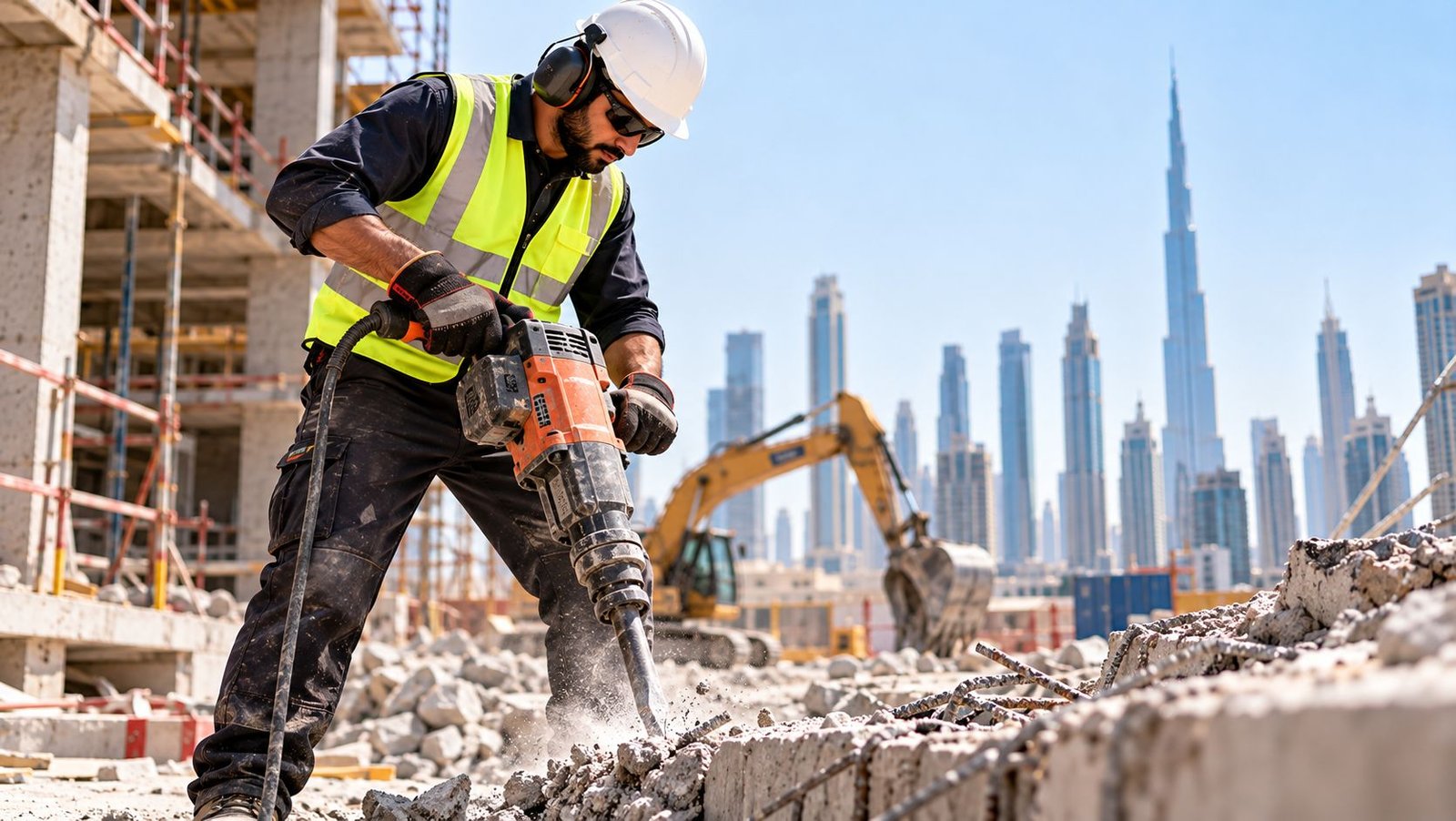
| Construction | Flammable liquids, electrical | Portable units, weather resistance | Dust, extreme temperatures |
| Hospitality | Cooking, electrical, textiles | Kitchen K-class, general ABC | Mixed occupancy, cultural considerations |
Multi-Hazard Environment Considerations
Modern UAE facilities often contain multiple fire risk types within single spaces, requiring strategic extinguisher placement and selection to address overlapping hazards effectively.
Complex Environment Applications
Multi-Risk Facility Examples
- Mixed-Use Buildings. Retail, office, and restaurant spaces requiring different extinguisher types
- Industrial Workshops. Metalworking, electrical systems, and flammable storage in proximity
- Educational Facilities. Laboratories, kitchens, electronics, and general classroom materials
- Healthcare Facilities. Medical gases, electrical equipment, pharmaceuticals, and general materials
Comprehensive risk assessment becomes essential for choosing the right fire extinguisher in facilities with multiple hazard types rather than single-risk environments.
Storage and Maintenance Requirements in Desert Climate
Temperature and Humidity Management for Equipment Longevity
UAE’s desert climate creates unique storage and maintenance challenges that directly impact fire extinguisher reliability and compliance with safety standards.
| Component | Temperature Stress | Humidity Effects | UV Exposure | Mitigation Requirements |
|---|---|---|---|---|
| Pressure Vessel | Thermal expansion stress | Corrosion acceleration | Gauge degradation | Climate-controlled storage |
| Discharge Mechanism | Seal deterioration | Mechanism binding | Plastic component failure | Regular lubrication |
| Agent Chemistry | Performance degradation | Clumping/separation | Chemical breakdown | Temperature monitoring |
| Safety Pin/Handle | Metal expansion | Corrosion/binding | Handle degradation | Protective covers |
Inspection and Testing Protocols for UAE Conditions
Standard international maintenance schedules require modification for UAE conditions to ensure continued effectiveness and regulatory compliance when choosing the right fire extinguisher maintenance approach.
Enhanced Maintenance Schedule for Desert Conditions
UAE-Specific Maintenance Framework| Inspection Type | Standard Frequency | UAE Recommended | Critical Checkpoints | Documentation Required |
|---|---|---|---|---|
| Visual Inspection | Monthly | Bi-weekly | Pressure gauge, damage, accessibility | Checklist with signatures |
| Weight Check | Quarterly | Monthly | Agent level, pressure loss detection | Weight comparison logs |
| Discharge Test | Annual | Bi-annual | Full performance verification | Test results and recharge |
| Internal Inspection | 6 years | 4 years | Corrosion, agent condition | Professional service records |
Cost-Benefit Analysis and Long-Term Value Considerations
Initial Investment vs Operational Costs
Choosing the right fire extinguisher requires understanding total cost of ownership rather than simply comparing purchase prices, particularly given UAE’s challenging operating environment.
Total Cost of Ownership Analysis
| Cost Category | Budget Option | Standard Quality | Premium Systems | Impact Factor |
|---|---|---|---|---|
| Purchase Price | AED 150 | AED 350 | AED 800 | Initial investment |
| Maintenance/Year | AED 80 | AED 60 | AED 45 | Ongoing operational cost |
| Replacement Frequency | 3 years | 5 years | 8 years | Long-term replacement |
| Compliance Risk | High | Medium | Low | Regulatory penalties |
| Performance Reliability | Fair | Good | Excellent | Emergency effectiveness |
Note: Cost analysis reflects UAE market conditions and environmental stress factors.
Return on Investment Through Risk Mitigation
Quality fire extinguisher investments provide measurable returns through reduced insurance premiums, avoided penalties, and improved operational continuity during emergencies.
Investment Benefits Analysis
ROI Contributing Factors
- Insurance Premium Reductions. Discounts for certified comprehensive fire safety systems
- Regulatory Compliance. Avoiding penalties through proper equipment selection
- Property Protection. Early fire suppression preventing catastrophic damage and business interruption
- Operational Continuity. Minimizing downtime and revenue loss during fire incidents
Comprehensive fire extinguisher programs typically achieve positive ROI through combined risk mitigation benefits when choosing the right fire extinguisher systems.
Professional Installation and Training Requirements
Certified Installation Standards and Best Practices
UAE regulations require professional installation by certified technicians to ensure proper extinguisher placement, mounting, and integration with building fire safety systems.
Professional Installation Requirements
- Certified Technician. UAE Civil Defence approved installer certification
- Proper Mounting. Height, accessibility, and structural support specifications
- Signage Installation. Multilingual signs meeting visibility requirements
- System Integration. Connection with building alarm and suppression systems
- Documentation. Installation certificates and compliance verification
Installation Quality Impact on Performance
Professional Installation Benefits
- Proper installation increases emergency effectiveness significantly
- Correct placement reduces response time during emergencies
- Professional mounting ensures equipment remains functional during building vibration and temperature cycling
- Certified documentation prevents regulatory compliance issues
Training Program Development and Maintenance
Effective fire extinguisher programs require ongoing training that addresses UAE-specific conditions and cultural considerations when choosing the right fire extinguisher training approach.
Comprehensive Training Components
Training Program Elements
- Fire Classification Recognition. Identifying fire types common in UAE environments
- Equipment Operation. Hands-on practice with facility-specific extinguisher types
- Emergency Response Procedures. Integration with building evacuation and alarm systems
- Maintenance Awareness. Basic inspection and problem identification
- Cultural Considerations. Training delivery in multiple languages for diverse UAE workforce
Comprehensive extinguisher training programs improve emergency response coordination and reduce fire damage during actual incidents throughout UAE facilities.
Penalties and Legal Compliance Requirements
UAE Federal and Local Penalties for Fire Safety Violations
Understanding penalty structures helps emphasize the importance of choosing the right fire extinguisher and maintaining proper compliance with all regulations.
Official Penalty Framework
- Article 311 of the Federal Penal Code states any person who removes a fire extinguisher or renders it unfit for use faces jail sentence of no less than one year or fine of not less than 50,000 AED
- Cabinet Resolution No. (24) of 2012 imposes Dh50,000 fine for unlicensed fire safety activities
- Abu Dhabi Civil Defence imposes Dh10,000 fine for non-compliance with fire safety standards
- Dh2,000 fine for obstacles hindering access to firefighting devices and equipment
Mandatory Equipment Requirements
Fire extinguishers are mandatory in all residential, commercial, and industrial buildings in Dubai, with each unit requiring at least one functional extinguisher meeting Civil Defence standards. The UAE Fire and Life Safety Code requires extinguishers to be “kept in their designated places at all times” and “conspicuously located where they will be readily accessible.”
Frequently Asked Questions
Dubai Civil Defence requires ABC-rated extinguishers (minimum 2A.10B.C) for most commercial spaces, with additional K-class extinguishers mandatory for commercial kitchens. Residential buildings need minimum 1A.5B.C units, while industrial facilities require larger capacity units (4A.60B.C) plus specialized agents based on specific hazards. Server rooms must have CO₂ extinguishers to prevent equipment damage.
UAE conditions require enhanced maintenance beyond standard schedules. Visual inspections should occur bi-weekly rather than monthly, with weight checks monthly instead of quarterly. Professional servicing is recommended every 6 months rather than annually due to heat stress and humidity effects. Documentation must be maintained for Civil Defence inspections.
While ABC dry powder extinguishers work for many applications, specialized areas need specific types. Commercial kitchens require K-class wet chemical extinguishers, server rooms need CO₂ units, and areas with sensitive electronics should avoid powder extinguishers that cause extensive cleanup damage. Risk assessment determines the strategy for choosing the right fire extinguisher placement.
UAE heat affects extinguisher performance, requiring larger capacity units than standard ratings suggest. Minimum 2kg units for residential use, 3-6kg for commercial spaces, and 6-9kg for industrial applications provide adequate performance margins. Extreme heat environments may require even larger capacities when choosing the right fire extinguisher size.
Look for UAE Civil Defence approval stamps on equipment, verify supplier licenses with local authorities, and ensure international certifications (EN3, UL, or equivalent). Request documentation proving compliance with UAE Fire and Life Safety Code requirements. Reputable suppliers provide installation certification and maintenance support.
UAE regulations require training in fire safety and extinguisher operation. Training must cover fire classification, equipment operation (PASS method), when to fight vs evacuate, and facility-specific procedures. Refresher training is recommended annually, with hands-on practice essential for effectiveness when choosing the right fire extinguisher training program.
Yes, extreme UAE conditions accelerate component degradation. While manufacturer expiration dates remain valid, enhanced monitoring is essential. Pressure gauges should be checked monthly, and professional inspection every 6 months rather than annually. Internal inspection intervals may need reduction from 6 to 4 years.
Failures result in immediate compliance orders with correction periods. Penalties range from AED 2,000 to AED 50,000 depending on violation severity. Serious deficiencies can result in temporary operation suspension until compliance is achieved. Maintaining proper documentation and regular maintenance prevents most inspection failures.
Important Safety Notice. Choosing the right fire extinguisher involves complex considerations of fire risks, environmental conditions, and regulatory requirements specific to your UAE facility. This guidance provides general principles but cannot replace professional fire safety assessment by certified specialists familiar with your specific hazards and applicable regulations.
Fire extinguisher selection represents a critical safety decision that affects lives, property, and business continuity. Understanding these seven key considerations enables informed decisions that provide effective protection when emergencies occur while maintaining full regulatory compliance.
Ready to ensure your fire extinguisher selection meets UAE requirements and provides optimal protection?
Consult with Dubai Civil Defence certified fire safety specialists who can conduct comprehensive risk assessments and recommend equipment solutions tailored to your specific facility requirements and environmental conditions.