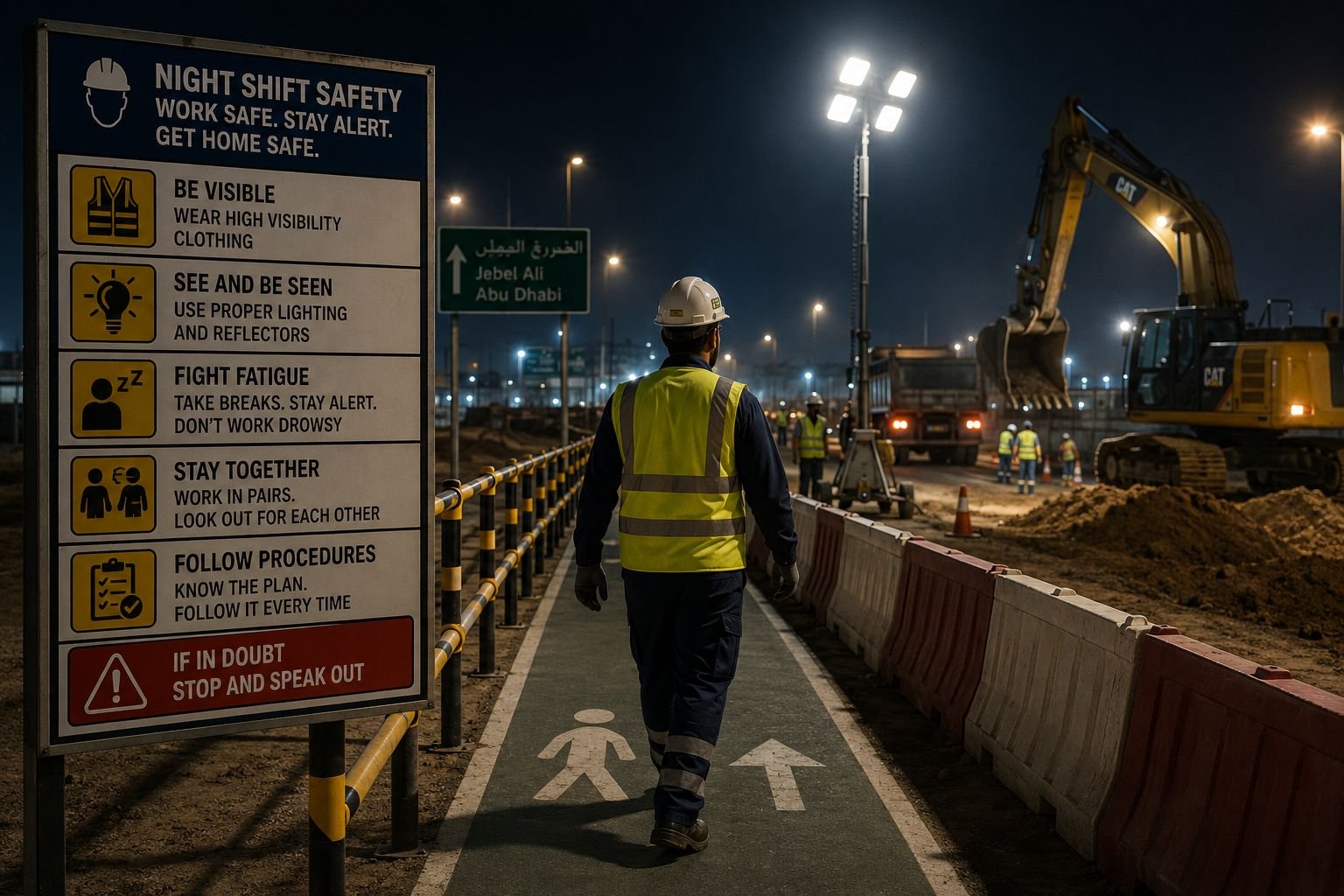
Night shift safety became a bigger question across the UAE once summer scheduling pushed large volumes of outdoor work into the hours after sunset. Roadworks, infrastructure projects, port operations, logistics and maintenance all run through the night from May through September to avoid daytime heat.
Night work is not daytime work with the lights on. Visibility drops. Fatigue peaks in the early hours regardless of how well the worker slept. Fewer people are on site, so incidents take longer to discover and emergency response takes longer to arrive. Each of those needs its own control.
Why Night Work Carries a Different Risk Profile
Vision performance falls
The eye’s ability to judge distance, detect movement at the periphery and distinguish colour all degrade in low light. Artificial lighting restores some of it and never all of it.
The circadian low point
Human alertness drops to its lowest between roughly 2am and 6am regardless of sleep quality. Reaction time slows and error rates rise. Scheduling should account for it instead of ignore it.
Supervision thins out
Night crews typically run leaner. Fewer supervisors means less observation, and a worker in difficulty may not be noticed quickly.
Emergency response is slower
Fewer first aiders on site, longer ambulance response in some areas, and a gate that may be unmanned all extend the time between injury and treatment.
| NIGHT HAZARD | CAUSE | PRIMARY CONTROL |
|---|---|---|
| Struck by vehicle | Reduced pedestrian visibility | Active and passive high-visibility clothing, lit routes |
| Trip and fall | Poor route lighting, unseen level change | Task and route lighting, marking, housekeeping |
| Fatigue error | Circadian low, long shifts | Shift design, break scheduling, task rotation |
| Delayed discovery of injury | Lone or thin working | Check-in system, communication devices |
| Slower emergency response | Reduced on-site cover | Trained first aiders per shift, clear access route |
Measure 1. Light the Task, the Route and the Hazard Separately
Site lighting is three jobs, not one.
Task lighting where the work happens
The work face needs enough light to see detail. General flood lighting from a distance leaves the worker’s own body casting a shadow across the task.
Route lighting where people walk
Walkways, stair access, gate approaches and welfare routes all need lighting continuity. A dark stretch between two lit areas is where trips happen, because the eye has not adjusted.
Hazard lighting on the obstruction itself
Excavations, temporary barriers, materials and plant need marking in their own right. Solar units avoid trailing cables and need no attention between shifts. A solar flower LED warning light mounted on a barrier stays visible all night without a power run.
Control glare and contrast
A bright floodlight pointed toward a walking route blinds the person walking it. Aim lighting away from approach directions and avoid deep shadow immediately adjacent to bright areas.
Provide portable light to the individual
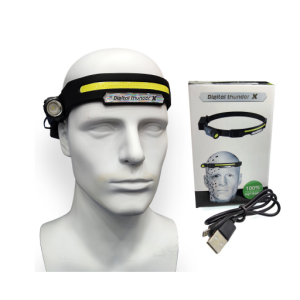
Fixed lighting cannot reach every corner. A rechargeable head lamp keeps both hands free and puts light where the worker is looking instead of where the mast is pointed.
Measure 2. Raise Visibility of Every Person on Site
Reflective material only works when something shines on it.
Understand the limits of passive reflection
Retroreflective tape returns light toward its source. A driver whose headlights are pointed elsewhere sees nothing. At a blind corner or an oblique approach, passive material can return almost no light.
Add active illumination for high-risk roles.
Banksmen, traffic marshals and anyone working near moving plant benefit from garments that emit light instead of reflect it. An LED reflective vest is visible from angles where tape returns nothing.
Specify the garment class for the environment.
Higher vehicle speeds and darker environments call for greater retroreflective area. Options across the safety jacket range cover the classes commonly specified on UAE night operations.
Add visibility above the shoulder line.
A worker bent over a task presents little reflective area to an approaching vehicle. A reflective cap or reflective helmet marking raises the visible profile.
Keep reflective material clean.
Dust and mud kill retroreflectivity. A soiled garment can lose a large share of its performance. Build cleaning into the workwear cycle instead of replacing garments that have gone dirty.
Consider a belt for short-exposure visitors.
Supervisors, inspectors and delivery drivers moving briefly across a site need visibility without a full garment. A reflecting belt covers that use.
Measure 3. Manage Fatigue Through Shift Design
Fatigue cannot be trained away. It has to be scheduled around.
Limit consecutive night shifts.
Long runs of consecutive nights accumulate sleep debt that a single rest day does not clear.
Rotate forward, not backward.
Where rotation is used, moving morning to afternoon to night is easier to adapt to than the reverse.
Schedule breaks into the low point.
The 2am to 6am window needs more frequent breaks, not fewer. Plan a substantial break inside it.
Avoid high-risk tasks in the low window.
Complex, precision or high-consequence tasks should sit at the start of the shift where possible.
Watch the commute.
The drive home after a night shift is one of one of the more dangerous parts of night work. Provide transport where practical, or rest facilities for workers who need them.
Train supervisors to recognise fatigue.
Repeated errors, microsleeps, slowed speech and irritability are the signs. A fatigued worker rarely recognises it in themselves.
Measure 4. Control Vehicle Movement Under Reduced Visibility
Night amplifies every traffic hazard.
Light the vehicle before it moves.
A heavy duty amber revolving warning light announces plant movement at a distance and through dust, where a reversing alarm alone is masked by site noise.
Delineate routes with self-illuminating markers.
Cones and poles disappear at night unless they carry reflective banding or their own light. Cone-mounted solar lights hold the line through the shift without intervention.
Extend banksman provision at night.
A banksman working at night needs stronger visibility, a lit signalling device and a position the driver can in practice see against a dark background.
Reduce speeds after dark.
A limit appropriate for daylight is too high at night. Set and enforce a lower night limit.
Mark the works area clearly for public traffic.
Where a site interfaces with public roads, the approach taper and works zone need continuous lit delineation. Broader provision sits across the transportation and logistics safety equipment range.
AAA Safe Team supplies site lighting, solar warning lights, head lamps, high-visibility clothing and traffic delineation equipment across Dubai, Abu Dhabi, Sharjah and the wider UAE. Contact our technical team for night operation specification advice.
Measure 5. Close the Communication Gap
Thin crews need better communication, not the same communication.
Establish a check-in schedule.
Anyone working alone or in an isolated area checks in at fixed intervals. A missed check-in triggers a search, not a wait.
Provide radio coverage across the site.
Mobile signal is unreliable in basements, tunnels, plant rooms and steel structures. Radio with confirmed coverage is more dependable.
Confirm the emergency call chain.
Who calls the ambulance. Who opens the gate. Who meets the ambulance and guides it in. Night shift crews must know their own answers, not the day shift’s.
Provide a means of raising alarm at distance.
Where a worker cannot be heard over plant noise, a safety whistle carries further than a shout and costs nothing to issue.
Measure 6. Prepare for Emergencies With Reduced Cover
Night emergency planning must assume fewer people and slower response.
Staff first aid cover on every shift.
A first aider rostered on day shift only leaves the night crew unprotected. Provision must be shift-specific.
Keep first aid and emergency equipment accessible.
Locked stores and unlit cabinets defeat the purpose. Confirm access at night, not during a daytime audit.
Light the emergency routes and assembly points.
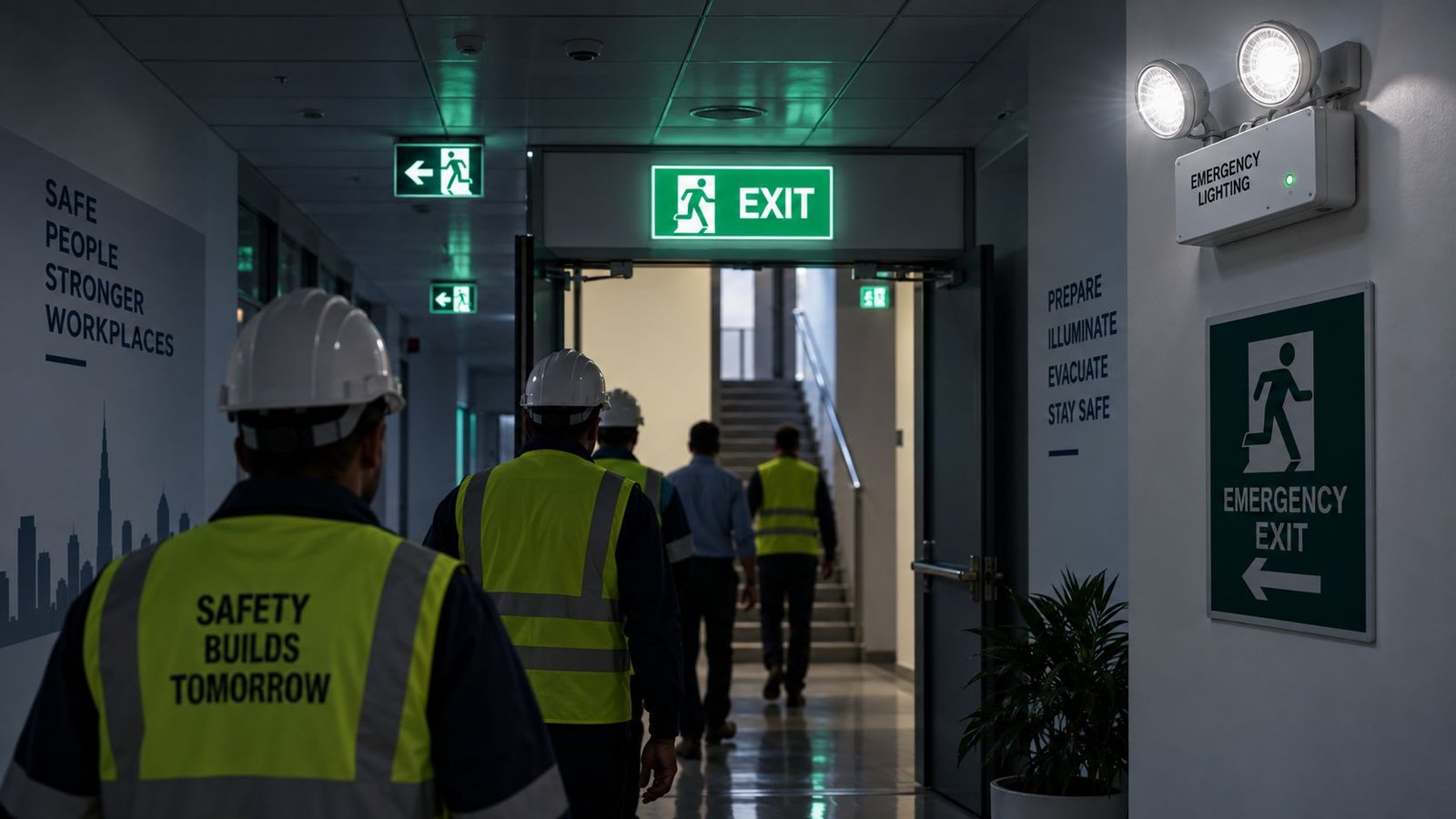
An assembly point nobody can find in the dark is not an assembly point. Emergency lighting must cover escape routes to their final discharge.
Keep the site entrance identifiable.
Emergency vehicles need to find the gate. Signage, lighting and a nominated person at the entrance all shorten response time.
Test the plan at night.
A drill run at 10am tells you nothing about performance at 3am. Run at least one night drill per year.
Measure 7. Hand Over Properly Between Shifts
Handover is where night work either continues safely or inherits a hazard.
Make handover face to face.
A note left on a desk is not a handover. Outgoing and incoming supervisors speak directly.
Cover the live hazards.
Open excavations, isolated systems, incomplete work, permits still open, plant left in an unusual state, and anything that changed during the shift.
Never leave a permit open across handover.
Either close it or transfer it formally with named acceptance from the incoming supervisor.
Walk the site together where practical.
A joint walk at changeover catches what a verbal briefing misses.
Log and escalate unresolved items.
Anything not closed at handover needs an owner and a deadline instead of a repeat mention on the next shift.
| NIGHT SHIFT CONTROL | OWNER | VERIFICATION |
|---|---|---|
| Lighting levels at task and route | Site management | Walk the route after dark, before shift start |
| High-visibility garment class and condition | Stores and supervisor | Pre-shift check, cleanliness included |
| Break schedule inside the circadian low | Planner | Roster review |
| Vehicle lighting and route delineation | Plant supervisor | Pre-shift plant check |
| First aid cover and equipment access | HSE | Shift roster and access test |
| Handover completion | Supervisors | Signed handover record |
Sites building out a night operation can browse the night operation equipment or contact our specialists for an itemised quotation covering lighting, visibility and delineation equipment.
Frequently Asked Questions
Vision performance drops in low light and alertness falls to its lowest in the early morning hours. Crews are typically leaner, so incidents take longer to discover and emergency response is slower.
Alertness reaches its lowest point roughly between 2am and 6am. Error rates and reaction times both worsen in that window regardless of how well the worker slept beforehand.
Retroreflective material returns light toward its source, so it only performs when a light is pointed at it. At oblique angles or where no light source faces the worker, it can return little. Active illuminated garments cover that gap.
Requirements depend on the task, the environment and the applicable standard. The practical test is whether workers can see task detail, route obstructions and level changes clearly, without glare or deep shadow at the transitions.
Shorter runs allow better recovery. Long consecutive runs accumulate sleep debt that a single rest day does not clear. Set limits in the shift policy and apply them.
Cover must be provided on every shift. Rostering first aiders on days only leaves the night crew unprotected at the time when response is already slower.
Dust, mud and repeated washing degrade the retroreflective surface. A heavily soiled garment can lose a large share of its performance. Cleaning and inspection should be part of the workwear cycle.
Open excavations, isolated systems, incomplete work, open permits, plant left in an unusual state and anything that changed during the shift. Handover should be face to face with a signed record.
Disclaimer
This article provides general guidance on night shift and low light work safety in the UAE. It is not legal, regulatory, medical or lighting engineering advice, and it does not replace a site-specific risk assessment carried out by a competent person.
Lighting levels, shift limits and fatigue management requirements depend on the task, the environment and applicable standards. Requirements vary by Emirate and by sector, and regulations change over time.
Consult qualified health and safety and occupational health professionals when designing a night operation.